
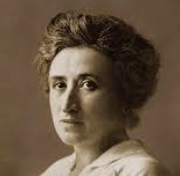
Rosa Luxemburg — Revolution, Democracy, and the Courage of Principle (1871–1919)
Rosa Luxemburg was a Polish-born German socialist theorist, economist, and revolutionary activist whose fearless independence of mind made her one of the most original and consequential political thinkers of the early twentieth century.
Equally willing to challenge the reformist right of the socialist movement and the authoritarian left, she fought for a socialism that was genuinely democratic — rooted in the spontaneous self-organization of the working class rather than the decrees of a revolutionary vanguard.
Her central concern: that freedom is not a reward to be distributed after the revolution but the condition of the revolution itself — and that any movement that sacrifices democratic life in the name of historical necessity has already betrayed the future it claims to be building.
Reform or Revolution
Luxemburg's first major theoretical work, written in 1899 in direct response to Eduard Bernstein's revisionist argument that socialism could be achieved through gradual parliamentary reform, established her as a formidable polemicist and a theorist of the first rank.
She did not simply reassert orthodox Marxism against Bernstein. She argued that his revisionism rested on a fundamental misunderstanding of how capitalism actually operates — that the contradictions driving the system toward crisis were deepening, not resolving, and that the parliamentary road offered not gradual progress but permanent accommodation to a system that would never reform itself out of existence.
Reform and revolution were not alternative paths to the same destination — they expressed different understandings of what capitalism was and what it required to overcome it. Luxemburg's answer was unambiguous: the system had to be transformed at its root, not managed at its margins.
The argument was rigorous, combative, and entirely her own — arrived at through independent economic analysis rather than deference to Marx's authority.
"Those who do not move do not notice their chains."
The Mass Strike and Spontaneous Organization
Luxemburg's 1906 essay on the mass strike — written in the wake of the 1905 Russian Revolution — was her most original contribution to revolutionary theory and the work that most clearly distinguished her from both the reformist right and the Leninist left.
She argued that the mass strike was not a tactic to be planned and deployed by party leadership but a living phenomenon — the spontaneous expression of working-class energy and creativity when the contradictions of capitalism became intolerable. It could not be switched on and off by central command. It arose from the accumulated experience and radicalization of ordinary working people responding to their conditions.
This placed her in direct tension with Lenin's model of the disciplined vanguard party — the professional revolutionaries who would lead a class incapable of spontaneously developing revolutionary consciousness on its own. Luxemburg trusted the class. She was deeply skeptical of the party that claimed to speak for it while substituting its own judgment for the class's self-activity.
History would test both positions with brutal consequences.
"The working class demands the right to make its own mistakes and learn in the dialectic of history."
The Critique of Lenin and the Russian Revolution
Luxemburg's most prescient and most courageous writing was her 1918 critique of the Bolshevik Revolution — composed in a German prison cell, unpublished in her lifetime, and proved right by events with a thoroughness that remains painful to read.
She welcomed the October Revolution as a historic act of courage. She then subjected it to the most searching criticism that any socialist had yet offered — attacking the suppression of the Constituent Assembly, the restrictions on press freedom, and above all Lenin and Trotsky's theory that proletarian dictatorship required the elimination of democratic freedoms in the transitional period.
Freedom only for the supporters of the government, only for the members of one party — however numerous they may be — is no freedom at all. Freedom is always and exclusively freedom for the one who thinks differently. This was not a liberal concession — it was a socialist conviction, grounded in her understanding that without free debate, free press, and free elections, even a socialist government must degenerate into the rule of a clique.
Lenin built what she predicted. Stalin perfected it.
"Freedom is always the freedom of the one who thinks differently."
Imperialism and the Accumulation of Capital
Luxemburg's most ambitious theoretical work, "The Accumulation of Capital" published in 1913, offered an original and controversial analysis of why capitalism required constant expansion into non-capitalist territories and markets.
She argued that capitalism could not sustain itself within its own boundaries — that it depended on the continuous absorption of pre-capitalist economies to maintain the demand that kept the system viable. Imperialism, on this account, was not a policy choice but a structural necessity — the violent frontier along which capitalism perpetually expanded until there was nothing left to absorb, at which point the system would face its terminal crisis.
The theory was criticized by other Marxists — including Lenin — on technical grounds, and remains contested among economists. But its central insight — that capitalism's domestic stability rests on external exploitation — has lost none of its relevance.
"Imperialism is the political expression of the accumulation of capital in its competitive struggle for what remains still open of the non-capitalist environment."
Murder and the Legacy of a Life Cut Short
Luxemburg was arrested during the failed Spartacist uprising in Berlin in January 1919 and murdered by Freikorps soldiers acting with the tacit authorization of the Social Democratic government she had spent her life fighting. She was forty-seven years old. Her body was thrown into a canal and not recovered for months.
The manner of her death concentrated every irony of her political life into a single moment: killed by the right-wing paramilitaries that the reformist socialists she had criticized had chosen as their instrument of order. The party that claimed to represent the working class authorized the murder of the woman who had most clearly articulated what that claim required.
Her intellectual legacy has been claimed by democratic socialists, council communists, anti-Stalinist Marxists, and feminist theorists — all of them finding in her work a resource for resisting the authoritarianism that swallowed so much of the left in the century after her death.
She remains one of the twentieth century's most necessary voices — the socialist who insisted that socialism without freedom was not socialism at all, and paid for that insistence with her life.
"I was, I am, I shall be."
— the last words of her final published article, written hours before her arrest and murder
CivilSimian.com created by AxiomaticPanic, CivilSimian, Kalokagathia