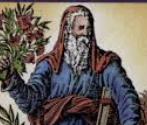
The dyad gets its name from passing through or asunder; for the dyad is the first to have separated itself from the monad, whence also it is called "daring." For when the monad manifests unification, the dyad steals in and manifests separation.
They also gave it the title of "opinion," because truth and falsity lie in opinion. And they called it "movement," "generation," "change," "division," "length," "multiplication," "addition," "kinship," "relativity," "the ratio in proportionality." For the relation of two numbers is of every conceivable form.
The Pythagoreans called the monad "intellect" because they thought that intellect was akin to the One; for among the virtues, they likened the monad to moral wisdom; for what is correct is one. And they called it "being," "cause of truth," "simple," "paradigm," "order," "concord," "what is equal among the greater and the lesser," "the mean between intensity and slackness," "moderation in plurality," "the instant now in time," and moreover they call it "ship," "chariot," "friend," "life," "happiness."
Furthermore, the monad produces itself and is produced from itself, since it is self-sufficient and has no power set over it and is everlasting; and it is evidently the cause of permanence, just as God is thought to be in the case of actual physical things, and to be the preserver and maintainer of natures.
Just as without the monad there is in general no composition of anything, so also without it there is no knowledge of anything whatsoever, since it is a pure light, most authoritative over everything in general, and it is sun-like and ruling, so that in each of these respects it resembles God, and especially because it has the power of making things cohere and combine, even when they are composed of many ingredients and are very different from one another, just as he made this universe harmonious and unified out of things which are likewise opposed.
Likewise, they call it "Chaos," which is Hesiod's first generator, because Chaos gives rise to everything else, as the monad does. It is also thought to be both "mixture" and "blending," "obscurity" and "darkness" thanks to the lack of articulation and distinction of everything which ensues from it. Anatolius says that it is called "matrix" and "matter," on the grounds that without it there is no number. The mark which signifies the monad is the source of all things.
If the potential of every number is in the monad, then the monad would be intelligible number in the strict sense, since it is not yet manifesting anything actual, but everything conceptually together in it.
This also is a beautiful circumstance, that they referred every thing to Pythagoras, and called it by his name, and that they did not ascribe to themselves the glory of their own inventions, except very rarely.
The Pythagoreans thought those who teach for the sake of reward show themselves worse than sculptors, or artists who perform the work sitting. For these, when someone orders wood to make a statue of Hermes, search for wood suited to receive the proper form; while those pretend that they can readily produce the works of virtue from every nature.
No one will deny that the soul of Pythagoras was sent to mankind from Apollo's domain, having either been one of his attendants, or more intimate associates, which may be inferred both from his birth, and his versatile wisdom.