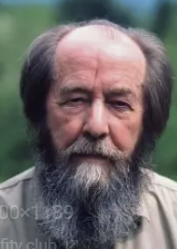
Here, lads, we live by the law of the taiga. But even here people manage to live. D'you know who are the ones the camps finish off? Those who lick other men's left-overs, those who set store by the doctors, and those who peach on their mates.
Human nature is full of riddles, and one of these riddles is this: How is it that people who have been crushed by the sheer weight of slavery and cast to the bottom of the pit can nevertheless find strength to rise up and free themselves, first in spirit then in body, while those who soar unhampered over the peaks of freedom suddenly appear to lose the taste for freedom, lose the will to defend it, and hopelessly confused and lost almost begin to crave slavery?
0
⚖0
▼Source
source
"Argentina's President Javier Milei Loves Being the Skunk at the Garden Party" (at 47m35s), Honestly with Bari Weiss, 6 June 2024.
The clock of communism has stopped striking. But its concrete building has not yet come crashing down. For that reason, instead of freeing ourselves, we must try to save ourselves from being crushed by its rubble.
0
⚖0
▼Source
source
How We Must Rebuild Russia in Komsomolskaya Pravda
There is a word very commonly used these days: "anti-communism." It's a very stupid word, badly put together. It makes it appear as though communism were something original, something basic, something fundamental. Therefore, it is taken as the point of departure, and anti-communism is defined in relation to communism. Here is why I say that this word was poorly selected, that it was put together by people who do not understand etymology: the primary, the eternal concept is humanity. And communism is anti-humanity. Whoever says "anti-communism" is saying, in effect, anti-anti-humanity. A poor construction. So we should say: that which is against communism is for humanity. Not to accept, to reject this inhuman Communist ideology is simply to be a human being. It isn't being a member of a party.
0
⚖0
▼Source
source
Speech in Washington D.C. (30 June 1975), published in Solzhenitsyn: The Voice of Freedom (1975), p. 30