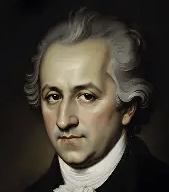
Nothing is great but truth, and the smallest truth is great. The other day I had a thought, which I put like this: Even a harmful truth is useful, for it can be harmful only for the moment and will lead to other truths, which must always become useful, very much so. Conversely, even a useful error is harmful, for it can be useful only for the moment, enticing us into other errors, which become more and more harmful.
0
⚖0
▼Source
source
Letter to Charlotte von Stein (1787) in Goethe's World View: Presented in His Reflections and Maxims (1963), Edited with an Introduction by Frederick Ungar, Translated by Heinz Norden, pp. 72-73, Frederick Ungar Publishing Company, New York.
Young Schopenhauer, a zealous and thorough-going Kantian, tried to explain that light would cease to exist along with the seeing eye. "What!" he said, according to Schopenhauer's own report, "looking at him with his Jove-like eyes,"-"You should rather say that you would not exist if the light could not see you?"
0
⚖0
▼Source
source
As quoted by Friedrich Jodl, "Goethe and Kant," The Monist (1901) f. Edward C. Hegeler, ed. Paul Carus, Vol. 11, p. 264. As translated from Professor Jodl's MS. by W. H. Carruth, of the University of Kansas.
And now the sagacious reader, who is capable of reading into these lines what does not stand written in them, but is nevertheless implied, will be able to form some conception of the serious feelings with which I then set foot in Emmendingen.
0
⚖0
▼Source
source
Autobiography: Truth and Poetry Book xviii. London 1884 p. 115 books.google.de
Who is the happiest of men? He who values the merits of others, And in their pleasure takes joy, even as though 'twere his own. Not in the morning alone, not only at mid-day he charmeth; Even at setting, the sun is still the same glorious planet.
0
⚖0
▼Source
source
Distichs in The Poems of Goethe (1853) as translated in the original metres by Edgar Alfred Bowring
The artist may be well advised to keep his work to himself till it is completed, because no one can readily help him or advise him with it...but the scientist is wiser not to withhold a single finding or a single conjecture from publicity.
I have found a paper of mine among some others in which I call architecture 'petrified music.' Really there is something in this; the tone of mind produced by architecture approaches the effect of music.
0
⚖0
▼Source
source
Conversations with Eckermann (23 March 1829) - Often quoted as "Architecture is frozen music."
I am more and more convinced that poetry is the universal possession of mankind, revealing itself everywhere and at all times in hundreds and hundreds of men. ... I therefore like to look about me in foreign nations, and advise everyone to do the same. National literature is now a rather unmeaning term; the epoch of world literature is at hand, and everyone must strive to hasten its approach.