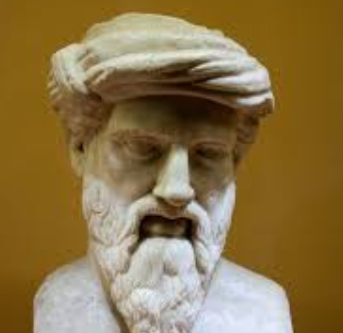
It is impossible to decide whether a particular detail of the Pythagorean universe was the work of the master, or filled in by a pupil—a remark which equally applies to Leonardo or Michelangelo. But there can be no doubt that the basic features were conceived by a single mind; that Pythagoras of Samos was both the founder of a new religious philosophy, and the founder of Science, as the word is understood today.
0
⚖0
▼Source
source
Arthur Koestler, The Sleepwalkers: A History of Man's Changing Vision of the Universe (1959, 1963)
The Ionians were optimistic, heathenly materialists... Every philosopher of the period seems to have had his own theory regarding the nature of the universe around him. ...The sixth century scene evokes the image of an orchestra expectantly tuning up, each player absorbed in his own instrument only, deaf to the caterwaulings of the others. Then there is a dramatic silence, the conductor enters the stage, raps three times with his baton, and harmony emerges from the chaos. The maestro is Pythagoras of Samos, whose influence on the ideas, and thereby on the destiny, of the human race was probably greater than that of any single man before or after him.
0
⚖0
▼Source
source
Arthur Koestler, The Sleepwalkers: A History of Man's Changing Vision of the Universe (1959, 1963)
Nicomachus concludes his first book with a theorem that indicates that mathematics was not yet free from ethical and æsthetic mixture. From Pythagoras onward two ideas were widespread in Greek, especially Platonic, philosophy. These are that the beautiful and the definite are prior to the ugly and the indefinite, and that from them are formed all the parts and classes of the infinite and indefinite. Nicomachus aims to show that in mathematics the same principle holds good in that from equality may be derived all the species of inequality.
0
⚖0
▼Source
source
George Johnson, [https://books.google.com/books?id=FIpNAAAAMAAJ The Arithmetical Philosophy of Nicomachus of Gersa] (1916)
Pythagoras taught, accordingly, that he had himself been originally Euphorbus, and then Callides, thirdly Hermotimus, fourthly Pyrrhus, and lastly Pythagoras; and that those things which had existed, after certain revolutions of time, came into being again; so that nothing in the world should be thought of as new. He said that true philosophy was a meditation on death; that its daily struggle was to draw forth the soul from the prison of the body into liberty: that our learning was recollection, and many other things which Plato works out in his dialogues, especially in the Phaedo and Timæus. For Plato, after having formed the Academy and gained innumerable disciples, felt that his philosophy was deficient on many points, and therefore went to Magna Græcia, and there learned the doctrines of Pythagoras from Archytas of Tarentum and Timæus of Locris: and this system he embodied in the elegant form and style which he had learned from Socrates. The whole of this, as we can prove, Origen carried over into his book Περὶ ᾿Αρχῶν, only changing the name.
0
⚖0
▼Source
source
St. Jerome, Apology Against Rufinus, Book III, sec. 40
Pythagoras conceived that the first attention that should be given to men should be addressed to the senses, as when one perceives beautiful figures and forms, or hears beautiful rhythms and melodies. Consequently he laid down that the first erudition was that which subsists through music's melodies and rhythms, and from these he obtained remedies of human manners and passions, and restored the pristine harmony of the faculties of the soul.
After his father's death, though he was still but a youth, his aspect was so venerable, and his habits so temperate that he was honored and even reverenced by elderly men, attracting the attention of all who saw and heard him speak, creating the most profound impression. That is the reason that many plausibly asserted that he was a child of the divinity. Enjoying the privilege of such a renown, of an education so thorough from infancy, and of so impressive a natural appearance he showed that he deserved all these advantages by deserving them, by the adornment of piety and discipline, by exquisite habits, by firmness of soul, and by a body duly subjected to the mandates of reason. An inimitable quiet and serenity marked all his words and actions, soaring above all laughter, emulation, contention, or any other irregularity or eccentricity; his influence at Samos was that of some beneficent divinity. His great renown, while yet a youth, reached not only men as illustrious for their wisdom as Thales at Miletus, and Bias at Prione, but also extended to the neighboring cities. He was celebrated everywhere as the "long-haired Samian," and by the multitude was given credit for being under divine inspiration.
0
⚖0
▼Source
source
Iamblichus of Chalcis in Life of Pythagoras translated by Thomas Taylor; Ch. 2: Youth, Education, Travels
No one will deny that the soul of Pythagoras was sent to mankind from Apollo's domain, having either been one of his attendants, or more intimate associates, which may be inferred both from his birth, and his versatile wisdom.
0
⚖0
▼Source
source
Iamblichus of Chalcis, Life of Pythagoras translated by Thomas Taylor; Ch. 2: Youth, Education, Travels
Much learning does not teach wisdom; otherwise it would have taught Hesiod and Pythagoras, and again Xenophanes and Hecataeus.
0
⚖0
▼Source
source
Heraclitus (c. 500 BC) as quoted by Sir Thomas Little Heath, A History of Greek Mathematics, [https://books.google.com/books?id=h4JsAAAAMAAJ Vol. 1], p.65, citing Diog. L. ix. 1 (Fr. 40 in Vorsokratiker i3, p. 86. 1-3).
Pythagoras, the son of Mnesarchus, was the most learned of all men of history; and having selected from these writings, he thus formed his own wisdom and extensive learning, and mischievous art.
0
⚖0
▼Source
source
Heraclides Ponticus (c. 360 BC) as quoted in C. D. Yonge's translation of Lives and Opinions of Eminent Philosophers, "Pythagoras", Sect.5 (1853)
Pythagoras was indeed the first man to call himself a philosopher. Others before had called themselves wise (sophos), but Pythagoras was the first to call himself a philosopher, literally a lover of wisdom. More importantly, for Pythagoras and his followers philosophy was not merely an intellectual pursuit, but a way of life, the aim of which was the assimilation to God.
0
⚖0
▼Source
source
Kenneth Sylvan Guthrie and David R. Fideler, The Pythagorean Sourcebook and Library: An Anthology of Ancient Writings which Relate to Pythagoras and Pythagorean Philosophy (1919)