↑ Back to the start
6 months 2 weeks ago
The laws of Manu are the doctrines of Plato, Philo, Zoroaster, Pythagoras, and of the Kabala. The esoterism of every religion may be solved by the latter. The kabalistic doctrine of the allegorical Father and Son, or Xlarrjp and Aoyos is identical with the groundwork of Buddhism. Moses could not reveal to the multitude the sublime secrets of religious speculation, nor the cosmogony of the universe ; the whole resting upon the Hindu Illusion, a clever mask veiling the Sanctum Sanctorum, and which has misled so many theological commentators. (p. 271)
0
⚖0
▼ Source
source
The Veil of Isis, Part 1, Science.
6 months 2 weeks ago
Zoroaster, Pythagoras, Epicharmus, Empedocles, Kebes, Euripides, Plato, Euclid, Philo, Boethius, Virgil, Marcus Cicero, Plotinus, Iamblichus, Proclus, Psellus, Synesius, Origen, and, finally, Aristotle himself, far 'from denying our immortality, support it most emphatically. (p. 251)
0
⚖0
▼ Source
source
The Veil of Isis, Part 1, Science.
6 months 2 weeks ago
If we carefully trace the terms nazar, and nazaret, throughout the best known works of ancient writers, we will meet them in connection with “Pagan” as well as Jewish adepts. Thus, Alexander Polyhistor says of Pythagoras that he was a disciple of the Assyrian Nazarrt, whom some suppose to be Ezekiel. Diogenes Laertius states most positively that Pythagoras, after being initiated into all the Mysteries of the Greeks and barbarians, “went into Egypt and afterward visited the Chaldeans and Magi;” and Apuleius maintains that it was Zoroaster who instructed Pythagoras. (p. 140)
0
⚖0
▼ Source
source
The Veil of Isis, Part 1, Science.
6 months 2 weeks ago
If the Pythagorean metempsychosis should be thoroughly explained and compared with the modern theory of evolution, it would be found to supply every "missing link" in the chain of the latter. But who of our scientists would consent to lose his precious time over the vagaries of the ancients. Notwithstanding proofs to the contrary, they not only deny that the nations of the archaic periods, but even the ancient philosophers had any positive knowledge of the Heliocentric system. The "Venerable Bedes," the Augustines and Lactantii appear to have smothered, with their dogmatic ignorance, all faith in the more ancient theologists of the pre-Christian centuries. But now philology and a closer acquaintance with Sanskrit literature have partially enabled us to vindicate them from these unmerited imputations. In the Vedas, for instance, we find positive proof that so long ago as 2000 B.C., the Hindu sages and scholars must have been acquainted with the rotundity of our globe and the Heliocentric system. Hence, Pythagoras and Plato knew well this astronomical truth; for Pythagoras obtained his knowledge in India, or from men who had been there, and Plato faithfully echoed his teachings.
0
⚖0
▼ Source
source
Vol. I, [https://www.theosociety.org/pasadena/isis/iu1-01.htm Ch. I], p.8.
6 months 2 weeks ago
It is certain that Pythagoras awakened the deepest intellectual sympathy of his age, and that his doctrines exerted a powerful influence upon the mind of Plato. His cardinal idea was that there existed a permanent principle 'of unity beneath the forms, changes, and other phenomena of the universe. Aristotle asserted that he taught that “ numbers are the first principles of all entities.” Ritter has expressed the opinion that the formula of Pythagoras should be taken symbolically, which is doubtless correct. (p. XV Before the Veil)
0
⚖0
▼ Source
source
Before the Veil, xv.
6 months 2 weeks ago
All was oracular and dogmatic in the school of Pythagoras. He prized and justly prized the greatness of his attainments and discoveries, and had no conception that any thing could go beyond them. He did not encourage, nay, he resolutely opposed, all true independence of mind, and that undaunted spirit of enterprise which is the atmosphere in which the sublimest thoughts are most naturally generated. He therefore did not throw open the gates of science and wisdom, and invite every comer; but on the contrary narrowed the entrance, and carefully reduced the number of aspirants. He thought not of the most likely methods to give strength and permanence and an extensive sphere to the progress of the human mind. For these reasons he wrote nothing; but consigned all to the frail and uncertain custody of tradition. And distant posterity has amply avenged itself upon the narrowness of his policy; and the name of Pythagoras, which would otherwise have been ranked with the first luminaries of mankind, and consigned to everlasting gratitude, has in consequence of a few radical and fatal mistakes, been often loaded with obloquy, and the hero who bore it been indiscriminately classed among the votaries of imposture and artifice.
0
⚖0
6 months 2 weeks ago
It is difficult to imagine any thing more instructive, and more pregnant with matter for salutary reflection, than the contrast presented to us by the character and system of action of Pythagoras on the one hand, and those of the great enquirers of the last two centuries, for example, Bacon, Newton and Locke, on the other. Pythagoras probably does not yield to any one of these in the evidences of true intellectual greatness. In his school, in the followers he trained resembling himself, and in the salutary effects he produced on the institutions of the various republics of Magna Graecia and Sicily, he must be allowed greatly to have excelled them. His discoveries of various propositions in geometry, of the earth as a planet, and of the solar system as now universally recognised, clearly stamp him a genius of the highest order. Yet this man, thus enlightened and philanthropical, established his system of proceeding upon narrow and exclusive principles, and conducted it by methods of artifice, quackery and delusion. One of his leading maxims was, that the great and fundamental truths to the establishment of which he devoted himself, were studiously to be concealed from the vulgar, and only to be imparted to a select few, and after years of the severest noviciate and trial. He learned his earliest lessons of wisdom in Egypt after this method, and he conformed through life to the example which had thus been delivered to him. The severe examination that he made of the candidates previously to their being admitted into his school, and the years of silence that were then prescribed to them, testify this. He instructed them by symbols, obscure and enigmatical propositions, which they were first to exercise their ingenuity to expound. The authority and dogmatical assertions of the master were to remain unquestioned; and the pupils were to fashion themselves to obsequious and implicit submission, and were the furthest in the world from being encouraged to the independent exercise of their own understandings. There was nothing that Pythagoras was more fixed to discountenance, than the communication of the truths upon which he placed the highest value, to the uninitiated. It is not probable therefore that he wrote any thing: all was communicated orally, by such gradations, and with such discretion, as he might think fit to adopt and to exercise. Such were some of the main causes that have made his efforts perishable, and the lustre which should have attended his genius in a great degree transitory and fugitive. He was probably much under the influence of a contemptible jealousy, and must be considered as desirous that none of his contemporaries or followers should eclipse their master. -->

0
⚖0
6 months 2 weeks ago
The close of the life of Pythagoras was, according to every statement, in the midst of misfortune and violence. Some particulars are related by Iamblichus, which, though he is not an authority beyond all exception, are so characteristic as seem to entitle them to the being transcribed. … Cylon, the richest man, or, as he is in one place styled, the prince, of Crotona, had manifested the greatest partiality to Pythagoras. He was at the same time a man of rude, impatient and boisterous character. He, together with Perialus of Thurium, submitted to all the severities of the Pythagorean school. They passed the three years of probation, and the five years of silence. They were received into the familiarity of the master. They were then initiated, and delivered all their wealth into the common stock. They were however ultimately pronounced deficient in intellectual power, or for some other reason were not judged worthy to continue among the confidential pupils of Pythagoras. They were expelled. The double of the property they had contributed was paid back to them. A monument was set up in memory of what they had been; and they were pronounced dead to the school. It will easily be conceived in what temper Cylon sustained this degradation. Of Perialus we hear nothing further. But--> … Cylon, from feelings of the deepest reverence and awe for Pythagoras, which he had cherished for years, was filled even to bursting with inextinguishable hatred and revenge. The unparalleled merits, the venerable age of the master whom he had so long followed, had no power to control his violence. His paramount influence in the city insured him the command of a great body of followers. He excited them to a frame of turbulence and riot. He represented to them how intolerable was the despotism of this pretended philosopher. They surrounded the school in which the pupils were accustomed to assemble, and set it on fire. Forty persons perished in the flames. According to some accounts Pythagoras was absent at the time. According to others he and two of his pupils escaped. He retired from Crotona to Metapontum. But the hostility which had broken out in the former city, followed him there. He took refuge in the Temple of the Muses. But he was held so closely besieged that no provisions could be conveyed to him; and he finally perished with hunger, after, according to Laertius, forty days' abstinence.
0
⚖0
6 months 2 weeks ago
What however seems to be agreed in by all his biographers, is that he professed to have already in different ages appeared in the likeness of man: first as Aethalides, the son of Mercury; and, when his father expressed himself ready to invest him with any gift short of immortality, he prayed that, as the human soul is destined successively to dwell in various forms, he might have the privilege in each to remember his former state of being, which was granted him. From Aethalides he became Euphorbus, who slew Patroclus at the siege of Troy. He then appeared as Hermotimus, then Pyrrhus, a fisherman of Delos, and finally Pythagoras. He said that a period of time was interposed between each transmigration, during which he visited the seat of departed souls; and he professed to relate a part of the wonders he had seen. He is said to have eaten sparingly and in secret, and in all respects to have given himself out for a being not subject to the ordinary laws of nature. Pythagoras therefore pretended to miraculous endowments. Happening to be on the sea-shore when certain fishermen drew to land an enormous multitude of fishes, he desired them to allow him to dispose of the capture, which they consented to, provided he would name the precise number they had caught. He did so, and required that they should throw their prize into the sea again, at the same time paying them the value of the fish.
0
⚖0
6 months 2 weeks ago
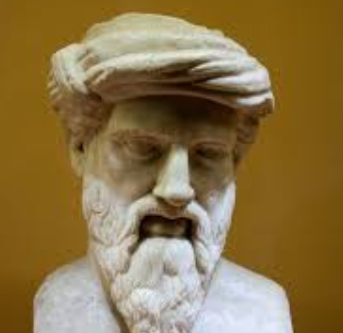
To give the greater authority and effect to his communications Pythagoras hid himself during the day at least from the great body of his pupils, and was only seen by them at night. Indeed there is no reason to suppose that any one was admitted into his entire familiarity. When he came forth, he appeared in a long garment of the purest white, with a flowing beard, and a garland upon his head. He is said to have been of the finest symmetrical form, with a majestic carriage, and a grave and awful countenance. He suffered his followers to believe that he was one of the Gods, the Hyperborean Apollo, and is said to have told Abaris that he assumed the human form, that he might the better invite men to an easiness of approach and to confidence in him. -->
0
⚖0

Works (Thanks to Project Gutenberg)

CivilSimian.com created by AxiomaticPanic, CivilSimian, Kalokagathia