↑ Back to the start
6 months 2 weeks ago
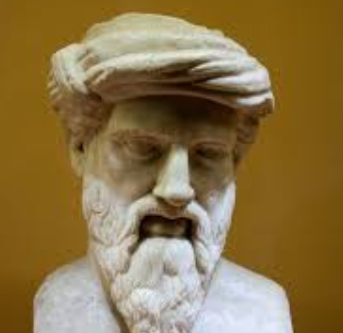
When in the end Pythagoras thought himself fully qualified for the task he had all along had in view, he was no less strict in prescribing ample preliminaries to his own scholars. At the time that a pupil was proposed to him, the master, we are told, examined him with multiplied questions as to his principles, his habits and intentions, observed minutely his voice and manner of speaking, his walk and his gestures, the lines of his countenance, and the expression and management of his eye, and, when he was satisfied with these, then and not till then admitted him as a probationer. It is to be supposed that all this must have been personal. As soon however as this was over, the master was withdrawn from the sight of the pupil; and a noviciate of three and five, in all eight years, was prescribed to the scholar, during which time he was only to hear his instructor from behind a curtain, and the strictest silence was enjoined him through the whole period. As the instructions Pythagoras received in Egypt and the East admitted of no dispute, so in his turn he required an unreserved submission from those who heard him: autos iphae "the master has said it," was deemed a sufficient solution to all doubt and uncertainty.
0
⚖0
6 months 2 weeks ago
One revolution that Pythagoras worked, was that, whereas, immediately before, those who were most conspicuous among the Greeks as instructors of mankind in understanding and virtue, styled themselves sophists, professors of wisdom, this illustrious man desired to be known only by the appellation of a philosopher, a lover of wisdom. The sophists had previously brought their denomination into discredit and reproach, by the arrogance of their pretensions, and the imperious way in which they attempted to lay down the law to the world. The modesty of this appellation however did not altogether suit with the deep designs of Pythagoras, the ascendancy he resolved to acquire, and the oracular subjection in which he deemed it necessary to hold those who placed themselves under his instruction. This wonderful man set out with making himself a model of the passive and unscrupulous docility which he afterwards required from others. He did not begin to teach till he was forty years of age, and from eighteen to that period he studied in foreign countries, with the resolution to submit to all his teachers enjoined, and to make himself master of their least communicated and most secret wisdom.
0
⚖0
6 months 2 weeks ago
To inculcate a pure and a simple mode of subsistence was also an express object of pursuit to Pythagoras. He taught a total abstinence from every thing having had the property of animal life. … He taught temperance in all its branches, and a resolute subjection of the appetites of the body to contemplation and the exercises of the mind; and, by the unremitted discipline and authority he exerted over his followers, he caused his lessons to be constantly observed. There was therefore an edifying and an exemplary simplicity that prevailed as far as the influence of Pythagoras extended, that won golden opinions to his adherents at all times that they appeared, and in all places.
0
⚖0
6 months 2 weeks ago
But this marvellous man in some way, whether from the knowlege he received, or from his own proper discoveries, has secured to his species benefits of a more permanent nature, and which shall outlive the revolutions of ages, and the instability of political institutions. He was a profound geometrician. The two theorems, that the internal angles of every right-line triangle are equal to two right angles, and that the square of the hypothenuse of every right angled triangle is equal to the sum of the squares of the other two sides, are ascribed to him. In memory of the latter of these discoveries he is said to have offered a public sacrifice to the Gods; and the theorem is still known by the name of the Pythagorean theorem.
0
⚖0
6 months 2 weeks ago
Pythagoras was a man of the most various accomplishments, and appears to have penetrated in different directions into the depths of human knowledge. He sought wisdom in its retreats of fairest promise, in Egypt and other distant countries. In this investigation he employed the earlier period of his life, probably till he was forty, and devoted the remainder to such modes of proceeding, as appeared to him the most likely to secure the advantage of what he had acquired to a late posterity. He founded a school, and delivered his acquisitions by oral communication to a numerous body of followers. He divided his pupils into two classes, the one neophytes, to whom was explained only the most obvious and general truths, the other who were admitted into the entire confidence of the master. These last he caused to throw their property into a common stock, and to live together in the same place of resort. He appears to have spent the latter half of his life in that part of Italy, called Magna Graecia, so denominated in some degree from the numerous colonies of Grecians by whom it was planted, and partly perhaps from the memory of the illustrious things which Pythagoras achieved there.
0
⚖0
6 months 2 weeks ago
Around 600 BCE, Pythagoras observed that the tones of a lyre sound most harmonious when the ratio of string lengths forms a simple whole-number fraction. Inspired by such hints, Pythagoras and his followers made a remarkable intuitive leap. They foresaw the possibility of a different kind of world-model, less dependent on the accident of our senses but more in tune with Nature's hidden harmonies, and ultimately more faithful to reality. This is the meaning of... "All things are number."
0
⚖0
▼ Source
source
Frank Wilczek, The Lightness of Being (2008)
6 months 2 weeks ago
The association between religion and mathematically based science has its origins in the mists of history. ...the very dawn of Western culture in sixth-century B.C. Greece. ...[W]hen the Greeks were turning away from the mythological picture immortalized by Homer and Hesiod, the Ionian philosopher Pythagoras of Samos pioneered a worldview in which mathematics was seen as the key to reality. In place of the mythological gods, Pythagoras painted a picture in which the universe was conceived as a great musical instrument resonating with divine mathematical harmonies. ...[inspiring] mystics, theologians, and physicists ever since. ...But to Pythagoras and his followers, mathematics was the key not simply to the physical world, but more importantly to the spiritual world—for they believed that numbers were literally gods. By contemplating numbers and their relationships, the Pythagoreans sought union with the "divine." For them, mathematics was first and foremost a religious activity.
0
⚖0
▼ Source
source
Margaret Wertheim, Pythagoras' Trousers: God, Physics, and the Gender Wars (1995) Introduction, pp. 9-10.
6 months 2 weeks ago
It was a maxim of Pythagoras that the two most excellent things for man were to speak the truth, and to render benefits to each other.
0
⚖0
▼ Source
source
Joseph Dame Weeks, History of the Knights of Pythias, with an Account of the Life and Times of Damon and Pythias (1874) Note: The bolded portion of this has sometimes been presented as a quote of Pythagoras, but has not been found in this form in any exis
6 months 2 weeks ago
From of old, amid the rage of robbery and blood-lust, it came to wise men's consciousness that the human race was suffering from a malady which necessarily kept it in progressive deterioration. Many a hint from observation of the natural man, as also dim half-legendary memories, had made them guess the primal nature of this man, and that his present state is therefore a degeneration. A mystery enwrapped Pythagoras, the preacher of vegetarianism; no philosopher since him has pondered on the essence of the world, without recurring to his teaching. Silent fellowships were founded, remote from turmoil of the world, to carry out this doctrine as a sanctification from sin and misery.
0
⚖0
▼ Source
source
Richard Wagner, Religion and Art (1880), translated by William Ashton Ellis, [http://users.belgacom.net/wagnerlibrary/prose/wlpr0126.htm#d0e1158 Part II]
6 months 2 weeks ago
It is very important to note that some 2,500 years ago at the least Pythagoras went from Samos to the Ganges to learn geometry…But he would certainly not have undertaken such a strange journey had the reputation of the Brahmins' science not been long established in Europe…
0
⚖0
▼ Source
source
Voltaire, Riding the Indian Tiger, William Nobrega and Ashish Sinha. Quoted from Gewali, Salil (2013). Great Minds on India. New Delhi: Penguin Random House. Also in Sushama Londhe, [https://www.google.com/books/edition/A_Tribute_to_Hinduism/G3AMAQAAMAAJ?

Works (Thanks to Project Gutenberg)

CivilSimian.com created by AxiomaticPanic, CivilSimian, Kalokagathia