
8 months ago
My cares and my inquiries are for decency and truth, and in this I am wholly occupied.
▼
Source
Book I, epistle i, line 11
8 months ago
Mediocrity in poets has never been tolerated by either men, or gods, or booksellers.
▼
Source
Lines 372-373
8 months ago
This to the right, that to the left hand strays, and all are wrong, but wrong in different ways.
▼
Source
Book II, satire iii, line 50 (trans. Conington)
8 months ago
He is not poor who has enough of things to use. If it is well with your belly, chest and feet, the wealth of kings can give you nothing more.
▼
Source
Book I, epistle xii, line 4
8 months ago
But, when the elements have been mingled in the fashion of a man and come to the light of day, or in the fashion of the race of wild beasts or plants or birds, then men say that these come into being; and when they are separated, they call that woeful death. They call it not aright; but I too follow the custom, and call it so myself.
▼
Source
fr. 9 As quoted by John Burnet, Early Greek philosophy (1908) p. 240
8 months ago
Fools -- for their thoughts are not well-considered who suppose that not-being exists or that anything dies and is wholly annihilated.
▼
Source
fr. 11
8 months ago
Fortunate is he who has acquired a wealth of divine understanding, but wretched the one whose interest lies in shadowy conjectures about divinities.
▼
Source
fr. 132
8 months ago
Nothing of the All is either empty or superfluous.
▼
Source
fr. 13
8 months ago
A law there is, an oracle of Doom, Of old enacted by the assembled gods, That if a Daemon-such as live for ages- Defile himself with foul and sinful murder, He must for seasons thrice ten thousand roam Far from the Blest; such is the path I tread, I too a wanderer and exile from heaven.
▼
Source
tr. Phillip H. De Lacy and Benedict Einarson. Cf. full quotation at Leonard p. 54-55 fr. 115, as paraphrased in Plutarch's Moralia
8 months ago
As it has long been and shall be, not ever, I think, will unfathomable time be emptied of either. This quote refers to Love and Strife, the fundamental opposing and ordering forces in Empedocles' model of the cosmos.
▼
Source
fr. 16
8 months ago
For already, sometime, I have been a boy and a girl, a shrub, a bird, and a silent fish in the sea.
▼
Source
fr. 117
8 months ago
Hear first the four roots of all things: shining Zeus, life-bringing Hera, Aidoneus, and Nestis, who wets with tears the mortal wellspring.
▼
Source
fr. 6
8 months ago
From such honor and such a height of fortune am I, thus fallen to earth, cast down amongst mortals.
▼
Source
fr. 119
8 months ago
And I will tell you something else: there is no birth of all mortal things, nor any end in wretched death, but only a mixing and dissolution of mixtures; 'birth' is so called on the part of mankind.
▼
Source
fr. 8
8 months ago
But what is lawful for all extends across wide-ruling aether and, without cease, through endless sunshine.
▼
Source
fr. 135, as quoted in Aristotle's Rhetoric, 1373 b16
8 months ago
One day, observing a child drinking out of his hands, he cast away the cup from his wallet with the words, "A child has beaten me in plainness of living."
▼
Source
Diogenes Laërtius, vi. 37
8 months ago
Asked where he came from, he said, "I am a citizen of the world."
▼
Source
Diogenes Laërtius, vi. 63
8 months ago
When Alexander the Great addressed him with greetings, and asked if he wanted anything, Diogenes replied "Yes, stand a little out of my sunshine."
▼
Source
From Plutarch, Alexander, 14. Cf. Diogenes Laërtius, vi. 38, Cicero, Tusculan Disputations, v. 32
8 months ago
When scolded for masturbating in public, he said "I wish it were as easy to banish hunger by rubbing my belly."
▼
Source
Diogenes Laërtius, vi. 46, 69
8 months ago
The noblest people are those despising wealth, learning, pleasure and life; esteeming above them poverty, ignorance, hardship and death.
▼
Source
Stobaeus, iv. 29a. 19
8 months ago
He used to reason as follows: 'Everything belongs to the gods; the wise are friends of the gods; friends hold all things in common; ergo, everything belongs to the wise.'
▼
Source
Diogenes Laërtius, vi. 37, as reported in Diogenes the Cynic: Sayings and Anecdotes as translated by Robin Hard (Oxford: 2012), p. 13
8 months ago
He was going into a theatre, meeting face to face those who were coming out, and being asked why, "This," he said, "is what I practise doing all my life."
▼
Source
Diogenes Laërtius, vi. 64
8 months ago
If you are to be kept right, you must possess either good friends or red-hot enemies. The one will warn you, the other will expose you.
▼
Source
Plutarch, Moralia, 74C
8 months ago
When some one reminded him that the people of Sinope had sentenced him to exile, he said, "And I sentenced them to stay at home."
▼
Source
Diogenes Laërtius, vi. 49
8 months ago
Virtue cannot dwell with wealth either in a city or in a house.
▼
Source
Stobaeus, iv. 31c. 88
8 months ago
To one who asked what was the proper time for lunch, he said, "If a rich man, when you will; if a poor man, when you can."
▼
Source
Diogenes Laërtius, vi. 40
8 months ago
When the slave auctioneer asked in what he was proficient, he replied, "In ruling people."
▼
Source
Diogenes Laërtius, vi. 74
8 months ago
On reaching Athens he fell in with Antisthenes. Being repulsed by him, because he never welcomed pupils, by sheer persistence Diogenes wore him out. Once when he stretched out his staff against him, the pupil offered his head with the words, "Strike, for you will find no wood hard enough to keep me away from you, so long as I think you've something to say."
▼
Source
Diogenes Laërtius, vi. 21,
8 months ago
He once begged alms of a statue, and, when asked why he did so, replied, "To get practice in being refused."
▼
Source
Diogenes Laërtius, vi. 49
8 months ago
Self-taught poverty is a help toward philosophy, for the things which philosophy attempts to teach by reasoning, poverty forces us to practice.
▼
Source
Stobaeus, iv. 32a. 11
8 months ago
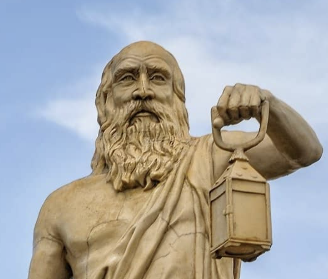
He lit a lamp in broad daylight and said, as he went about, "I am looking for a human."
▼
Source
Diogenes Laërtius, vi. 41. This line is frequently translated as "I am looking for an honest man."
8 months ago
It is not that I am mad, it is only that my head is different from yours.
▼
Source
Stobaeus, iii. 3. 51
8 months ago
Being asked where in Greece he saw good men, he replied, "Good men nowhere, but good boys at Sparta."
▼
Source
Diogenes Laërtius, vi. 27
8 months ago
To the question what wine he found pleasant to drink, he replied, "That for which other people pay."
▼
Source
Diogenes Laërtius, vi. 54
8 months ago
Poverty is a virtue which one can teach oneself.
▼
Source
Stobaeus, iv. 32a. 19
8 months ago
He was seized and dragged off to King Philip, and being asked who he was, replied, "A spy upon your insatiable greed."
▼
Source
Diogenes Laërtius, vi. 43. Cf. Plutarch, Moralia, 70CD.
8 months ago
When people laughed at him because he walked backward beneath the portico, he said to them: "Aren't you ashamed, you who walk backward along the whole path of existence, and blame me for walking backward along the path of the promenade?"
▼
Source
Stobaeus, iii. 4. 83
8 months ago
When some one boasted that at the Pythian games he had vanquished men, Diogenes replied, "Nay, I defeat men, you defeat slaves."
▼
Source
Diogenes Laërtius, vi. 33, 43
8 months ago
When asked why people give to beggars but not to philosophers, he replied, 'Because they expect they may become lame and blind, but never that they will become philosophers.'
▼
Source
Diogenes Laërtius, vi. 56, as reported in Diogenes the Cynic: Sayings and Anecdotes as translated by Robin Hard (Oxford: 2012), p. 18
8 months ago
Perdiccas threatened to put him to death unless he came to him, "That's nothing wonderful," Diogenes said, "for a beetle or a tarantula would do the same."
▼
Source
Diogenes Laërtius, vi. 44
8 months ago
Other dogs bite only their enemies, whereas I bite also my friends in order to save them.
▼
Source
Stobaeus, iii. 13. 44
8 months ago
To Xeniades, who had purchased Diogenes at the slave market, he said, "Come, see that you obey orders."
▼
Source
Diogenes Laërtius, vi. 36
8 months ago
He was breakfasting in the marketplace, and the bystanders gathered round him with cries of "dog." "It is you who are dogs," cried he, "when you stand round and watch me at my breakfast."
▼
Source
Diogenes Laërtius, vi. 61
8 months ago
Once he saw the officials of a temple leading away some one who had stolen a bowl belonging to the treasurers, and said, "The great thieves are leading away the little thief."
▼
Source
Diogenes Laërtius, vi. 45
8 months ago
Boasting, like gilded armour, is very different inside from outside.
▼
Source
Stobaeus, iii. 22. 40

8 months ago
Now, that we do not really know of what sort each thing is, or is not, has often been shown.
CivilSimian.com created by AxiomaticPanic, CivilSimian, Kalokagathia