
Mysticism is just tomorrow's science dreamed today.
Absurdity destroys the and of the enumeration by making impossible the in where the things enumerated would be divided up.
It is my own experience ... that commentators are far more ingenious at finding meaning than authors are at inserting it.
Evil always turns up in this world through some genius or other.
The WTO-related events in Seattle created the first experience of a rainbow politics-a successful pluralistic politics, without the working of a master mind, but with the currents and beauty that come out of free thinking. In the new politics, people have different ways of talking, but I feel the core will be living democracy and living economies, and that it will include both taking personal responsibility to make change and being part of national and international movements for change.
No easy way leads from the earth to heaven..
Boredom is connected naturally with time, with the horror of time, with the experience and the consciousness of time. Those who are not aware of time do not become bored. Basically life is only possible if one is not aware of time. If one should happen to want to experience consciously one of those moments that pass, one would be lost; life would become unbearable.
True confessions are written with tears only. But my tears would drown the world, as my inner fire would reduce it to ashes.
I am for freedom of religion, & against all maneuvres to bring about a legal ascendancy of one sect over another, for freedom of the press, and against all violations of the Constitution to silence by force and not by reason the complaints or criticisms, just or unjust, of our citizens against the conduct of their agents.
There must have been many who had a relationship to Jesus similar to that of Barabbas (his name was Jesus Barrabas). The Danish "Barrabas" is about the same as "N.N." [Mr. X or John Doe], filius patris, his father's son. - It is too bad, however, that we do not know anything more about Barrabas; it seems to me that in many ways he could have become a counterpart to the Wandering Jew. The rest of his life must have taken a singular turn. God knows whether or not he became a Christian. - It would be a poetic motif to have him, gripped by Christ's divine power, step forward and witness for him.
And so one can imagine that in amorous seduction the other is the locus of your secret - the other unknowingly holds that which you will never have the chance to know.
The rise of new science in the seventeenth century laid hold upon general culture in the next century. The enlightenment... testified to the widespread belief that at last light had dawned, that dissipation of ignorance, superstition, and bigotry was at hand, and the triumph of reason was assured -- for reason was counterpart in man of the laws of nature which science was disclosing. The reign of law in the natural world was to be followed by the reign of law in human affairs.
In 1970s Britain, conservative philosophy was the preoccupation of a few half-mad recluses.
The effect of music is so very much more powerful and penetrating than is that of the other arts, for these others speak only of the shadow, but music of the essence.
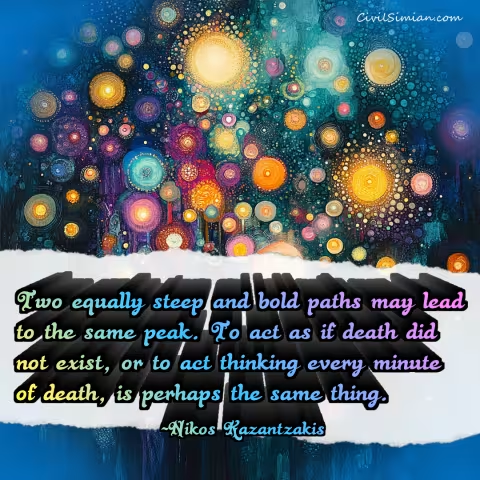
A sword by itself does not slay; it is merely the weapon used by the slayer.
Good nature is, of all moral qualities, the one that the world needs most, and good nature is the result of ease and security, not of a life of arduous struggle. Modern methods of production have given us the possibility of ease and security for all; we have chosen, instead, to have overwork for some and starvation for the others. Hitherto we have continued to be as energetic as we were before there were machines; in this we have been foolish, but there is no reason to go on being foolish for ever.
The medieval peasant prior to the 13th century does not compare himself to the feudal lord, nor does the artisan compare himself to the knight. ... From the king down to the hangman and the prostitute, everyone is "noble" in the sense that he considers himself as irreplaceable. In the "system of free competition," on the other hand, the notions on life's tasks and their value are not fundamental, they are but secondary derivations of the desire of all to surpass all the others. No "place" is more than a transitory point in this universal chase.
A screen bans reality.
Jesus is too colossal for the pen of phrasemongers, however artful. No man can dispose of Christianity with a bon mot.
My life - I had lived in its heights and its depths, in bitter sorrow and ecstatic joy, in black despair and fervent hope. I had drunk the cup to the last drop. I had lived my life. Would I had the gift to paint the life I had lived!
What a stupendous, what an incomprehensible machine is man! Who can endure toil, famine, stripes, imprisonment and death itself in vindication of his own liberty, and the next moment, be deaf to all those motives whose powers supported him through his trial, and inflict on his fellow men a bondage, one hour of which is fraught with more misery than ages of that which he rose in rebellion to oppose.
England, it is true, in causing a social revolution in Hindostan, was actuated only by the vilest interests, and was stupid in her manner of enforcing them. But that is not the question. The question is, can mankind fulfil its destiny without a fundamental revolution in the social state of Asia? If not, whatever may have been the crimes of England she was the unconscious tool of history in bringing about that revolution.
And though this may seem to subtile a deduction of the Lawes of Nature, to be taken notice of by all men;whereof the most part are too busie in getting food, and the rest too negligent to understand; yet to leave all men unexcusable, they have been contracted into one easie sum, intelligble, even to the meanest capacity; and that is, Do not that to another, which thou wouldest not have done to thyselfe; which sheweth him, that he has no more to do in learning the Lawes of Nature, but, when weighing the actions of other men with his own, they seem too heavy, to put them into the other part of the balance, and his own into their place, that his own passions, and selfe love, may adde nothing to the weight; and then there is none of these Laws of Nature that will not appear unto him very reasonable.
Her green eyes fluttered swiftly twice or thrice, then glazed,her mouth gaped open, bleating, then her jaws hung looseand retched up all her soul in lumps of clotting blood.
Children have as much mind to shew that they are free, that their own good actions come from themselves, that they are absolute and independent, as any of the proudest of you grown men, think of them as you please.
Every time that a man has, with a pure heart, called upon Osiris, Dionysus, Buddha, the Tao, etc., the Son of God has answered him by sending the Holy Spirit. And the Holy Spirit has acted upon his soul, not by inciting him to abandon his religious tradition, but by bestowing upon him light - and in the best of cases the fullness of light - in the heart of that same religious tradition. ... It is, therefore, useless to send out missions to prevail upon the peoples of Asia, Africa or Oceania to enter the Church.
Everyone is entitled to commit murder in the imagination once in a while, not to mention lesser infractions.
Till women are more rationally educated, the progress in human virtue and improvement in knowledge must receive continual checks.
Feelings, the most diverse, very strong and very weak, very significant and very worthless, very bad and very good, if only they infect the reader, the spectator, the listener, constitute the subject of art.
And I will tell you something else: there is no birth of all mortal things, nor any end in wretched death, but only a mixing and dissolution of mixtures; 'birth' is so called on the part of mankind.
Fascism is not defined by the number of its victims, but by the way it kills them.
Every way of classifying a thing is but a way of handling it for some particular purpose.
This world is but canvas to our imaginations.
The power of perpetuating our property in our families is one of the most valuable and interesting circumstances belonging to it, and that which tends most to the perpetuation of society itself. It makes our weakness subservient to our virtue; it grafts benevolence even upon avarice. The possession of family wealth and of the distinction which attends hereditary possessions (as most concerned in it,) are the natural securities for this transmission.
476 ... is usually taken as the date of the "fall of the Roman Empire." The date, however, is a false one. No one at this period of time considered that the Roman Empire had "fallen." Indeed, it still existed and was the most powerful realm in Europe. Its capital was at Constantinople and the Emperor was Zeno. It is only because we ourselves are culturally descended from the Roman west, that we tend to ignore the continued existence of the Roman Empire in the east.
He was free, free in every way, free to behave like a fool or a machine, free to accept, free to refuse, free to equivocate; to marry, to give up the game, to drag this death weight about with him for years to come. He could do what he liked, no one had the right to advise him, there would be for him no Good or Evil unless he thought them into being.
Power is more 'spacious' than violence. And violence becomes power if it 'gives itself more time.' Looked at from this perspective, power rests on an excess of space and time.
I subdue matter and force it to become my mind's good medium. I rejoice in plants, in animals, in man and in gods, as though they were my children. I feel all the universe nestling about me and following me as though it were my own body.
The only thing we are naturally afraid of is pain, or loss of pleasure. And because these are not annexed to any shape, colour, or size of visible objects, we are frighted of none of them, till either we have felt pain from them, or have notions put into us that they will do us harm.
A book can never be anything more than the impression of its author's thoughts [Ein Buch kann nie mehr seyn, als der Abdruck der Gedanken des Verfassers]. The value of these thoughts lies either in the matter about which he has thought, or in the form in which he develops his matter - that is to say, what he has thought about it.
What most people in our culture mean by being lovable is essentially a mixture between being popular and having sex appeal.
The advance of liberalism, so-called, in Christianity, during the past fifty years, may fairly be called a victory of healthy-mindedness within the church over the morbidness with which the old hell-fire theology was more harmoniously related. We have now whole congregations whose preachers, far from magnifying our consciousness of sin, seem devoted rather to making little of it. They ignore, or even deny, eternal punishment, and insist on the dignity rather than on the depravity of man. They look at the continual preoccupation of the old-fashioned Christian with the salvation of his soul as something sickly and reprehensible rather than admirable; and a sanguine and 'muscular' attitude, which to our forefathers would have seemed purely heathen, has become in their eyes an ideal element of Christian character. I am not asking whether or not they are right, I am only pointing out the change.
No evil is honorable; but death is honorable; therefore death is not evil.
Paradise was unendurable, otherwise the first man would have adapted to it; this world is no less so, since here we regret paradise or anticipate another one. What to do? Where to go? Do nothing and go nowhere, easy enough.
It does not matter whether the right to govern is hereditary or obtained with the consent of the governed. A State is absolute in the sense which I have in mind when it claims the right to a monopoly of all the force within the community, to make war, to make peace, to conscript life, to tax, to establish and dis-establish property, to define crime, to punish disobedience, to control education, to supervise the family, to regulate personal habits, and to censor opinions. The modern State claims all of these powers, and, in the matter of theory, there is no real difference in the size of the claim between communists, fascists, and democrats.
I think of the course of human history as a long, swelling, increasingly polyphonic poem - a poem that leads up to nothing save itself. When the species is extinct, "human nature's total message" will not be a set of propositions, but a set of vocabularies - the more, and the more various, the better.
CivilSimian.com created by AxiomaticPanic, CivilSimian, Kalokagathia