
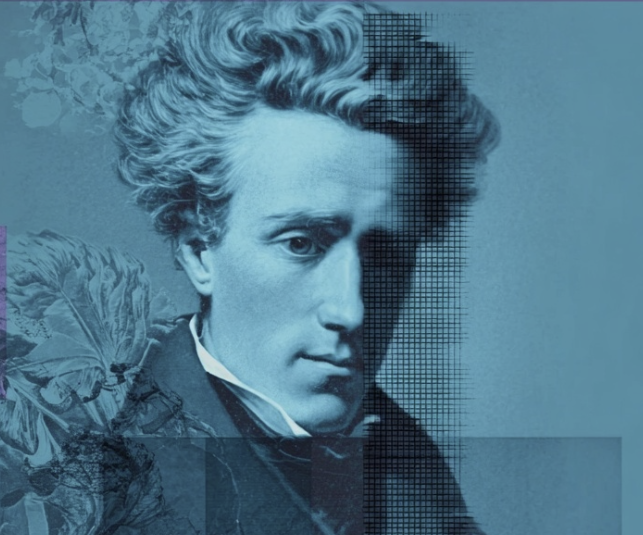
Søren Kierkegaard — Anxiety, the Leap, and the Single Individual Before God (1813–1855)
Søren Aabye Kierkegaard was a Danish philosopher, theologian, literary critic, and cultural provocateur — born in Copenhagen on 5 May 1813, the last of seven children of Michael Pedersen Kierkegaard, a wealthy wool merchant haunted by a secret he never fully disclosed — possibly a curse he had pronounced against God in a moment of adolescent despair, and an illegitimate child born before his marriage. Five of his seven children died before him, as did his wife — and Michael Kierkegaard was convinced these deaths were divine punishment for his sin. Søren grew up under the shadow of this melancholy, which he later described as "the great earthquake" that shook his sense of the world's stability. He studied theology at the University of Copenhagen, completed his master's thesis on Socratic irony in 1841, was briefly engaged to Regine Olsen — an engagement he broke off in one of the most discussed personal decisions in the history of philosophy — and spent the rest of his short life in Copenhagen, writing at a furious pace, conducting a public polemic against the Danish State Church, and dying on 11 November 1855 at the age of forty-two, possibly of a spinal condition, collapsing on the street and dying in hospital five weeks later. He refused final communion from a priest — insisting that no ordained minister of the established church could administer a sacrament he recognized as genuine.
He published under a remarkable range of pseudonyms — Victor Eremita, Johannes de Silentio, Vigilius Haufniensis, Johannes Climacus, Anti-Climacus, Hilarius Bookbinder — each representing a different perspective or stage of existence, none to be identified with Kierkegaard's own position without careful argument. His major works included "Either/Or" (1843), "Fear and Trembling" (1843), "The Concept of Anxiety" (1844), "Philosophical Fragments" (1844), "Stages on Life's Way" (1845), "Concluding Unscientific Postscript" (1846), "Works of Love" (1847), and "The Sickness unto Death" (1849). He was neglected in his own time and rediscovered in the twentieth century — influencing Heidegger, Sartre, Barth, Tillich, Buber, Kafka, and the entire existentialist tradition that claimed him as its father.
His central concern, expressed through pseudonyms, indirect communication, and every literary device available to him: that the deepest truth about human existence was not available through objective philosophical argument — that it had to be appropriated subjectively, personally, passionately — and that the reduction of human existence to systems, crowds, and categories was not merely a philosophical error but a betrayal of what it meant to be a self.
Against Hegel — The Individual Against the System
Kierkegaard's philosophy was formed in opposition to Hegel — specifically to the Hegelian system's claim to have comprehended the whole of reality, including human existence, within rational categories. For Hegel, the individual was a moment in the self-development of Absolute Spirit — the particular was always in the service of the universal, and the individual found their true significance as an expression of the historical and rational whole. For Kierkegaard, this was precisely the error — not because Hegel's logic was formally defective but because it systematically left out the one thing that mattered most: the existing individual, the single person who had to live their life, make their choices, face their anxiety, and stand before God alone.
"The System" — Kierkegaard's ironic term for Hegelian philosophy — could comprehend everything except existence. It moved by logical necessity; existence moved by freedom and risk. It dealt in essences; existence was always becoming, never finished. It absorbed the individual into the universal; existence demanded that the individual remain irreducibly themselves. "Subjectivity is truth" — Kierkegaard's counter-slogan to Hegel — was not a relativism but a claim about what kind of truth mattered most for an existing individual: not the objective truths of science and logic, which could be held with detachment, but the subjective truths that had to be appropriated passionately, lived through, staked one's life on.
"It is perfectly true, as the philosophers say, that life can only be understood backwards. But they forget the other proposition, that it must be lived forwards."
— Kierkegaard, Journals
The Three Stages — Aesthetic, Ethical, Religious
Kierkegaard's most widely known philosophical framework distinguished three "stages" or "spheres" of existence: the aesthetic, the ethical, and the religious. The aesthetic stage was the mode of existence organized around immediacy, pleasure, and the avoidance of boredom — the Don Juan who moved from one conquest to the next, the melancholic aesthete who found everything interesting except commitment. Its characteristic failure was despair: the aesthete eventually found that no pleasure, no novelty, no rotation of experience could satisfy the deeper longing at the center of selfhood.
The ethical stage was organized around duty, responsibility, and the universal — the Judge Wilhelm of "Either/Or" who found meaning in marriage, vocation, and civic life, who chose himself through commitment rather than fleeing into aesthetic variety. Its characteristic failure was guilt: the ethical person discovered that they could not actually live up to the ethical demands they imposed on themselves, and that no human ethical framework could fully address the deepest questions of guilt and forgiveness. The religious stage — which itself had two forms (Religiousness A and B) — was the mode of existence organized around the absolute relation to God, the willingness to stake everything on a commitment that could not be rationally justified. Its characteristic feature was not comfort but greater anxiety — the anxiety of standing before the Absolute, alone, without the crowd's support.
"The most common form of despair is not being who you are."
— Kierkegaard, The Sickness unto Death
Anxiety — The Dizziness of Freedom
"The Concept of Anxiety" (1844) was Kierkegaard's most psychologically penetrating work — and the one that most directly influenced twentieth-century existentialism and psychology. Its central concept: anxiety (Angest) was not fear of a specific object but the mood that arose from the awareness of freedom itself — the dizziness one felt when looking into the abyss of one's own possibilities. "Anxiety is the dizziness of freedom." The person who was anxious was not anxious about anything in particular but about the fact that they could choose — that the future was open, that nothing determined in advance what they would make of themselves.
This was not a pathological state to be eliminated but a permanent feature of human existence — the mark of genuine freedom. The person without anxiety was either not free (an animal) or in bad faith (a human being who had suppressed awareness of their freedom). Kierkegaard distinguished this from despair — which was the condition of being wrongly related to oneself, either refusing to be oneself or refusing to be in relation to God. Anxiety was the gateway to authentic selfhood; despair was the failure to pass through it. Heidegger's Angst, Sartre's nausea at freedom, and the entire tradition of existential anxiety in twentieth-century philosophy were Kierkegaard's concepts in new registers.
"Anxiety is the dizziness of freedom. Anxiety arises when the spirit wants to posit the synthesis of which it is the third factor — and looks down into its own possibility, taking hold of finiteness to support itself."
— Kierkegaard, The Concept of Anxiety
Fear and Trembling — The Teleological Suspension of the Ethical
"Fear and Trembling" (1843) — published pseudonymously as Johannes de Silentio — was Kierkegaard's most dramatically concentrated philosophical work and the one that posed his most challenging question to the ethical tradition. Its subject was Abraham's willingness to sacrifice Isaac — the moment at which God commanded what ethics categorically prohibited. The pseudonym Johannes de Silentio could not understand Abraham — could not explain him in ethical terms, could not admire him as a tragic hero, could not reduce his action to any recognizable human category. Abraham was a "knight of faith" — one who had made the double movement of infinite resignation (giving up everything) and then faith (receiving everything back).
The philosophical challenge: if Abraham was admirable — if faith could require what ethics prohibited — then ethics was not the highest category. There was a "teleological suspension of the ethical" — a possibility that the absolute relation to God could override the universal moral law. This was not an endorsement of violence in God's name but a philosophical argument that the religious and the ethical were not simply identical — that genuine faith was not reducible to morality — and that the existing individual before God stood in a relation that no ethical system could fully capture. Levinas, who criticized this argument sharply, called it a violence — and the debate between Kierkegaard and Levinas on ethics and religion is among the most important in twentieth-century philosophy.
"The ethical as such is the universal, and as the universal it applies to everyone, which may be expressed from another point of view by saying that it applies every instant. The single individual does not have an immediate relation to the universal. Only as the single individual does he stand in an absolute relation to the absolute."
— Kierkegaard, Fear and Trembling
Indirect Communication — The Method as Philosophy
Kierkegaard's most distinctive philosophical contribution was not merely his ideas but his method: the use of pseudonymous authorship, literary forms, irony, and indirection to communicate truths that direct statement could not convey. A direct philosophical argument told readers what to think — it could be absorbed intellectually without existential transformation. Indirect communication forced readers to take responsibility for their own understanding — to do the philosophical work themselves, to discover through the reading what they already knew but had refused to acknowledge. The pseudonyms were not mere disguise but philosophical devices — each represented a perspective or stage of existence that the reader encountered and had to evaluate from the inside.
This was Socratic in inspiration: Kierkegaard saw himself as a kind of Danish Socrates, practicing irony and indirect communication to awaken his contemporaries from the complacent illusion that they were already Christians, already ethical, already in possession of the selfhood they had barely begun to seek. The point was not to provide answers but to make the questions impossible to ignore. The deepest philosophical insight — that you had to become a self, that this was an infinite task, that no system could do it for you — could not be argued directly without being betrayed. It had to be performed.
"Subjectivity is truth. An objective uncertainty held fast in an appropriation-process of the most passionate inwardness is the truth, the highest truth attainable for an existing individual."
— Kierkegaard, Concluding Unscientific Postscript
The Attack on the Church — The Final Polemic
In the last year of his life, Kierkegaard published a series of polemical pamphlets — "The Moment" — attacking the Danish State Church as a fraudulent institution that had made Christianity comfortable, institutional, and thus precisely the opposite of what Christianity required. Christianity demanded the imitation of Christ — poverty, suffering, rejection, the willingness to be despised. What the established church offered was social respectability, professional clergy, and the reassurance that being a good Danish citizen was the same as being a Christian. This was, for Kierkegaard, a fundamental betrayal — the reduction of infinite requirement to finite comfort, the domestication of the absolute into the social. The attack was vicious, funny, and deeply sincere — and it cost him his health, his reputation, and ultimately his life. He collapsed on the street in October 1855 and died in November, his final weeks spent in hospital refusing ecclesiastical communion.
"The matter is quite simple. The Bible is very easy to understand. But we Christians are a bunch of scheming swindlers. We pretend to be unable to understand it because we know very well that the minute we understand it, we are obliged to act accordingly."
— Kierkegaard, Journals
Legacy — The Father Who Refused the Inheritance
Kierkegaard's influence on the twentieth century was immense and largely ironic. The "existentialists" who claimed him — Sartre, Heidegger, Camus — took his categories (anxiety, authentic existence, the leap, the individual) and stripped them of the theological framework for which he had developed them. The theologians — Barth, Tillich, Buber — took different aspects of his work and developed them in directions he might equally have contested. He was claimed by both atheistic and theistic versions of existentialism — by thinkers who kept his categories and dropped his God, and by thinkers who kept his God and dropped much of his philosophy. None of these inheritances was quite what he intended — which was entirely consistent with his method: a thinker who refused to tell readers what to think could not be surprised when they thought differently.
On CivSim he belongs alongside Sartre, Heidegger, and Camus — the existentialist tradition from which the others drew and which he would have recognized only imperfectly. His challenge to Universal Humanism is the most personal available: a philosophy committed to the dignity of persons must ask what a person is — and Kierkegaard's answer was that a person was not a bearer of rights, a social role, or a rational agent, but a single individual before God, constituted by their freedom, their anxiety, their choices, and their relation — or failure of relation — to the Absolute. Any philosophy that comprehended persons within a system — however benevolent — had already committed the error that his entire life's work was designed to expose. "The crowd is untruth." The single individual was always something the crowd, and the system, could not contain.
"The crowd is untruth. Therefore was Christ crucified, because he would have nothing to do with the crowd, would not allow himself to be helped by it, would not be its king. He only wanted to be individuals. And whoever is truly capable of being an individual will find strength to give the suffering of his life its highest meaning."
— Kierkegaard, "The Individual"
CivilSimian.com created by AxiomaticPanic, CivilSimian, Kalokagathia