
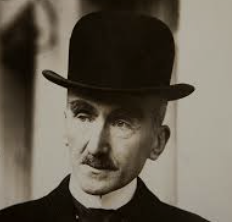
Henri Bergson — Duration, Élan Vital, and the Philosophy of Creative Life (1859–1941)
Henri-Louis Bergson was a French philosopher — born in Paris on 18 October 1859 to a Polish-Jewish father (the name Bergson derived from Berek's sons, a wealthy Polish Jewish family) and an English-Irish Jewish mother, who spent his early childhood in London before his family returned to France, showed exceptional gifts in both mathematics and the humanities at the Lycée Condorcet, entered the École Normale Supérieure in 1878, caused something of a scandal by choosing philosophy over mathematics — his teachers thought mathematics was his calling — taught philosophy in provincial lycées for more than a decade, published his doctoral thesis "Time and Free Will" in 1889, and in 1900 was appointed to the chair of philosophy at the Collège de France, where his lectures drew such enormous crowds — including not only philosophers but artists, writers, politicians, and general audiences — that the rue Saint-Jacques was blocked by carriages on Thursday mornings. He was awarded the Nobel Prize in Literature in 1927 "in recognition of his rich and vitalizing ideas and the brilliant skill with which they have been presented." He died in Paris on 4 January 1941, in German-occupied France. Despite being offered exemption from anti-Jewish laws by the Vichy government, he insisted on registering as a Jew, standing in line for hours in bitter winter weather, seriously ill, to do so. He died weeks later.
He was the most celebrated philosopher in the world during the first decade of the twentieth century — a fame that declined steeply after the First World War and that Gilles Deleuze's "Le Bergsonisme" (1966) began to rehabilitate. His major works were "Time and Free Will" (1889), "Matter and Memory" (1896), "Laughter" (1900), "An Introduction to Metaphysics" (1903), "Creative Evolution" (1907) — his most famous work, translated into twenty languages — and "The Two Sources of Morality and Religion" (1932). Proust was his cousin by marriage and drew on his philosophy of memory. William James called him "the most original philosopher alive." Einstein debated him about the nature of time in 1922 — a confrontation whose outcome remains philosophically contested.
His central concern, the thread that connected all his work: that the mechanistic, spatializing, analytical approach to reality — adequate for practical manipulation of the world — systematically missed the most essential feature of existence: its dynamic, temporal, creative character, which could be grasped only through intuition, not through the decomposing analysis of the intellect.
Duration — Against Clock Time
The discovery that generated Bergson's entire philosophy — which he later described as coming to him in a moment of insight while trying to understand what was wrong with Herbert Spencer's philosophy — was the concept of duration (la durée). Clock time was a spatial representation of time: a line divided into equal, discrete units, each identical to the others, each externally related to its neighbors. This was time as physics and mathematics required it — measurable, reversible, abstractable from any particular content. But it was not time as it was actually lived.
Lived time — duration — was qualitative rather than quantitative, continuous rather than discrete, heterogeneous rather than uniform. Each moment of consciousness was different from every other — not merely in its content but in its quality, its felt character. And moments of consciousness were not externally related, like beads on a string, but internally interpenetrating: the past was not behind the present but within it, shaping it, coloring it. Memory was not a storage system that retrieved fixed images from the past but a dynamic process in which the past continuously flowed into and constituted the present. Duration was not something that happened to consciousness — it was what consciousness was. "To exist is to change, to change is to mature, to mature is to go on creating oneself endlessly."
"To exist is to change, to change is to mature, to mature is to go on creating oneself endlessly."
— Henri Bergson, Creative Evolution
Intuition Against Intellect — Two Ways of Knowing
Bergson's epistemology was built on a fundamental distinction between two ways of knowing: analysis and intuition. Analysis — the method of science and of ordinary intellect — approached its object from the outside, circling it from multiple points of view, decomposing it into elements, translating it into symbols and concepts. This produced knowledge that was useful for practical purposes — for acting on the world — but that necessarily missed the thing itself. You could accumulate photographs of a city from every possible angle, he proposed, and still not know what it was to walk through it. You could pile commentary upon commentary on a line of Homer and still not have the experience of reading it in its original language. Analysis produced a model of the thing, not the thing in its living actuality.
Intuition was the alternative: a direct, sympathetic coincidence with the object — a method of knowing that placed itself within the thing's own duration rather than observing it from outside. This was not a vague or mystical faculty but a rigorous philosophical discipline: the effort to overcome the habits of practical intelligence and to attend to experience in its flowing, undivided actuality. "A true empiricism is that which proposes to get as near to the original itself as possible, to search deeply into its life, and so, by a kind of intellectual auscultation, to feel the throbbings of its soul." Intuition was Bergson's answer to the question Kant had thought unanswerable: how to know the thing in itself.
"A true empiricism is that which proposes to get as near to the original itself as possible, to search deeply into its life, and so, by a kind of intellectual auscultation, to feel the throbbings of its soul."
— Bergson, An Introduction to Metaphysics
Creative Evolution — Élan Vital Against Mechanism
"Creative Evolution" (1907) extended the philosophy of duration and intuition to the largest possible canvas: the history of life on earth. Bergson accepted evolutionary theory as empirically established while rejecting the two dominant philosophical interpretations of it: mechanism (evolution as the blind interaction of physical forces) and finalism (evolution as the unfolding of a predetermined plan). Both, he argued, made the same mistake: they assumed that the outcome of evolution was in some sense given in advance — either determined by prior causes or directed toward a predetermined end. Both therefore missed what was most remarkable about life: its genuine creativity, its capacity to produce genuinely new forms that could not have been predicted from what preceded them.
His alternative: the élan vital — the vital impulse — an immanent, creative force that flowed through all living things, not a transcendent designer but an internal tendency toward greater complexity and freedom. The élan vital was not a soul injected into matter from outside but the living momentum of life itself, constantly encountering the resistance of matter and generating new forms in response to that encounter. Evolution's two great lines — instinct (leading to insect life) and intelligence (leading to human beings) — were both expressions of this single original impulse, diverging as the impulse expressed itself in the different possibilities that matter offered. Consciousness was evolution's crowning achievement: the form in which the élan vital became most free, most capable of genuine novelty, most liberated from material constraint.
"The élan vital is not a transcendent force or intelligent designer, but an immanent, indivisible current of life that flows through all living beings — the source of the novelty, unpredictability, and inventiveness that characterize the unfolding of life on Earth."
The Einstein Debate — Two Conceptions of Time
In April 1922, at the Société française de philosophie in Paris, Bergson and Albert Einstein met to debate the nature of time — one of the most consequential and most contested intellectual encounters of the century. Einstein's special theory of relativity had proposed that time was relative — that the rate at which time passed depended on the velocity of the observer — and had appeared to undermine any notion of a universal "now" shared by all observers simultaneously. Bergson argued that this applied to the physicist's measurable, spatialized time but not to lived duration — that the multiplicity of times that relativity described presupposed a single lived time from which the physicist's calculations proceeded. Einstein responded that the philosopher's intuition of duration was a psychological fact, not a physical one, and that physics was concerned with physical facts.
The exchange produced a verdict from the assembled physicists that has shaped reception of the debate ever since: physics won, philosophy lost. But the verdict was premature. Bergson's distinction between lived time and measured time — between duration as experienced and time as a physical variable — is not refuted by relativity but orthogonal to it. They were addressing different questions. The debate's significance is that it crystallized, at the moment of maximum prestige for physics, the question of whether scientific measurement exhausted what there was to say about time — a question that remains genuinely open.
"The debates between Einstein and Bergson on the nature of time were a significant intellectual event of the early 20th century, pitting Einstein's scientific conception of time as measurable and objective against Bergson's philosophical view of time as fluid and subjective — sparking discussions that resonated far beyond physics and philosophy."
The Two Sources — Open and Closed Society
"The Two Sources of Morality and Religion" (1932) — Bergson's last major work, published when he was seventy-three — was his most directly political and his most theologically engaged. He distinguished between two sources of morality and religion, corresponding to two types of society. "Closed" societies were organized around obligation, conformity, and social pressure — the morality of the herd, enforcing solidarity through habit and custom. The religion of closed societies was similarly conformist: static religion, which reinforced social cohesion through myth, ritual, and the fear of transgression. "Open" societies were organized around aspiration, creativity, and love — the morality of the saint and the hero, who transcended the demands of the group through an overflowing vitality that drew others upward. Dynamic religion — mysticism in its highest form — was the spiritual expression of this open morality: the direct apprehension of the creative impulse of life that underlay all existence.
Bergson identified the Christian mystics — and some non-Christian mystics — as the exemplars of the open moral type, and acknowledged that his own philosophical trajectory had brought him close to the Catholic position. He did not convert — partly, he wrote, out of solidarity with Jews in a time of rising anti-Semitism. The last act of his life — registering as a Jew under the Vichy occupation — was the biographical fulfillment of the moral philosophy he had spent forty years developing: the choice of solidarity over safety, of open humanity over the closed group's demand for self-preservation.
"Closed morality expresses the pressure of society upon its members. Open morality is the aspiration of what is best in man — it is not a constraint but an appeal, an élan, which draws some souls upward and through them exerts an attraction on all humanity."
— Bergson, The Two Sources of Morality and Religion
Legacy — The Philosopher of Life Recovered
Bergson's reputation suffered a catastrophic decline after the First World War — partly because his voluntarist, vitalist philosophy was associated with the catastrophic enthusiasms of 1914, partly because the rising prestige of analytic philosophy and logical positivism made his methodology look pre-scientific, and partly because Sartre's existentialism and structuralism dominated French intellectual life in the mid-century. Deleuze's recovery of Bergson in 1966 — reading him through the lens of difference and multiplicity — began a rehabilitation that has continued. Process philosophers, phenomenologists, cognitive scientists, and philosophers of biology have all found genuine resources in his work. Proust's "In Search of Lost Time" — the greatest novel of memory in any language — is saturated with Bergsonian duration. William James's radical empiricism and pluralism ran in parallel. Whitehead's process philosophy was the closest systematic development of Bergson's process orientation in the Anglo-American tradition.
On CivSim he belongs alongside Goethe, Whitehead, and James — the tradition that insisted on process, creativity, and temporal becoming as the fundamental features of reality that static, analytic philosophy systematically missed. His challenge to Universal Humanism is the temporality challenge: a philosophy of human dignity and flourishing that models persons as static bearers of rights and preferences — as things with properties — may be missing the most essential feature of persons: that they are not things but durations — beings whose identity is constituted by their history of change, whose dignity lies not in what they are at any given moment but in the open, creative, self-creating process they are. "To exist is to change, to change is to mature, to mature is to go on creating oneself endlessly."
"The present moment always will have been."
— Bergson — his most compressed statement of duration's irreversibility
CivilSimian.com created by AxiomaticPanic, CivilSimian, Kalokagathia