
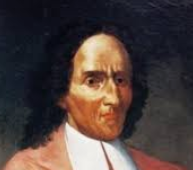
Giambattista Vico
Member for
4 months 3 weeksGiambattista Vico — Verum Factum, the New Science, and the Philosophy of History as Human Creation (1668–1744)
Giambattista Vico was an Italian philosopher, rhetorician, jurist, and historian — born in Naples on 23 June 1668 to a bookseller, who fell from a ladder at age seven, fracturing his skull, and spent three years recovering at home with tutors — which shaped his extraordinary autodidactic formation. He attended the University of Naples, graduating in civil and canon law in 1694, spent nine years as a tutor in Vatolla south of Salerno, and in 1699 received the chair of rhetoric at the University of Naples — a position he held until retirement in 1741, aspiring unsuccessfully for most of his career to the more prestigious and better-paid chair of jurisprudence. In 1734 he was appointed Royal Historiographer by Charles III at a salary that finally exceeded what the rhetoric chair had paid. He died on 23 January 1744.
His major work — "La Scienza Nuova" ("The New Science"), first published in 1725 and revised in substantially different editions in 1730 and 1744 — was largely unread in his own century. It was the German Romantic historians who first recognized its significance, and subsequent generations discovered in it the anticipation of an extraordinary range of subsequent developments: Herder's philosophy of history, Hegel's dialectic, Marx's historical materialism, Nietzsche's critique of rationalism, the comparative mythology of Bachofen, the Homeric scholarship of Wolf, the historical jurisprudence of Savigny, and the foundations of modern anthropology, sociology, and the philosophy of language. Joyce used the corsi e ricorsi as the structural principle of Finnegans Wake. Samuel Beckett called Vico one of the supreme influences on Joyce's art.
His central concern: to found a genuine science of human history — a science that could explain how human societies arose, what stages they passed through, and why — based not on the mathematical rationalism of Descartes but on the principle that human beings could know best what they themselves had made.
Against Descartes — The Critique of Mathematical Rationalism
Vico's philosophical project began as a critique of Cartesian method. Descartes had located certainty in "clear and distinct ideas" — propositions whose truth was directly perceivable by rational intuition — and had held mathematics up as the model of genuine knowledge. He had dismissed rhetoric, history, poetry, and humanistic learning as sources of probability at best, not truth. When Cartesian science swept into Naples, people began teaching children mathematics and critical analysis at the expense of imagination, rhetoric, and the cultural traditions that Vico had devoted his career to defending.
Vico's objection was both epistemological and pedagogical. Epistemological: Descartes' criterion of clear and distinct ideas could not actually guarantee the truth of its deliverances — clarity and distinctness were psychological properties of the perceiving mind, not marks of objective truth. Pedagogical: a culture that trained children in analysis and criticism before developing imagination, memory, and rhetorical capacity was producing minds incapable of understanding the human world they would inhabit. Children should develop their imaginations when they are young. Premature indoctrination in criticism smothered the mental capacities that could not be developed later if they were not exercised early.
"In the opening of the Discourse on Method, Descartes rejects rhetoric and culture as sources of certainty — implying there is really no value for these institutions. Vico would devote most of his writings to stemming this tide, defending the importance of rhetoric and imagination throughout a career that began with the Study Methods and culminated in the New Science."
Verum Factum — The True and the Made Are Convertible
The epistemological foundation of Vico's philosophy — first formulated in "De Antiquissima Italorum Sapientia" (1710) — was the principle verum et factum convertuntur: "the true and the made are convertible." Genuine knowledge was possible only of what had been made by the knower. God knew nature completely because God had made it. Humans could not know nature with the same completeness — they were observers of something not of their making, and their knowledge of it was therefore limited. But human beings had made the human world: languages, laws, institutions, myths, ceremonies, rituals, political structures. And of this world — precisely because it was human making — they could in principle have genuine, complete knowledge.
This was not a limitation of knowledge but its most important possibility. The sciences of nature were always working against the opacity of an alien creation. The sciences of human history and society were working with the grain of a creation whose makers were the same beings doing the knowing. Mathematics admitted of certainty, Vico acknowledged — but only because mathematics was a human construction, not a discovery. Its certainty was the certainty of making, not of observation.
"The criterion and rule of the true is to have made it. Accordingly, our clear and distinct idea of the mind cannot be a criterion of the mind itself, still less of other truths. For while the mind perceives itself, it does not make itself."
— Vico, De Antiquissima Italorum Sapientia (1710)
Poetic Wisdom — The Imagination Before Reason
The New Science's most distinctive contribution to the study of human culture was Vico's concept of "poetic wisdom" (sapienza poetica) — the primordial mode of human understanding through which the first human beings grasped their world not through rational concepts but through imaginative, mythic, metaphorical thought. "In the world's childhood, men were by nature sublime poets." The first peoples were children of the human race — they could not think abstractly, but they could imagine powerfully — and their myths, their gods, their epics were not childish errors but genuine wisdom expressed in the only form available to them.
Jove, for example — the sky god who thundered — was not merely a superstitious personification but an imaginative universal: a concrete figure that embodied everything the early Greeks understood about the sky, about authority, about divine power. These imaginative universals were not the abstractions of philosophy but they were genuinely cognitive — they organized experience, generated common sense, produced the social cement that held communities together. Myth was not the enemy of knowledge but its earliest form.
This was Vico's most radical methodological claim for the social sciences: to understand early human cultures, one had to think like them — to recover imaginatively the mode of understanding that produced their myths — rather than judging them by the standards of later rational reflection. The historian's task was an act of imaginative sympathy, a recovery of a way of being in the world that was different in kind from the historian's own.
"Poetic wisdom was the first wisdom of the world; because the first peoples, being children of the human race, were by nature sublime poets. This metaphysics was their poetry, a faculty born with them — born of their ignorance of causes, for ignorance, the mother of wonder, made everything wonderful to men who were ignorant of everything."
— Vico, New Science (1744)
The Three Ages and the Ideal Eternal History
The New Science proposed that all nations passed through three characteristic ages — an "Ideal Eternal History" that, while its content varied across cultures, followed the same structural pattern: the Age of Gods (theocratic, mythic, governed by imagination and fear), the Age of Heroes (aristocratic, governed by honor and struggle), and the Age of Men (democratic, governed by reason and individual right). Each age had its characteristic form of government, law, language, and literature. Each age expressed a different relationship between imagination and reflection, between communal solidarity and individual freedom.
The transition from age to age was not simply progress — each age gained something but also lost something essential. The Age of Men, for all its rational freedom and democratic equality, destroyed the communal bonds that poetic wisdom had created. When individual reflection replaced the shared imaginative wisdom that had held society together, the result was not liberation but dissolution — the "barbarism of reflection" in which society fragmented into competing self-interests and eventually collapsed. History then began again, either through external conquest or through a new "barbarism of sense" that regenerated the poetic age from which civilization had to grow again.
"History begins in a barbarism of sense and ends in a barbarism of reflection. The barbarism of reflection is a returned barbarism in which the common sense established by religion through poetic wisdom, holding a society together, has been broken down by individual interests — and the society descends into civil wars fought solely for personal gain."
— Vico, New Science; commentary paraphrased
The New Homer — Literature as Social History
One of Vico's most original contributions was his theory of Homer — which anticipated by decades the "Homeric Question" that would preoccupy nineteenth-century classical scholarship. Scholars had assumed that Homer was a single, identifiable individual — a poet of genius whose personal vision produced the Iliad and Odyssey. Vico argued instead that Homer was not a single person but an imaginative universal — a name for the collective poetic wisdom of the Greek people in their heroic age. The Homeric epics represented not individual genius but the shared imaginative understanding of an entire culture — the mythic and moral models through which Greeks understood courage, loyalty, cunning, honor, and fate.
This had methodological consequences for history: the epics were primary sources for the culture that produced them — not as records of historical events (they might be entirely fictional) but as records of the forms of sensibility and understanding that were operative in that culture. Language, literature, and myth were not ornaments to social life but constitutive of it — they were the medium in which culture thought.
"At a given moment the life of a society will manifest a typical unity of which all its social aspects — including its literature, language, law, art, politics, and philosophy — are expressions. As we look back on such an evolution we can see that institutions served quite other functions than those for which they were ostensibly designed."
— Oxford Reference, summarizing Vico's historical method
Sensus Communis — The Shared Wisdom Before Reflection
Vico's concept of sensus communis — shared sense, common sense — was not the mere common sense of everyday speech but the pre-reflective collective judgment of an age or people: the embedded wisdom of a culture's customs, laws, and language that was not produced by deliberate reasoning but that had evolved through the accumulated experience of living together. "Common sense is a judgment without reflection, shared by an entire order, an entire people, a nation, or the whole human race."
This sensus communis was for Vico the foundation of civic life — the ground from which both religion and law arose — and the target of Cartesian rationalism's most damaging tendency. When critical analysis was applied to sensus communis without understanding its social function, without recovering the imaginative wisdom embedded in it, the result was not enlightenment but destruction — the dissolution of the communal bonds that held society together in the name of an individual reason that could not replace them.
"Common sense is a judgment without reflection, shared by an entire order, an entire people, a nation, or the whole human race."
— Vico, New Science (1744), §142
Legacy — The Sleeping Partner of the Enlightenment
Peter Hamilton called Vico "the sleeping partner of the Age of Enlightenment" — his ideas were predecessors of the Enlightenment's concerns even though he was largely unknown in his own time. The subsequent tradition of thinkers who built on his work is remarkable in its range: Herder, Hegel, Marx, Dilthey, Croce, Sorel, Berlin, Gadamer, and — in literary form — Joyce. Isaiah Berlin considered him one of the most important thinkers in Western philosophy — the originator of the idea that the human sciences required a different method from the natural sciences, because their subject matter was human meaning rather than natural mechanism.
"This is the condition of 'beasts made more inhuman by the barbarism of reflection than the first men had been made by the barbarism of sense.'"
— Vico, New Science, §1106
CivilSimian.com created by AxiomaticPanic, CivilSimian, Kalokagathia