
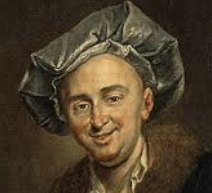
Julien Offray de La Mettrie — The Machine, the Body, and the Scandal of Materialism (1709–1751)
Julien Offray de La Mettrie was a French physician and philosopher whose radical materialism — the doctrine that the mind is nothing more than the brain in operation — scandalized the eighteenth century and earned him exile from France and then from Holland before Frederick the Great gave him sanctuary in Prussia.
A practicing doctor whose philosophical convictions grew directly from his medical observations, he drew conclusions about human nature that his contemporaries found either liberating or appalling — and rarely anything in between.
His central concern: that the human being is a machine — not as a degradation of human dignity but as an honest description of what the evidence shows — and that accepting this honestly is the beginning of a genuinely naturalistic ethics.
L'Homme Machine — Man a Machine
Published in 1748 and immediately burned by the authorities of Leiden, "L'Homme Machine" is one of the most consequential and most provocative works of the Enlightenment.
La Mettrie's argument was grounded in medicine, not metaphysics. He had observed that illness, fever, drugs, and food directly alter thought, mood, and personality — that the mind varies with the state of the body in ways that only a material connection could explain. Descartes had posited a sharp divide between mind and body; La Mettrie watched his patients and concluded that no such divide existed.
The soul, he argued, is not a separate immaterial substance supervening on the body — it is the body's organization in motion. Thought is what the brain does, as digestion is what the stomach does. The difference between a human being and an animal is one of degree and complexity, not of kind. The difference between an animal and a machine is similarly a matter of degree.
Man is a machine — a self-winding, self-repairing, extraordinarily complex machine, but a machine nonetheless.
"The human body is a machine which winds its own springs. It is the living image of perpetual motion."
Medicine as the Foundation of Philosophy
La Mettrie was unusual among Enlightenment philosophers in that his materialism was not primarily a metaphysical position arrived at through armchair reasoning but a clinical conclusion drawn from years of medical practice.
He had studied under the great Dutch physician Boerhaave and brought to philosophy the physician's habit of taking the body seriously as evidence — of treating what happens to consciousness when the brain is damaged, intoxicated, feverish, or starved as data that any honest account of the mind must accommodate.
His own experience of delirium during a severe fever was a turning point — watching his own thoughts dissolve and reconstitute as his body sickened and recovered, he found it impossible to maintain any theory of the mind as independent of its physical substrate.
Philosophy, for La Mettrie, had to answer to medicine — and medicine said the mind was the body's function.
"Let us not lose ourselves in the infinite — we are not made to have the least idea thereof. It is positively impossible for us to go back to the origin of things. It matters little to our peace whether matter is eternal or created."
Pleasure, Ethics, and the Natural Life
La Mettrie drew from his materialism an ethics of pleasure that shocked his contemporaries almost as much as his metaphysics.
If the human being is a natural organism, then the natural pleasures of the body — food, sex, sensation, rest, conviviality — are not temptations to be overcome but goods to be cultivated with intelligence and moderation. The ascetic contempt for the body that Christianity had enforced for centuries was, on his account, a form of violence against human nature.
Remorse, he argued with characteristic provocation, is a useless torment — a residue of superstition that serves no purpose once the act is past. What matters is learning, adjusting, and living better — not flagellating oneself in the service of a theological fiction.
He was not an advocate of license — the machine runs best when well maintained — but he refused to treat natural appetite as something shameful, and that refusal alone was enough to guarantee his condemnation by almost every authority of his day.
"Pleasure and pain are the only springs of the moral world — all the rest is convention."
The Exile and Frederick's Court
La Mettrie's publications made him persona non grata in every country that valued religious orthodoxy — which in 1748 meant virtually every country in Europe. His books were burned in France and Holland; his medical colleagues distanced themselves; clerics denounced him from pulpits.
Frederick the Great of Prussia, himself a philosophe with little patience for theological censorship, invited him to Berlin and made him a court physician and reader. La Mettrie spent the last years of his life at one of the few courts in Europe where his ideas could be discussed without fear.
He died in 1751, aged forty-one — according to contemporary accounts, from overindulgence at a feast held in his honor, which his enemies treated as providential judgment and which biographers have since found largely apocryphal. The story was too convenient for those who wished to see his hedonism refuted by the body he celebrated.
Frederick delivered his eulogy himself — a remarkable tribute to a man most of Europe was delighted to see gone.
"I die as I have lived — without remorse."
— attributed to La Mettrie on his deathbed
Legacy — The Materialist Who Arrived Too Early
La Mettrie was denounced by virtually everyone in his lifetime — including Voltaire and the philosophes who shared many of his anti-clerical commitments but found his materialism an embarrassment that would give ammunition to the enemies of Enlightenment. Even Diderot kept his distance.
Yet the position he staked out in 1748 — that the mind is the brain's activity, that human beings are continuous with animals, that ethics must be grounded in natural facts about pleasure and pain — is essentially the position that neuroscience, evolutionary biology, and much of philosophy has converged on over the subsequent two and a half centuries.
He was not a subtle thinker by the standards of his successors. But he was an honest one — willing to follow his observations to their conclusions regardless of who was offended, at a time when such honesty carried genuine personal cost.
In the company of Clifford, Mozi, and Kazantzakis on CivSim, he stands as another figure who paid the price of saying clearly what others preferred to leave unsaid — and whose vindication arrived long after he was in any position to enjoy it.
"If the soul is immaterial, why does wine make us lose our reason? Why does a fever produce delirium? Why do opium and other drugs produce sleep? These facts alone would be enough to establish materialism."
CivilSimian.com created by AxiomaticPanic, CivilSimian, Kalokagathia