
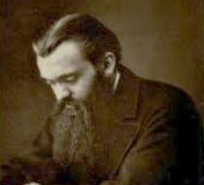
William Kingdon Clifford — Mathematics, Ethics of Belief, and the Courage of Doubt (1845–1879)
William Kingdon Clifford was a British mathematician and philosopher whose short life — he died of tuberculosis at thirty-three — produced work of remarkable originality in geometry, physics, and the philosophy of mind and belief.
A dazzling lecturer and fearless freethinker, he challenged religious orthodoxy with the same precision he brought to pure mathematics — insisting that intellectual honesty was not merely a personal virtue but a social obligation.
His central concern: that believing something without sufficient evidence is not merely an error but a moral wrong — a betrayal of the shared epistemic trust on which civilized life depends.
The Ethics of Belief
Clifford's most famous and enduring contribution was his 1877 essay "The Ethics of Belief" — one of the most provocative pieces of philosophical writing produced in the Victorian era.
He opened with a parable: a shipowner who convinces himself, without adequate investigation, that his vessel is seaworthy, sends it to sea, and watches it sink with all hands. The man's sincere belief in the ship's soundness, Clifford argued, does not diminish his guilt — it deepens it, because he had no right to that belief.
From this he drew his central maxim: it is wrong, always, everywhere, and for anyone, to believe anything upon insufficient evidence. Not merely unwise or unfortunate — morally wrong.
Belief, for Clifford, is never purely private. Every credulously held conviction contributes to a social atmosphere of credulity that makes whole communities vulnerable to manipulation, superstition, and self-deception.
"It is wrong always, everywhere, and for anyone, to believe anything upon insufficient evidence."
Against Religion and the Tribal Self
Clifford was a committed opponent of religious belief as it was commonly practiced — not on grounds of personal distaste but on his ethical theory of belief.
He argued that religious faith, in demanding assent beyond what evidence warrants, habituates the mind to a lowered epistemic standard that corrupts reasoning in every domain it touches. A person trained to believe without evidence in theology will find it easier to believe without evidence elsewhere.
He also attacked what he called the "tribal self" — the tendency of human beings to subordinate individual judgment to group loyalty, accepting the beliefs of their community not because those beliefs are warranted but because belonging requires it.
Intellectual courage, for Clifford, meant being willing to follow the evidence even when it separated you from your tribe.
"No simplicity of mind, no obscurity of station, can escape the universal duty of questioning all that we believe."
Contributions to Mathematics and Geometry
Clifford's philosophical boldness was matched by his mathematical creativity. He made significant contributions to non-Euclidean geometry, extending Riemann's work on curved spaces and developing what are now called Clifford algebras — algebraic structures that later proved fundamental to the mathematics of quantum mechanics and relativity.
As early as 1870 he speculated in a remarkable paper that the curvature of space might not be merely mathematical abstraction but a physical reality — that matter itself might be a manifestation of curved space. Einstein's general relativity, published thirty-five years later, vindicated the intuition with breathtaking precision.
Clifford did not live to see it. He died fourteen years before the theory was born.
The algebras bearing his name remain in active use across theoretical physics and computer graphics to this day.
"I hold that in the physical world nothing else takes place but this, variations in the curvature of space."
Mind, Matter, and Panpsychism
Clifford was one of the first modern thinkers to develop a serious panpsychist philosophy of mind — the view that consciousness is not confined to complex organisms but is a fundamental feature of reality, present in some form wherever matter exists.
He coined the term "mind-stuff" to describe the elementary mental constituents from which conscious experience is composed — arguing that just as matter is built up from atoms, mind is built up from simpler elements that pervade the physical world.
The position was heterodox in his time and remains controversial today. But panpsychism has experienced a serious philosophical revival in recent decades, with Clifford recognized as one of its most rigorous early proponents.
His willingness to follow arguments wherever they led, regardless of orthodoxy, was characteristic of everything he did.
"The universe consists of mind-stuff — and that which we call matter is simply a convenient grouping of events in mind."
Legacy — A Life Cut Short, An Argument That Endures
Clifford died in Madeira in 1879, having burned through his health with the same intensity he brought to everything else — lecturing, writing, debating, and living at a pace that tuberculosis made fatal.
William James wrote a direct philosophical response to "The Ethics of Belief" in his essay "The Will to Believe" — arguing that in certain domains, particularly religious and personal commitment, the right to believe beyond strict evidence was not only defensible but necessary. The debate between their positions has never been conclusively settled and remains one of epistemology's central fault lines.
Clifford's demand for evidentiary standards resonates with particular force in an era of misinformation, motivated reasoning, and tribal epistemology — a world that has proved his diagnosis of credulity's social costs more comprehensively than he could have imagined.
He remains one of the most bracing voices in the history of intellectual ethics — a man who treated honesty not as a preference but as the foundation of everything else worth building.
"If a man, holding a belief which he was taught in childhood or persuaded of afterwards, keeps down and pushes away any doubts which arise about it in his mind, the life of that man is one long sin against mankind."
CivilSimian.com created by AxiomaticPanic, CivilSimian, Kalokagathia