
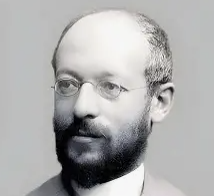
Georg Simmel — The Philosopher of Modern Life (1858–1918)
Georg Simmel was a German sociologist and philosopher known for his penetrating analysis of modernity, social interaction, and urban life.
Working at the intersection of philosophy and sociology, he developed a distinctive approach focused on the forms beneath everyday social experience.
His central concern: how the individual preserves meaning and selfhood within the overwhelming forces of modern society.
The Sociology of Forms
Simmel's most original contribution was his concept of "formal sociology" — the study of recurring patterns beneath the surface of social life.
He argued that the same social forms — competition, conflict, exchange, hierarchy — appear across vastly different contexts, from armies to families to markets.
By isolating these forms, Simmel believed sociology could reveal the deep grammar of human association.
Content changes; forms endure.
"Society exists where a number of individuals enter into interaction."
Money and Modernity
In his landmark work "The Philosophy of Money," Simmel traced the deep consequences of a money-based economy on human life.
Money, he argued, abstracts all value into a single measure — dissolving qualitative difference into quantitative equivalence.
This transformation frees the individual from direct personal dependencies, yet simultaneously empties personal relations of their depth.
Modernity gives freedom, but exacts a spiritual cost.
"Money is the most frightful leveler — it hollows out the core of things."
The Metropolis and Mental Life
Simmel's essay on the modern city remains among the most influential pieces of social philosophy ever written.
He described how urban existence bombards the individual with a relentless stream of stimulation — producing a protective mental attitude he called the blasé outlook.
The city dweller learns indifference as a survival strategy, dulling perception to avoid being overwhelmed.
Beneath this coolness, Simmel saw, lies not emptiness but a necessary defense of inner freedom.
"The metropolis exacts from man a different amount of consciousness than rural life."
The Stranger and Social Distance
Simmel's concept of the Stranger — one who is near and far simultaneously — became one of sociology's most enduring ideas.
The Stranger participates in a group without fully belonging to it, bringing an objectivity that insiders cannot possess.
This figure illuminates how social distance is not merely absence but a specific form of relation.
Strangeness, Simmel showed, is a structural position — not merely a personal feeling.
"The stranger is close to us insofar as we feel the commonness of human nature."
Legacy — A Fragmentary Brilliance
Simmel was famously described as a philosopher who left no school — only disciples in disguise.
His influence runs through urban sociology, cultural theory, phenomenology, and critical theory alike.
He wrote not in systems but in insights — flashing illuminations of the hidden architecture of social life.
He remains essential reading for anyone trying to understand what it means to be an individual in a modern world.
"Each period of life has its own wealth and its own tension; it need not be compared with any other."
CivilSimian.com created by AxiomaticPanic, CivilSimian, Kalokagathia