
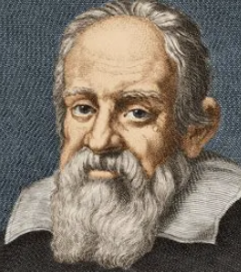
Galileo Galilei — The Rebel Who Taught the Universe to Speak Mathematics (1564–1642)
Galileo Galilei was one of the central architects of the scientific revolution. His work transformed astronomy, physics, and the way humanity investigates nature.
Where earlier scholars relied heavily on authority and tradition, Galileo insisted that nature must be understood through observation, experiment, and mathematical reasoning.
The result was a profound shift in human thought: the universe became something that could be measured, tested, and understood through science.
The Telescope and the New Sky
In 1609, Galileo heard about a new optical device invented in the Netherlands — the telescope.
He quickly built his own improved version and turned it toward the night sky.
What he saw shattered the traditional picture of the cosmos.
The Moon was not a perfect heavenly sphere, but a rugged landscape with mountains and craters.
Jupiter possessed four moons orbiting it, proving that not everything revolved around Earth.
Venus showed phases like the Moon, confirming that it orbited the Sun.
“The Moon is not smooth or perfectly spherical, but uneven, rough, and full of cavities.”
The Copernican Revolution
These discoveries supported a controversial idea proposed earlier by Nicolaus Copernicus: that Earth moves around the Sun.
At the time, the dominant view placed Earth at the center of the universe.
Galileo’s observations provided powerful evidence that this ancient model was wrong.
The universe was far more dynamic and complex than previously imagined.
“The book of nature is written in the language of mathematics.”
Physics and the Science of Motion
Galileo also transformed the study of motion.
Through experiments with falling objects and inclined planes, he demonstrated that objects accelerate uniformly under gravity.
He showed that heavy and light objects fall at the same rate when air resistance is ignored, contradicting centuries of Aristotelian physics.
These discoveries laid the groundwork for the later work of Isaac Newton.
“Measure what is measurable, and make measurable what is not so.”
Conflict with the Church
Galileo’s support for the heliocentric model eventually brought him into conflict with the Catholic Church.
In 1633, he was tried by the Roman Inquisition and forced to publicly recant his support for the idea that Earth moves around the Sun.
He spent the remainder of his life under house arrest.
Despite this condemnation, his scientific ideas continued to spread across Europe.
“And yet it moves.”
Legacy — The Birth of Modern Science
Galileo’s true revolution was methodological.
He demonstrated that knowledge about nature must come from careful observation, controlled experimentation, and mathematical description.
This approach became the foundation of modern science.
Astronomy, physics, engineering, and countless other fields still operate within the framework he helped establish.
Galileo did not merely discover new facts about the universe — he changed how humanity learns about the universe.
“All truths are easy to understand once they are discovered; the point is to discover them.”
CivilSimian.com created by AxiomaticPanic, CivilSimian, Kalokagathia