
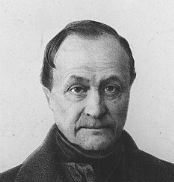
Auguste Comte — The Architect of Positivism and the Dream of a Scientific Society (1798–1857)
Auguste Comte believed humanity was passing through a decisive transformation. The age of theology and metaphysics, he argued, was giving way to a new era grounded in science, empirical observation, and social order. More than a philosopher, Comte was a system-builder with audacious ambition: to reorganize knowledge, morality, and politics under the guidance of reason. In doing so, he founded sociology and sketched one of the strangest hybrids in intellectual history — a religion without God.
A Revolutionary Childhood, A Disciplined Mind
Born in Montpellier in the aftermath of the French Revolution, Comte grew up amid political upheaval and ideological exhaustion. France had dismantled monarchy, church authority, and tradition — but what should replace them? For Comte, the chaos of post-revolutionary society demanded intellectual order.
Brilliant and volatile, he entered the École Polytechnique, where he absorbed mathematics, physics, and the spirit of Enlightenment rationalism. His temperament, however, was unstable. He quarreled with teachers, suffered mental breakdowns, and lived a life marked by personal turmoil and obsessive intensity. These tensions would echo through his philosophy.
“Order and progress.”
The Law of Three Stages
Comte’s most famous idea is the Law of Three Stages, a sweeping theory of intellectual history. Human thought, he claimed, progresses through three phases: the theological stage, where phenomena are explained by gods and spirits; the metaphysical stage, where abstract forces replace deities; and finally the positive stage, where explanations are grounded in observable facts and scientific laws.
This was not merely a description of history but a diagnosis of the present. Comte believed Europe was trapped in a dangerous transition — old beliefs had lost authority, but scientific thinking had not yet reorganized society. The result was moral disintegration and political instability.
“Each department of our knowledge passes successively through three different theoretical conditions.”
Positivism — Knowledge Without Metaphysics
Comte called his philosophy positivism. Knowledge, he insisted, must concern itself only with what can be observed, measured, and systematically related. Questions about ultimate causes, divine purposes, or hidden essences were not false so much as meaningless.
Science, in Comte’s view, does not explain why the universe exists — it explains how it behaves. This restraint was meant to discipline the mind and free society from endless metaphysical disputes. Positivism promised certainty, coordination, and predictability.
“To know in order to predict, to predict in order to control.”
Inventing Sociology — The Science of Society
Comte coined the term sociology, envisioning it as the crowning science — the study of social laws governing human behavior. Just as physics uncovers laws of matter, sociology would uncover laws of social order and change.
He believed social harmony required hierarchy, consensus, and the guidance of scientific elites. Democracy, unchecked individualism, and ideological conflict struck him as symptoms of intellectual immaturity. Stability mattered more than freedom.
“The most important science for humanity is the science of humanity itself.”
The Religion of Humanity
In one of philosophy’s strangest turns, Comte concluded that science alone could not satisfy human emotional needs. People required ritual, symbols, and shared devotion. His solution was the Religion of Humanity.
This secular religion replaced God with Humanity itself, complete with saints (scientists and benefactors), a calendar of festivals, and a priesthood of sociologists. Critics found it absurd. Admirers saw it as a sincere attempt to preserve social cohesion in a disenchanted world.
“Love as principle, order as basis, progress as end.”
Legacy — The Promise and Peril of Scientific Faith
Comte’s influence is vast and controversial. He helped shape sociology, inspired technocratic governance, and influenced thinkers from John Stuart Mill to Émile Durkheim. At the same time, his authoritarian tendencies and quasi-religious excesses remain cautionary.
Comte represents a recurring modern temptation: the belief that science can replace philosophy, morality, and tradition entirely. His work stands as both a foundation and a warning — a reminder that knowledge alone does not tell us how to live together.
“Ideas govern and overthrow the world.”
CivilSimian.com created by AxiomaticPanic, CivilSimian, Kalokagathia