
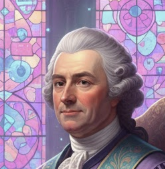
George Berkeley — The Philosopher Who Dared to Deny Matter (1685–1753)
George Berkeley was the most audacious metaphysician of the early modern era — a thinker who calmly argued that the physical world, as commonly understood, does not exist independently of perception. His philosophy of immaterialism shocked his contemporaries, baffled critics, and forced philosophy to confront a disturbing possibility: that reality itself may be inseparable from mind.
A Clergyman with a Radical Idea
Born in County Kilkenny, Ireland, Berkeley was educated at Trinity College, Dublin, where he absorbed classical philosophy, mathematics, and the emerging science of his age. He lived in the shadow of thinkers like Descartes, Locke, and Newton — giants who believed they were uncovering the true structure of a material universe.
Berkeley admired science but distrusted its metaphysical assumptions. As an Anglican clergyman, he believed philosophy should defend common sense and religious belief, not undermine them. Ironically, his solution would be one of the most counterintuitive philosophies ever proposed.
“Few men think, yet all will have opinions.”
Immaterialism — To Be Is to Be Perceived
Berkeley’s most famous claim is deceptively simple: esse est percipi — “to be is to be perceived.” He argued that what we call physical objects are nothing more than bundles of perceptions: colors, sounds, textures, tastes, and shapes as experienced by a mind.
Strip away perception, and nothing intelligible remains. Matter as an unseen, mind-independent substance, Berkeley claimed, is a meaningless abstraction invented by philosophers. We never perceive matter itself — only ideas.
“The table I write on, I say, exists; that is, I see and feel it.”
Against Abstract Ideas
Berkeley’s assault began with a critique of abstraction. Philosophers like Locke believed the mind could form abstract ideas — such as a triangle that is neither scalene, equilateral, nor isosceles. Berkeley rejected this entirely.
All ideas, he insisted, are particular. Abstractions are linguistic conveniences, not mental realities. This critique cut deeply into metaphysics, mathematics, and scientific explanation, exposing how easily words masquerade as things.
“It is indeed an opinion strangely prevailing among men, that houses, mountains, rivers, and in a word all sensible objects have an existence natural or real distinct from their being perceived.”
God as the Ground of Stability
Berkeley was no skeptic about reality — quite the opposite. He believed his philosophy rescued common sense from doubt. Objects persist when no human perceives them because they are continuously perceived by God.
God, in Berkeley’s system, is the infinite mind that orders and sustains the flow of ideas. Natural laws are not mechanical forces acting on matter, but consistent patterns in God’s presentation of experience. The world is stable not because matter endures, but because divine perception never lapses.
“The ideas of sense are more strong, lively, and distinct than those of the imagination.”
Science, Skepticism, and Common Sense
Berkeley did not reject science; he rejected metaphysical excess. He argued that science should concern itself with predicting experience, not speculating about unobservable substances. In this way, he anticipated later instrumentalist views of scientific theory.
He also believed materialism led directly to skepticism and atheism. By removing matter from the picture, Berkeley thought he had eliminated the gap between mind and world that plagued modern philosophy. Reality, for him, was immediately present — vivid, meaningful, and divinely sustained.
“All things in the world are gifts of God.”
Legacy — The Philosopher No One Could Ignore
Berkeley was widely mocked — famously caricatured by Samuel Johnson, who kicked a stone and declared, “I refute it thus.” Yet no one seriously denied the force of his arguments. Even those who rejected immaterialism were forced to respond to it.
His influence runs through Hume’s skepticism, Kant’s critical philosophy, and modern debates about perception, consciousness, and the nature of reality. Berkeley remains philosophy’s great provocateur — the man who asked whether the solid world we trust so completely might, in the end, be made entirely of mind.
“We have first raised a dust and then complain we cannot see.”
CivilSimian.com created by AxiomaticPanic, CivilSimian, Kalokagathia