
1 day ago
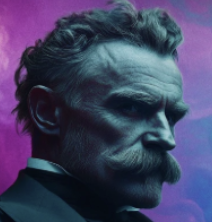
Nietzsche was not a poseur, nor was he represented as a hero during his lifetime. Since his death, many who claim to be his disciples have pictured him as an archetypal hero. Defiant carriage of the head; a lofty brow furrowed with sombre thoughts; thick, wavy hair, clustering down to the strong column of the neck; two falcon eyes beneath bushy eyebrows; every feature of this masterful countenance taut with willpower, health and strength—such is the portrait usually given of him. Like a second Vercingetorix, he is shown with a heavy moustache falling manfully over the hard-set lips which surmount a prominent chin, and involuntarily the image called up is that of the barbarian warrior, a Viking of the Teutonic north striding forward sword in hand to victory, his hunting horn slung over his shoulder and a spear within easy reach. It is thus that our sculptors and painters delight in portraying him, a Germanic superman, a Prometheus bound, hoping thereby to render this great recluse more accessible to men of little faith who, corrupted by school books and stage presentations, are incapable of detecting tragedy unless it is draped in theatrical trappings. But genuine tragedy is never theatrical, and the true portrait of Nietzsche is far less picturesque than busts and paintings of him would have us believe.
▼
Source
source
Stefan Zweig, The Struggle with the Daemon: Holderlin, Kleist, and Nietzsche (1925), translated by Eden and Cedar Paul
CivilSimian.com created by AxiomaticPanic, CivilSimian, Kalokagathia