

2 months 2 weeks ago
Gaiety - a quality of ordinary men. Genius always presupposes some disorder in the machine.
▼
Source
source
"Diseases"
2 months 2 weeks ago
One can only become a philosopher, but not be one. As one believes he is a philosopher, he stops being one.
▼
Source
source
"Selected Aphorisms from the Athenaeum (1798)", Dialogue on Poetry and Literary Aphorisms, Ernst Behler and Roman Struc, trans. (Pennsylvania University Press:1968) #54

1 month 3 weeks ago
Militarism, the destroyer of youth, the raper of women, the annihilator of the best in the race, the very mower of life.
1 week ago
A modern philosopher who has never once suspected himself of being a charlatan must be such a shallow mind that his work is probably not worth reading.
▼
Source
source
Metaphysical Horror
2 months 5 days ago
The real struggle is not between East and West, or capitalism and communism, but between education and propaganda.
▼
Source
source
As quoted in Encounter with Martin Buber (1972) by Aubrey Hodes, p. 135

2 months 1 day ago
To fall into a habit is to begin to cease to be.

3 months 2 weeks ago
Truth that has been merely learned is like an artificial limb, a false tooth, a waxen nose; at best, like a nose made out of another's flesh; it adheres to us only because it is put on. But truth acquired by thinking of our own is like a natural limb; it alone really belongs to us. This is the fundamental difference between the thinker and the mere man of learning. The intellectual attainments of a man who thinks for himself resemble a fine painting, where the light and shade are correct, the tone sustained, the colour perfectly harmonised; it is true to life. On the other hand, the intellectual attainments of the mere man of learning are like a large palette, full of all sorts of colours, which at most are systematically arranged, but devoid of harmony, connection and meaning.
▼
Source
source
Vol. 2, Ch. 22, § 261

4 months 2 weeks ago
A friend is one soul abiding in two bodies. p. 188; also reported in various sources as:Friendship is a single soul dwelling in two bodies. A true friend is one soul in two bodies. Love is composed of a single soul inhabiting two bodies. What is a friend? A single soul dwelling in two bodies.
3 months 2 weeks ago
History, is a conscious, self-mediating process - Spirit emptied out into Time; but this externalization, this kenosis, is equally an externalization of itself; the negative is the negative of itself. ... Thus absorbed in itself, it is sunk in the night of its self-consciousness; but in that night its vanished outer existence is perserved, and this transformed existence - the former one, but now reborn of the Spirit's knowledge - is the new existence, a new world and a new shape of Spirit.

4 months 4 days ago
Men are at variance with the one thing with which they are in the most unbroken communion, the reason that administers the whole universe.
3 months 1 week ago
Agriculture is now a motorized food industry, the same thing in its essence as the production of corpses in the gas chambers and the extermination camps, the same thing as blockades and the reduction of countries to famine, the same thing as the manufacture of hydrogen bombs.
▼
Source
source
Four Lectures on Technology

2 months 2 weeks ago
In democratic ages men rarely sacrifice themselves for another, but they show a general compassion for all the human race. One never sees them inflict pointless suffering, and they are glad to relieve the sorrows of others when they can do so without much trouble to themselves. They are not disinterested, but they are gentle.
▼
Source
source
Book Three, Chapter I.

1 month 3 weeks ago
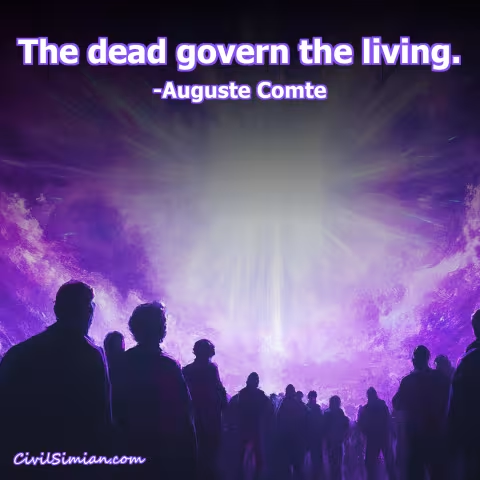
To-day is the parent of to-morrow. The present casts its shadow far into the future. That is the law of life, individual and social. Revolution that divests itself of ethical values thereby lays the foundation of injustice, deceit, and oppression for the future society. The means used to prepare the future become its cornerstone.

1 month 1 week ago
I suppose it is written that any one who sets up for a bit of a philosopher, must contradict himself to his very face. For here have I fairly talked myself into thinking that we have the whole thing before us at last; that there is no answer to the mystery, except that there are as many as you please; that there is no centre to the maze because, like the famous sphere, its centre is everywhere; and that agreeing to differ with every ceremony of politeness, is the only "one undisturbed song of pure concent" to which we are ever likely to lend our musical voices.
▼
Source
source
Crabbed Age and Youth.
3 months 1 week ago
Every questioning is a seeking. Every seeking takes its direction beforehand from what is sought. Questioning is a knowing search for beings in their thatness and whatness.
▼
Source
source
Introduction: The Exposition of the Question of the Meaning of Being (Stambaugh translation)
3 months 1 week ago
In everything well known something worthy of thought still lurks.
▼
Source
source
p. xxxix
1 month 2 weeks ago
Distinctive signs, full signs, never seduce us.
▼
Source
source
(p. 59)

3 months 2 weeks ago
A man cannot become a child again, or he becomes childish.
▼
Source
source
Introduction, p. 31.

3 months 2 weeks ago
Every man is a divinity in disguise, a god playing the fool. It seems as if heaven had sent its insane angels into our world as to an asylum. And here they will break out into their native music, and utter at intervals the words they have heard in heaven; then the mad fit returns, and they mope and wallow like dogs!
▼
Source
source
p. 165
3 months 2 weeks ago
...this our world, which is so real, with all its suns and milky ways is-nothing.

3 months 2 weeks ago
Man is a rational animal - so at least I have been told. Throughout a long life, I have looked diligently for evidence in favor of this statement, but so far I have not had the good fortune to come across it, though I have searched in many countries spread over three continents. Often paraphrased as "It has been said that man is a rational animal. All my life I have been searching for evidence which could support this."

1 month 2 weeks ago
If you want to be happy, be.
▼
Source
source
Attributed in Wisdom for the Soul : Five Millennia of Prescriptions for Spiritual Healing (2006) by Larry Chang, p. 352
1 month 1 week ago
A wise man rules his passions, a fool obeys them.
▼
Source
source
Maxim 49

4 months 4 days ago
The superior man, when resting in safety, does not forget that danger may come. When in a state of security he does not forget the possibility of ruin. When all is orderly, he does not forget that disorder may come. Thus his person is not endangered, and his States and all their clans are preserved.
Just now
The men of the future will yet fight their way to many a liberty that we do not even miss.
▼
Source
source
Cambridge 1995, p. 114

1 month 3 weeks ago
If people should ever start to do only what is necessary millions would die of hunger.
▼
Source
source
C 54 Variant translation: If all mankind were suddenly to practice honesty, many thousands of people would be sure to starve.
2 months 2 weeks ago
No protracted war can fail to endanger the freedom of a democratic country.
▼
Source
source
Book Three, Chapter XXII.

2 months 2 weeks ago
Deny them this participation of freedom, and you break that sole bond, which originally made, and must still preserve the unity of the empire.
2 months 1 day ago
Whenever a man talks he lies, and so far as he talks to himself - that is to say, so far as he thinks, knowing that he thinks - he lies to himself. The only truth in human life is that which is physiological. Speech - this thing that they call a social product - was made for lying.
▼
Source
source
Niebla [Mist]

2 months 1 week ago
The poor, by thinking unceasingly of money, reach the point of losing the spiritual advantages of non-possession, thereby sinking as low as the rich.

2 months 2 weeks ago
The Present Age, according to my view of it, stands in that Epoch which in my former lecture I named the THIRD, and which I characterized as the Epoch of Liberation-directly from the external ruling Authority, indirectly from the power of Reason as Instinct, and generally from Reason in any form; the Age of absolute indifference towards all truth, and of entire and unrestrained licentiousness:-the state of completed sinfulness.
▼
Source
source
p. 16
3 weeks 6 days ago
There is no such thing as gratitude in international politics.
▼
Source
source
Abridgement of Vols. 7-10 by D. C. Somervell
2 months 2 weeks ago
The best laws cannot make a constitution work in spite of morals; morals can turn the worst laws to advantage. That is a commonplace truth, but one to which my studies are always bringing me back. It is the central point in my conception. I see it at the end of all my reflections.
▼
Source
source
De la supériorité des mœurs sur les lois (1831) Oeuvres complètes, vol. VIII, p. 286.
1 month 2 weeks ago
When the real is no longer what it was, nostalgia assumes its full meaning. "The Precession of Simulacra,"
▼
Source
source
p. 6
2 months 1 week ago
Losing love is so rich a philosophical ordeal that it makes a hairdresser into a rival of Socrates.
1 week ago
Getting along with women, Knocking around with men, Having more credit than money, Thus one goes through the world.
▼
Source
source
Claudine von Villa Bella
2 months 1 week ago
For a writer, to change languages is to write a love letter with a dictionary.
3 months 2 weeks ago
Capitalist production does not exist at all without foreign commerce.
▼
Source
source
Vol. II, Ch. XX, p. 474 (See also...David Ricardo, The Principles of Political Economy and Taxation, Ch. VII, p. 81).

3 months 2 weeks ago
But what all the violence of the feudal institutions could never have effected, the silent and insensible operation of foreign commerce and manufactures gradually brought about.
▼
Source
source
Chapter IV, p. 448.

4 months 2 weeks ago
That which does not kill us makes us stronger.

4 months 1 week ago
You want to know whether I can make a long speech, such as you are in the habit of hearing; but that is not my way. Socrates speaking to Alcibiades
1 month 1 week ago
Success makes some crimes honorable.
▼
Source
source
Maxim 326

2 months 1 week ago
We should not pretend to understand the world only by the intellect; we apprehend it just as much by feeling. Therefore, the judgment of the intellect is, at best, only the half of truth, and must, if it be honest, also come to an understanding of its inadequacy. Variant translation: We should not pretend to understand the world only by the intellect. The judgement of the intellect is only part of the truth.
▼
Source
source
Conclusion, p. 628

3 months 1 week ago
The end of man (as a factual anthropological limit) is announced to thought from the vantage of the end of man (as a determined opening or the infinity of a telos). Man is that which is in relation to his end, in the fundamentally equivocal sense of the word. Since always.
▼
Source
source
"The Ends of Man," Margins of Philosophy, tr. w/ notes by Alan Bass. The University of Chicago Press. Chicago, 1982. (original French published in Paris, 1972, as Marges de la philosophie). p. 123
3 months 2 weeks ago
I am at heart more of a United-States-man than an Englishman.
▼
Source
source
Letter to Andrew Jackson (14 June 1830), quoted in Correspondence of Andrew Jackson, Volume 4, ed. David Maydole Matteson (1929), p. 146

1 month 1 week ago
The professional tends to classify and to specialize, to accept uncritically the ground rules of the environment. The ground rules provided by the mass response of his colleagues serves as a pervasive environment of which he is contentedly unaware.
▼
Source
source
(p. 93)
1 month 2 weeks ago
The most difficult subjects can be explained to the most slow-witted man if he has not formed any idea of them already; but the simplest thing cannot be made clear to the most intelligent man if he is firmly persuaded that he knows already, without a shadow of doubt, what is laid before him.
▼
Source
source
Chapter III, Christianity Misunderstood by Believers
CivilSimian.com created by AxiomaticPanic, CivilSimian, Kalokagathia