

1 month 3 weeks ago
There is a quality of life which lies always beyond the mere fact of life; and when we include the quality in the fact, there is still omitted the quality of the quality.
▼
Source
source
Religion in the Making (February 1926), Lecture II: "Religion and Dogma".
2 weeks 4 days ago
Hype is the awkward and desperate attempt to convince journalists that what you've made is worth the misery of having to review it.
▼
Source
source
"Hype"
2 months 4 weeks ago
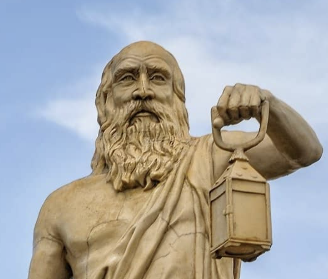
When asked why people give to beggars but not to philosophers, he replied, 'Because they expect they may become lame and blind, but never that they will become philosophers.'
▼
Source
source
Diogenes Laërtius, vi. 56, as reported in Diogenes the Cynic: Sayings and Anecdotes as translated by Robin Hard (Oxford: 2012), p. 18

1 month 3 weeks ago
the impressionable mind of the child realizes early enough that the lives of their parents are in contradiction to the ideas they represent; that, like the good Christian who fervently prays on Sunday, yet continues to break the Lord's commands the rest of the week, the radical parent arraigns God, priesthood, church, government, domestic authority, yet continues to adjust himself to the condition he abhors.
1 month 2 days ago
Everybody knows there is no fineness or accuracy of suppression; if you hold down one thing, you hold down the adjoining.
▼
Source
source
Ch. 1

4 months 1 week ago
One could construe the life of man as a great discourse in which the various people represent different parts of speech (the same might apply to states). How many people are just adjectives, interjections, conjunctions, adverbs? How few are substantives, active verbs, how many are copulas? Human relations are like the irregular verbs in a number of languages where nearly all verbs are irregular.
3 months ago
Animal Liberation is Human Liberation too.
▼
Source
source
Preface

3 months 1 week ago
Man is free at the instant he wants to be.
▼
Source
source
Source Brutus, act II, scene I, 1730

2 months 2 weeks ago
That some have never dreamed is as improbable as that some have never laughed.

3 months 1 week ago
A man cannot become a child again, or he becomes childish.
▼
Source
source
Introduction, p. 31.

3 months 4 days ago
From whence are these "rights of individuals" derived, and why should we care? Unless we presume the existence of some greater power that determines what is good, isn't it arbitrary to posit that human survival is more important than private property rights, an equally artificially construed concept? Isn't it arbitrary to assume that some sort of equality is preferable to a system where, say, the poor are assumed to have bad karma? If these 'rights of individuals' are derived only from shared humanity, then do 'individuals' (a thoroughly meaningless term, by the way), begin to lose them when they act inhumanely? And isn't it totally arbitrary to grant rights to humans rather than other creatures anyway?
▼
Source
source
Lecture in New Haven, On Constructed Rights

3 months 2 weeks ago
To an atheist all writings tend to atheism: he corrupts the most innocent matter with his own venom.
▼
Source
source
Ch. 12
1 day ago
The superior man has three things in which he delights, and to be ruler over the kingdom is not one of them. That his father and mother are both alive, and that the condition of his brothers affords no cause for anxiety;-this is one delight. That, when looking up, he has no occasion for shame before Heaven, and, below, he has no occasion to blush before men;-this is a second delight. That he can get from the whole kingdom the most talented individuals, and teach and nourish them;-this is the third delight.
▼
Source
source
7A:20, as translated by James Legge in The Chinese Classics, Vol. II (1861), p. 335
1 month 3 weeks ago
There is nothing in the real world which is merely an inert fact. Every reality is there for feeling: it promotes feeling; and it is felt.
▼
Source
source
Chapter IV, p. 310.

3 months 1 week ago
A nation never falls but by suicide.
▼
Source
source
1861

1 month 3 weeks ago
Yes, I know well that others before me have felt what I feel and express; that many others feel it today, although they keep silence about it. ...And I do not keep silence about it because it is for many the thing which must not be spoken, the abomination of abominations - infandum - and I believe that it is necessary now and again to speak the thing which must not be spoken. ...Even if it should lead only to irritating the devotees of progress, those who believe that truth is consolation, it would lead to not a little. To irritating them and making them say: "Poor fellow! if he would only use his intelligence to better purpose!... Someone perhaps will add that I do not know what I say, to which I shall reply that perhaps he may be right - and being right is such a little thing! - but that I feel what I say and I know what I feel and that suffices me. And that it is better to be lacking in reason than to have too much of it.
1 month 5 days ago
Evidence is the only good reason to believe anything.
▼
Source
source
Interview shown in AlJazeera ,
3 months 1 week ago
A commodity appears, at first sight, a very trivial thing, and easily understood.Its analysis shows that it is, in reality, a very queer thing, abounding in metaphysical subtleties and theological niceties.
▼
Source
source
Vol. I, Ch. 1, Section 4, pg. 81.

1 month 3 weeks ago
School children and students who love God should never say: "For my part I like mathematics"; "I like French"; "I like Greek." They should learn to like all these subjects, because all of them develop that faculty of attention which, directed toward God, is the very substance of prayer.
1 month 5 days ago
I am not advocating a morality based on evolution. I am saying how things have evolved. I am not saying how we humans morally ought to behave.
▼
Source
source
Ch. 1. Why Are People?
2 weeks 4 days ago
God may not play dice but he enjoys a good round of Trivial Pursuit every now and again.
▼
Source
source
"God"

1 month 1 week ago
"They must understand that we can only lose by taking the offensive. Patience and time are my warriors, my champions," thought Kutúzov. He knew that an apple should not be plucked while it is green. It will fall of itself when ripe, but if picked unripe the apple is spoiled, the tree is harmed, and your teeth are set on edge.
▼
Source
source
Bk XIII, Ch. 17

2 weeks 2 days ago
If you want to understand the beliefs that are shaping global politics, read the Book of Revelation.
▼
Source
source
Review: Sacred Causes by Michael Burleigh

3 months 1 week ago
Liberty, as we all know, cannot flourish in a country that is permanently on a war footing, or even a near war footing. Permanent crisis justifies permanent control of everybody and everything by the agencies of central government.
▼
Source
source
Chapter 1 (p. 14)

4 months 1 week ago
Of all the books I have ever worked on, I think Asimov's Guide to Shakespeare gave me the most pleasure, day in, day out. For months and months I lived and thought Shakespeare, and I don't see how there can be any greater pleasure in the world, any pleasure, that is, that one can indulge in for as much as ten hours without pause, day after day indefinitely.

3 months 1 week ago
The study a posteriori of the distribution of consciousness shows it to be exactly such as we might expect in an organ added for the sake of steering a nervous system grown too complex to regulate itself.
▼
Source
source
Ch. 5

2 months 1 day ago
If man has learned to see and know what really is, he will act in accordance with truth, Epistemology is in itself ethics, and ethics is epistemology.
▼
Source
source
p. 125
2 months 4 weeks ago
When the slave auctioneer asked in what he was proficient, he replied, "In ruling people."
▼
Source
source
Diogenes Laërtius, vi. 74

3 months 2 weeks ago
God the Almighty has made our rulers mad; they actually think they can do-and order their subjects to do-whatever they please. And the subjects make the mistake of believing that they, in turn, are bound to obey their rulers in everything.
▼
Source
source
p. 83

2 months 5 days ago
The deepest and most organic death is death in solitude, when even light becomes a principle of death. In such moments you will be severed from life, from love, smiles, friends and even from death. And you will ask yourself if there is anything besides the nothingness of the world and your own nothingness.
2 months 5 days ago
In the fact of being born there is such an absence of necessity that when you think about it a little more than usual, you are left-ignorant how to react-with a foolish grin

3 months 2 weeks ago
It is not the pleasure of curiosity, nor the quiet of resolution, nor the raising of the spirit, nor victory of wit, nor faculty of speech that are the true ends of knowledge, but it is a restitution and reinvesting, in great part, of man to the sovereignty and power, for whensoever he shall be able to call the creatures by their true names, he shall again command them.
▼
Source
source
Valerius Terminus: Of the Interpretation of Nature (ca. 1603), in Works, Vol. I, p. 83; The Works of Francis Bacon (1819), Vol. 2, p. 133

3 months 1 week ago
The value of money is in proportion to the quantity of the necessaries of life which it will purchase.
▼
Source
source
Chapter II, Part II, Article IV.

3 months 1 week ago
Of all the things that are beyond my power, I value nothing more highly than to be allowed the honor of entering into bonds of friendship with people who sincerely love truth. For, of things beyond our power, I believe there is nothing in the world which we can love with tranquility except such men.
▼
Source
source
Spinoza, Correspondence, 146, Letter xix
3 weeks 1 day ago
Economic reforms based on the idea of limitless growth in a limited world, can only be maintained by the powerful grabbing the resources of the vulnerable. The resource grab that is essential for "growth" creates a culture of rape-the rape of the earth, of local self-reliant economies, and of women.
▼
Source
source
On economic reforms in India and rape in India, from "Vandana Shiva: Our Violent Economy is Hurting Women " article in Yes Magazine
3 months 4 days ago
The authority of science ... promotes and encourages the activity of observing, comparing, measuring and ordering the physical characteristics of human bodies.... Cartesian epistemology and classical ideals produced forms of rationality, scientificity and objectivity that, though efficacious in the quest for truth and knowledge, prohibited the intelligibility and legitimacy of black equality.... In fact, to "think" such an idea was to be deemed irrational, barbaric or mad.
▼
Source
source
Prophesy Deliverance!

2 months 1 week ago
There is nothing enduring, permanent, either in me or out of me, nothing but everlasting change. I know of no existence, not even of my own. I know nothing and am nothing. Images - pictures - only are, pictures which wander by without anything existing past which they wander, without any corresponding reality which they might represent, without significance and without aim. I myself am one of these images, or rather a confused image of these images. All reality is transformed into a strange dream, without a world of which the dream might be, or a mind that might dream it. Contemplation is a dream; thought, the source of all existence and of all that I fancied reality, of my own existence, my own capacities, is a dream of that dream.
▼
Source
source
Jane Sinnett, trans 1846 p. 60

3 months 4 days ago
The interpretation of a case is corroborated only by the successful continuation of a self-formative process, that is by the completion of self-reflection, and not in any unmistakable way by what the patient says or how he behaves.
▼
Source
source
p. 266
1 month 3 weeks ago
May we not imagine that possibly this earthly life of ours is to the other life what sleeping is to waking? May not all our life be a dream and death an awakening? But an awakening to what? And supposing that everything is but the dream of God and that God one day will awaken? Will He remember His dream?

1 month 3 weeks ago
Why have women passion, intellect, moral activity - these three - and a place in society where no one of the three can be exercised? Men say that God punishes for complaining. No, but men are angry with misery. They are irritated with women for not being happy. They take it as a personal offence. To God alone may women complain without insulting Him!

3 months 1 week ago
Men of learning are those who have read the contents of books. Thinkers, geniuses, and those who have enlightened the world and furthered the race of men, are those who have made direct use of the book of the world.
▼
Source
source
"Thinking for Oneself"
3 months 1 week ago
I was seeing what Adam had seen on the morning of his creation - the miracle, moment by moment, of naked existence.
▼
Source
source
Pages 160-61
2 months 1 week ago
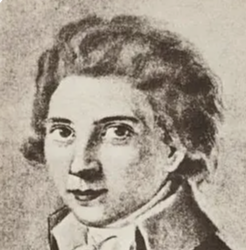
The mind understands something only insofar as it absorbs it like a seed into itself, nurtures it, and lets it grow into blossom and fruit. Therefore scatter holy seeds into the soil of the spirit.
▼
Source
source
"Ideas," Lucinde and the Fragments, P. Firchow, trans. (1991), § 5
3 months 2 weeks ago
The unassisted hand and the understanding left to itself possess but little power. Effects are produced by the means of instruments and helps, which the understanding requires no less than the hand; and as instruments either promote or regulate the motion of the hand, so those that are applied to the mind prompt or protect the understanding.
▼
Source
source
Aphorism 2
3 months 1 week ago
Defined in psychological terms, a fanatic is a man who consciously over-compensates a secret doubt.
▼
Source
source
"The Substitutes for Religion, The Religion of Sex"
3 months 1 week ago
The measure of action is the sentiment from which it proceeds. The greatest action may easily be one of the most private circumstance.
▼
Source
source
Goethe; or, The Writer
2 months 4 weeks ago
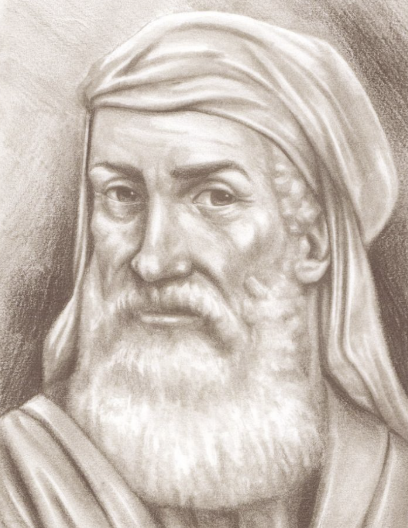
For already, sometime, I have been a boy and a girl, a shrub, a bird, and a silent fish in the sea.
▼
Source
source
fr. 117
3 months 2 weeks ago
There is no man so good, who, were he to submit all his thoughts and actions to the laws, would not deserve hanging ten times in his life.
▼
Source
source
Book III, Ch. 9. Of Vanity

4 months 1 week ago
No man of sense can put himself and his soul under the control of names... You must consider courageously and thoroughly and not accept anything carelessly.
3 months 1 week ago
In youth it is the outward aspect of things that most engages us; while in age, thought or reflection is the predominating quality of the mind. Hence, youth is the time for poetry, and age is more inclined to philosophy. In practical affairs it is the same: a man shapes his resolutions in youth more by the impression that the outward world makes upon him; whereas, when he is old, it is thought that determines his actions.
CivilSimian.com created by AxiomaticPanic, CivilSimian, Kalokagathia