

1 month 1 week ago
The imagination loves to trifle with what is not.
▼
Source
source
The Sea Fogs

1 month 4 weeks ago
Once the needs of hunger are satisfied - and they are soon satisfied - the vanity, the necessity - for it is a necessity - arises of imposing ourselves upon and surviving in others. Man habitually sacrifices his life to his purse, but he sacrifices his purse to his vanity. He boasts even of his weakness and his misfortunes, for want of anything better to boast of, and is like a child who, in order to attract attention, struts about with a bandaged finger.
2 months 1 week ago
Why is psychology the youngest of the empirical sciences? Why have we not long since discovered the unconscious and raised up its treasure-house of eternal images? Simply because we had a religious formula for everything psychic - and one that is far more beautiful and comprehensive than immediate experience. Though the Christian view of the world has paled for many people, the symbolic treasure-rooms of the East are still full of marvels that can nourish for a long time to come the passion for show and new clothes. What is more, these images - be they Christian or Buddhist or what you will - are lovely, mysterious, richly intuitive.
▼
Source
source
p. 7-8
3 months 2 days ago
Perhaps there is one chain [of inference] leading from the mental and the physical to a common source. It is conceivable in the abstract that if mental phenomena derive from the properties of matter at all, these may be identical at some level with nonphysical properties from which physical phenomena also derive. ...If there were such properties, they would be discoverable only by explanatory inference from both mental and physical phenomena. ... There would be properties of matter that were not physical from which the mental properties of organic systems were derived. This could still be called panpsychism.
▼
Source
source
"Panpsychism" (1979), pp. 184-185.

3 months 1 week ago
Many people think they are thinking when they are merely rearranging their prejudices.
▼
Source
source
To his young son from the Yosemite Valley on

3 months 6 days ago
When I was a student in the 1950s, I read Husserl, Sartre, Merleau-Ponty. When you feel an overwhelming influence, you try to open a window. Paradoxically enough, Heidegger is not very difficult for a Frenchman to understand. When every word is an enigma, you are in a not-too-bad position to understand Heidegger. Being and Time is difficult, but the more recent works are clearer. Nietzsche was a revelation to me. I felt that there was someone quite different from what I had been taught. I read him with a great passion and broke with my life, left my job in the asylum, left France: I had the feeling I had been trapped. Through Nietzsche, I had become a stranger to all that.
▼
Source
source
Truth, Power, Self : An Interview with Michel Foucault

2 months 4 days ago
Such abstraction which refuses to accept the given universe of facts as the final context of validation, such "transcending" analysis of the facts in the light of their arrested and denied possibilities, pertains to the very structure of social theory.
▼
Source
source
p. xliii

2 days ago
The weakest living creature, by concentrating his powers on a single object, can accomplish something. The strongest, by dispensing his over many, may fail to accomplish anything. The drop, by continually falling, bores its passage through the hardest rock. The hasty torrent rushes over it with hideous uproar, and leaves no trace behind.
▼
Source
source
The life of Friedrich Schiller: Comprehending an examination of his works (1825).

3 months 1 week ago
I like mathematics because it is not human and has nothing particular to do with this planet or with the whole accidental universe - because, like Spinoza's God, it won't love us in return.
▼
Source
source
Letter to Lady Ottoline Morrell, March, 1912, as quoted in Gaither's Dictionary of Scientific Quotations (2012), p. 1318

3 months 1 week ago
Beauty is the main positive form of the aesthetic assimilation of reality, in which aesthetic ideal finds it direct expression...
▼
Source
source
About Beauty

1 month 1 week ago
What should young people do with their lives today? Many things, obviously. But the most daring thing is to create stable communities in which the terrible disease of loneliness can be cured.
▼
Source
source
Commencement Address to Hobart and William Smith Colleges, May 26, 1974

1 month 1 week ago
Lives matter in the sense that they assume physical form within the sphere of appearance; lives matter because they are to be valued equally.
▼
Source
source
p. 12
3 weeks 6 days ago
I now propose briefly to... set forth, in a form intelligible to those who possess no special acquaintance with anatomical science, the chief facts upon which all conclusions respecting the nature and the extent of the bonds which connect man with the brute world must be based: I shall then indicate the one immediate conclusion which, in my judgment, is justified by those facts, and I shall finally discuss the bearing of that conclusion upon the hypotheses which have been entertained respecting the Origin of Man.
▼
Source
source
Ch.2, p. 74
1 month 4 weeks ago
I am the center of my universe, the center of the universe, and in my supreme anguish I cry with Michelet, "Mon moi, ils m'arrachent mon moi!" What is a man profited if he shall gain the world and lose his own soul? (Matt. xvi. 26).

2 weeks 6 days ago
[O]ne might naively suppose that a negative utilitarian would welcome human extinction. But only (trans)humans - or our potential superintelligent successors - are technically capable of phasing out the cruelties of the rest of the living world on Earth. And only (trans)humans - or rather our potential superintelligent successors - are technically capable of assuming stewardship of our entire Hubble volume.
▼
Source
source
"Unsorted Postings", Facebook, pre-2014

3 months 1 week ago
I did not know that mankind were suffering for want of gold. I have seen a little of it. I know that it is very malleable, but not so malleable as wit. A grain of gold will gild a great surface, but not so much as a grain of wisdom.
▼
Source
source
p. 488
3 months 1 week ago
I don't like the spirit of socialism - I think freedom is the basis of everything.
▼
Source
source
Letter to Constance Malleson (Colette), September 29, 1916

3 months 1 week ago
Those only are happy (I thought) who have their minds fixed on some object other than their own happiness; on the happiness of others, on the improvement of mankind, even on some art or pursuit, followed not as a means, but as itself an ideal end. Aiming thus at something else, they find happiness by the way.
▼
Source
source
(p. 142)

2 months 1 week ago
A people represents not so much an aggregate of ideas and theories as of obsessions.

2 months 2 weeks ago
Impenetrable in their dissimulation, cruel in their vengeance, tenacious in their purposes, unscrupulous as to their methods, animated by profound and hidden hatred for the tyranny of man - it is as though there exists among them an ever-present conspiracy toward domination, a sort of alliance like that subsisting among the priests of every country.
▼
Source
source
"On Women" (1772), as translated in Selected Writings (1966) edited by Lester G. Crocker

1 month 3 weeks ago
The Kropotkins, the Perovskayas, the Breshkovskayas, and hosts of others repudiated wealth and station and refused to serve King Mammon. They went among the people, not to lift them up but themselves to be lifted up, to be instructed, and in return to give themselves wholly to the people. That accounts for the heroism, the art, the literature of Russia, the unity between the people, the mujik and the intellectual. That to some extent explains the literature of all European countries, the fact that the Strindbergs, the Hauptmanns, the Wedekinds, the Brieux, the Mirbeaus, the Steinlins and Rodins have never dissociated themselves from the people.

3 months 3 weeks ago
These five rules [above] form all that is necessary to render proofs convincing, immutable, and to say all, geometrical; and the eight rules together render them even more perfect.

3 months 2 weeks ago
Alonso of Aragon was wont to say in commendation of age, that age appears to be best in four things - old wood best to burn, old wine to drink, old friends to trust, and old authors to read.
▼
Source
source
No. 97

3 months 1 week ago
How can I, who was not able to retain my own past, hope to save that of another?

3 months 1 day ago
It is difficult to speak of the universal specifically.
▼
Source
source
Line 128
2 months 3 days ago
The true antithesis of nature is not art but arbitrary conceit, fantasy, and stereotyped convention.
▼
Source
source
p. 158
2 months 2 weeks ago
The mathematical thermology created by Fourier may tempt us to hope that, as he has estimated the temperature of the space in which we move, me may in time ascertain the mean temperature of the heavenly bodies: but I regard this order of facts as for ever excluded from our recognition. We can never learn their internal constitution, nor, in regard to some of them, how heat is absorbed by their atmosphere. We may therefore define Astronomy as the science by which we discover the laws of the geometrical and mechanical phenomena presented by the heavenly bodies.
▼
Source
source
Book II: Astronomy, Ch. I: General View
2 weeks 6 days ago
Suppose we encounter an advanced civilization that has engineered a happy biosphere. Population sizes are controlled by cross-species immunocontraception. Free-living herbivores lead idyllic lives in their wildlife parks. Should we urge the reintroduction of starvation, asphyxiation, disemboweling and being eaten alive by predators? Is their regime of compassionate stewardship of the biosphere best abandoned in favour of "re-wilding"? I suspect the advanced civilization would regard human pleas to restore the old Darwinian regime of "Nature, red in tooth and claw" as callous if not borderline sociopathic.
▼
Source
source
Reply to "I am horrified at what goes on in philosophy departments, personally", Freethought Blogs, 10 Sept. 2015

3 months 1 week ago
Who is going to educate the human race in the principles and practice of conservation?
▼
Source
source
Chapter 12 (p. 112)

1 month 3 weeks ago
Feminism is the struggle to end sexist oppression. Therefore, it is necessarily a struggle to eradicate the ideology of domination that permeates Western culture on various levels, as well as a commitment to reorganizing society so that the self-development of people can take precedence over imperialism, economic expansion, and material desires.

3 months 2 weeks ago
II. The tax which each individual is bound to pay ought to be certain, and not arbitrary.
▼
Source
source
Chapter II, Part II, p. 892.
1 month 1 week ago
Nonviolence is an ideal that cannot always be fully honored in the practice. To the degree that those who practice nonviolent resistance put their body in the way of an external power, they make physical contact, presenting a force against force in the process. Nonviolence does not imply the absence of force or of aggression. It is, as it were, an ethical stylization of embodiment, replete with gestures and modes of non-action, ways of becoming an obstacle, of using the solidity of the body and its proprioceptive object field to block or derail a further exercise of violence.
▼
Source
source
p. 22

1 month 1 week ago
Cartoons drove the photo back to myth and dream screen.
3 months 1 week ago
A living dog is better than a dead lion. Shall a man go and hang himself because he belongs to the race of pygmies, and not be the biggest pygmy that he can? Let every one mind his own business, and endeavor to be what he was made. Why should we be in such desperate haste to succeed, and in such desperate enterprises? If a man does not keep pace with his companions, perhaps it is because he hears a different drummer. Let him step to the music which he hears, however measured or far away.
▼
Source
source
pp. 366-67
3 months 1 week ago
I don't think that there are any sinister persons deliberately trying to rob people of their freedom but I do think, first of all, that there are a number of impersonal forces which are pushing in the direction of less and less freedom. And I also thing there are a number of technological devices which anybody who wishes to use, can use, to accelerate this process of going away from freedom, of imposing control.

1 month 2 weeks ago
In default of any other proof, the thumb would convince me of the existence of a God.
▼
Source
source
Stanislas (1856)
3 months 1 week ago
It is amusing to hear the modern Christian telling you how mild and rationalistic Christianity really is and ignoring the fact that all its mildness and rationalism is due to the teaching of men who in their own day were persecuted by all orthodox Christians.
▼
Source
source
"Sources of Intolerance"

3 months 2 weeks ago
An evil may be real, tho' its cause has no relation to us: It may be real, without being peculiar: It may be real, without shewing itself to others: It may be real, without being constant: And it may be real, without falling under the general rules. Such evils as these will not fail to render us miserable, tho' they have little tendency to diminish pride: And perhaps the most real and the most solid evils of life will be found of this nature.
▼
Source
source
Part 1, Section 6

3 months 1 week ago
The devil...the prowde spirit...cannot endure to be mocked.
▼
Source
source
Thomas More, quoted at the beginning of The Screwtape Letters
2 days ago
Mahomet can work no miracles; he often answers impatiently: I can work no miracles. I? "I am a Public Preacher;" appointed to preach this doctrine to all creatures. Yet the world, as we can see, had really from of old been all one great miracle to him. Look over the world, says he; is it not wonderful, the work of Allah; wholly "a sign to you," if your eyes were open!

2 months 3 weeks ago
Let thy mind rule thy tongue!
3 months 1 week ago
His obedience is real since he really and truly fulfills his mission, since he runs real risks in order to carry out the beloved's orders. But, on the other hand, it is imaginary because he submits only to a creature of his mind.
▼
Source
source
p. 152

4 months 1 week ago
Not merely in the realm of commerce but in the world of ideas as well our age is organizing a regular clearance sale. Everything is to be had at such a bargain that it is questionable whether in the end there is anybody who will want to bid. Every speculative price-fixer who conscientiously directs attention to the significant march of modern philosophy, every Privatdocent, tutor, and student, every crofter and cottar goes further. Perhaps it would be untimely and ill-timed to ask them where they are going.

1 month 3 weeks ago
Much reading has brought upon us a learned barbarism.
▼
Source
source
F 144
3 months 1 week ago
We have just seen that, apart from money-capital, circulating capital is only another name for commodity-capital. But to the extent that labour power circulates in the market,it is not capital, no form of commodity-capital. It is not capital at all; the labourer is not a capitalist, although he brings a commodity to market, namely his own skin.
▼
Source
source
Vol. II, Ch. X, p. 211.
2 months 2 days ago
Subjective reason ... is inclined to abandon the fight with religion by setting up two different brackets, one for science and philosophy, and one for institutionalized mythology, thus recognizing both of them. For the philosophy of objective reason there is no such way out. Since it hold to the concept of objective truth, it must take a positive or a negative stand with regard to the content of established religion.
▼
Source
source
p. 12.
3 days ago
How highly should we honor the Macedonians, who for the greater part of their lives never cease from fighting with the barbarians for the sake of the security of Greece? For who is not aware that Greece would have constantly stood in the greater danger, had we not been fenced by the Macedonians and the honorable ambition of their kings?
▼
Source
source
Histories, IX, 35:2 (Loeb)
3 months 1 day ago
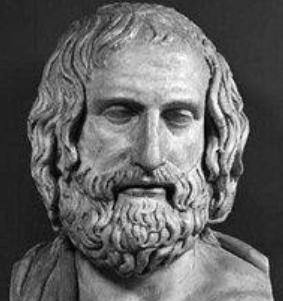
The Greeks follow a wrong usage in speaking of coming into being and passing away; for nothing comes into being or passes away, but there is mingling and separation of things that are. So they would be right to call coming into being mixture, and passing away separation.
▼
Source
source
Frag. B 17, quoted in John Burnet's Early Greek Philosophy, (1920), Chapter 6.

3 months 1 week ago
The little honesty that exists among authors is discernible in the unconscionable way they misquote from the writings of others.
2 days ago
Such parliamentary bagpipes I myself have heard play tunes, much to the satisfaction of the people.
CivilSimian.com created by AxiomaticPanic, CivilSimian, Kalokagathia