

1 month 1 week ago
Take our politicians: they're a bunch of yo-yos. The presidency is now a cross between a popularity contest and a high school debate, with an encyclopedia of cliches.
▼
Source
source
As quoted in The Portable Curmudgeon (1987) by Jon Winokur, p. 219

3 months 2 weeks ago
We are obviously heading for revolution-something I have never once doubted since 1850. The first act will include a by no means gratifying rehash of the stupidities of '48-'49. However, that's how world history runs its course, and one has to take it as one finds it.
▼
Source
source
Letter to Ludwig Kugelmann (28 December 1862), quoted in The Collected Works of Karl Marx and Friedrich Engels: Volume 41. Letters 1860-64 (2010), p. 437

2 months 2 weeks ago
Yes - you, you alone must pay for everything because you turned up like this, because I'm a scoundrel, because I'm the nastiest, most ridiculous, pettiest, stupidest, and most envious worm of all those living on earth who're no better than me in any way, but who, the devil knows why, never get embarrassed, while all my life I have to endure insults from every louse - that's my fate. What do I care that you do not understand any of this?
▼
Source
source
Part 2, Chapter 9
4 months 2 weeks ago
May not we then confidently pronounce that man happy who realizes complete goodness in action, and is adequately furnished with external goods? Or should we add, that he must also be destined to go on living not for any casual period but throughout a complete lifetime in the same manner, and to die accordingly, because the future is hidden from us, and we conceive happiness as an end, something utterly and absolutely final and complete? If this is so, we shall pronounce those of the living who possess and are destined to go on possessing the good things we have specified to be supremely blessed, though on the human scale of bliss.
2 months 1 week ago
And because the condition of Man, (as hath been declared in the precedent Chapter) is a condition of Warre of every one against everyone; in which case every one is governed by his own Reason; and there is nothing he can make use of, that may not be a help unto him, in preserving his life against his enemyes; It followeth, that in such a condition, every man has a Right to every thing; even to one anothers body.
▼
Source
source
The First Part, Chapter 14, p. 64

2 days ago
It is disgraceful, instead of proceeding ahead, to be carried along, and then suddenly, amid the whirlpool of events, to ask in a dazed way: "How did I get into this condition?"
3 months 3 weeks ago
It is easier for the prince to make friends of those men who were contented under the former government, and are therefore his enemies, than of those who, being discontented with it, were favourable to him and encouraged him to seize it.
▼
Source
source
Ch. 20
3 days ago
Because our time is struggling toward the word with which it may express its spirit, many names come to the fore and all make claim to being the right one. Without our assistance, time will not bring the right word to light; we must all work together on it. If, however, so much depends on us, we may reasonably ask what they have made of us and what they propose to make of us; we ask about the education through which they seek to make us creators of that word. Do they conscientiously cultivate our predisposition to become creators or do they treat us only as creatures whose nature simply permits training? Therefore we are concerned above all with what they make of us in the time of our plasticity; the school question is a life question.
▼
Source
source
p. 11

4 months 2 weeks ago
I will make an attempt to attain freedom, the youthful soul says to itself; and is it to be hindered in this by the fact that two nations happen to hate and fight one another, or that two continents are separated by an ocean, or that all around it a religion is taught with did not yet exist a couple of thousand years ago. All that is not you, it says to itself.
3 months 2 weeks ago
Even if there never have been actions arising from such pure sources, what is at issue here is not whether this or that happened; that, instead, reason by itself and independently of all appearances commands what ought to happen; that, accordingly, actions of which the world has perhaps so far given no example, and whose very practicability might be very much doubted by one who bases everything on experience, are still inflexibly commanded by reason ... because ... duty ... lies, prior to all experience, in the idea of a reason determing the will by means of apriori grounds.

2 months 2 weeks ago
In doing good, we are generally cold, and languid, and sluggish; and of all things afraid of being too much in the right. But the works of malice and injustice are quite in another style. They are finished with a bold, masterly hand; touched as they are with the spirit of those vehement passions that call forth all our energies, whenever we oppress and persecute.
▼
Source
source
Speech at Bristol Previous to the Election (6 September 1780), quoted in The Works of the Right Honourable Edmund Burke, Vol. II (1855), pp. 158-159

3 months 3 weeks ago
By Natura naturans we must understand what is in itself and is conceived through itself, or such attributes of substance as express an eternal and infinite essence, that is ... God, insofar as he is considered as a free cause. But by Natura naturata I understand whatever follows from the necessity of God's nature, or from God's attributes, that is, all the modes of God's attributes insofar as they are considered as things which are in God, and can neither be nor be conceived without God.
▼
Source
source
Part I, Prop. XXIX, Scholium, trans: Edwin Curley, London: Penguin, 1996


3 months 2 weeks ago
My dear Wormwood, I note what you say about guiding your patient's reading and taking care that he sees a good deal of his materialist friend. But are you not being a trifle naive? It sounds as if you suppose that argument was the way to keep him out of the enemy's clutches. That might have been so if he had lived a few centuries earlier.
▼
Source
source
Letter I
1 month 6 days ago
The conformation of his mind was such that whatever was little seemed to him great, and whatever was great seemed to him little. Serious business was a trifle to him, and trifles were his serious business.
▼
Source
source
'Horace Walpole', The Edinburgh Review (October 1833), quoted in T. B. Macaulay, Critical and Historical Essays Contributed to The Edinburgh Review, Vol. II (1843), p. 99

3 months 1 week ago
Thou shouldst not become presumptuous through much treasure and wealth; for in the end it is necessary for thee to leave all.

2 months 1 day ago
The fierce willingness to repudiate domination in a holistic manner is the starting point for progressive cultural revolution.
▼
Source
source
Women, Art, and Society: Fourth Edition (2007) by Whitney Chadwick ISBN 0-500-20393-8
2 months ago
The freedom of the 'everyday mind' consists rather in not kneeling down in awe. Its mental attitude is better expressed as sitting unmoveable like an object.
2 months 1 week ago
Accordingly, time logically supposes a continuous range of intensity of feeling. It follows then, from the definition of continuity, that when any particular kind of feeling is present, an infinitesimal continuum of all feelings differing infinitesimally from that, is present.

7 months 3 weeks ago
This is probably the fundamental dimension of 'ideology': ideology is not simply a 'false consciousness', an illusory representation of reality, it is rather this reality itself which is already to be conceived as 'ideological' - 'ideological' is a social reality whose very existence implies the non-knowledge of its participants as to its essence -that is, the social effectivity, the very reproduction of which implies that the individuals 'do not know what they are doing'. 'Ideological is not the false consciousness of a (social) being but this being itself in so far as it is supported by "false consciousness"'. Thus we have finally reached the dimension of the symptom, because one of its possible definitions would also be 'a formation whose very consistency implies a certain non-knowledge on the part of the subject': the subject can 'enjoy his symptom' only in so far as its logic escapes him - the measure of the success of its interpretation is precisely its dissolution.
2 months ago
Rather, power is most powerful, most stable, where it creates a feeling of freedom and where it does not need to resort to violence.
2 months 2 weeks ago
Nothing, I am sure, calls forth the faculties so much as the being obliged to struggle with the world; and this is not a woman's province in a married state. Her sphere of action is not large, and if she is not taught to look into her own heart, how trivial are her occupations and pursuits! What little arts engross and narrow her mind!
▼
Source
source
Thoughts on the Education of Daughters (1787), "Matrimony", p. 100

3 months 1 week ago
Does man think because he has found that thinking pays? Does he bring his children up because he has found it pays?
▼
Source
source
§ 467

3 months 2 weeks ago
That Man is the product of causes that had no prevision of the end they were achieving; that his origin, his growth, his hopes and fears, his loves and his beliefs, are but the outcome of accidental collocations of atoms; that no fire, no heroism, no intensity of thought and feeling, can preserve individual life beyond the grave; that all the labors of the ages, all the devotion, all the inspiration, all the noonday brightness of human genius, are destined to extinction in the vast death of the solar system, and that the whole temple of Man's achievement must inevitably be buried beneath the debris of a universe in ruins - all these things, if not quite beyond dispute, are yet so nearly certain that no philosophy which rejects them can hope to stand. Only within the scaffolding of these truths, only on the firm foundation of unyielding despair, can the soul's habitation henceforth be safely built.

3 months 3 weeks ago
I have never seen a greater monster or miracle in the world than myself.
▼
Source
source
Book III, Ch. 11. Of Cripples
2 weeks 3 days ago
There is thus a certain plausibility to Nietzsche's doctrine, though it is dynamite. He maintains in effect that the gulf separating Plato from the average man is greater than the cleft between the average man and a chimpanzee.
▼
Source
source
p. 151
3 months 1 week ago
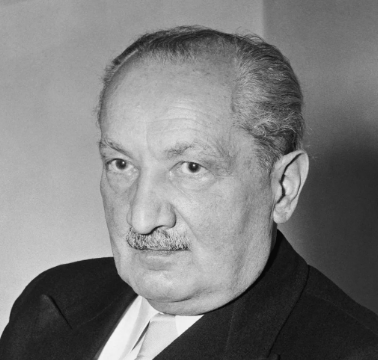
"Here is the chalk." This is a truth; and here and the now hereby characterize the chalk so that we emphasize by saying; the chalk, which means "this." We take a scrap of paper and we write the truth down: "Here is the chalk." We lay this written statement beside the thing of which it is the truth. After the lecture is finished both doors are opened, the classroom is aired, there will be a draft, and the scrap of paper, let us suppose, will flutter out into the corridor. A student finds it on his way to the cafeteria, reads the sentence. "Here is the chalk," and ascertains that this is not true at all. Through the draft the truth has become an untruth. Strange that a truth should depend on a gust of wind. ... We have made the truth about the chalk independent of us and entrusted it to a scrap of paper.
▼
Source
source
p. 29-30
2 months 1 week ago
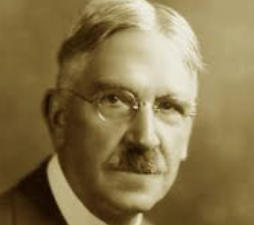
We cannot grasp any idea, any organ of meditation, we cannot possess it in full force, until we have felt and sensed it, as much so as if it were an odor or a color.

2 months 2 weeks ago
"No human laws are of any validity if contrary to the law of nature; and such of them as are valid derive all their force and all their authority mediately or immediately from this original." Thus writes Blackstone, to whom let all honour be given for having so far outseen the ideas of his time; and, indeed, we may say of our time. A good antidote, this, for those political superstitions which so widely prevail. A good check upon that sentiment of power-worship which still misleads us by magnifying the prerogatives of constitutional governments as it once did those of monarchs. Let men learn that a legislature is not "our God upon earth," though, by the authority they ascribe to it, and the things they expect from it, they would seem to think it is. Let them learn rather that it is an institution serving a purely temporary purpose, whose power, when not stolen, is at the best borrowed.
▼
Source
source
Pt. III, Ch. 19 : The Right to Ignore the State, § 2
2 months 2 days ago
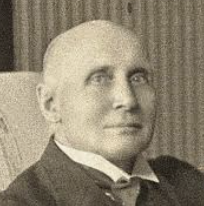
The universities are schools of education, and schools of research. But the primary reason for their existence is not to be found either in the mere knowledge conveyed to the students or in the mere opportunities for research afforded to the members of the faculty. Both these functions could be performed at a cheaper rate, apart from these very expensive institutions. Books are cheap, and the system of apprenticeship is well understood. So far as the mere imparting of information is concerned, no university has had any justification for existence since the popularization of printing in the fifteenth century. Yet the chief impetus to the foundation of universities came after that date, and in more recent times has even increased. The justification for a university is that it preserves the connection between knowledge and the zest of life, by uniting the young and the old in the imaginative consideration of learning.

1 month 2 weeks ago
Every innovation scraps its immediate predecessor and retrieves still older figures - it causes floods of antiques or nostalgic art forms and stimulates the search for museum pieces.
7 months 3 weeks ago
4 months 2 weeks ago
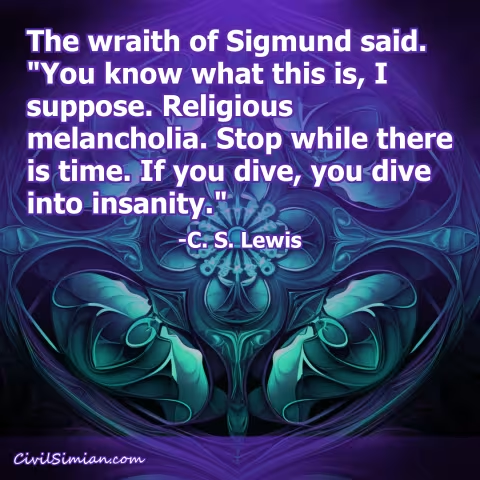
He believes in that mummery a good deal less than I do, and I don't believe in it at all.

3 months 2 weeks ago
"What is meant by saying that my choice of which way to walk home after the lecture is ambiguous and matter of chance?...It means that both Divinity Avenue and Oxford Street are called but only one, and that one either one, shall be chosen.
▼
Source
source
The Dilemma of Determinism (1884) p.155

3 months 2 weeks ago
There has been a general trend in recent times toward a Unitarian mythology and the worship of one God. This is the tendency which it is customary to regard as spiritual progress. On what grounds? Chiefly, so far as one can see, because we in the Twentieth Century West are officially the worshippers of a single divinity. A movement whose consummation is Us must be progressive. Quod erat demonstrandum.
▼
Source
source
"One and Many," p. 16

2 months 4 days ago
What the sorrowful Jew of Amsterdam called the essence of a thing, the effort that it makes to persist indefinitely in its own being, self-love, the longing for immortality, is it not perhaps the primal and fundamental condition of all reflective or human knowledge? And is it not therefore the true base, the real starting-point, of all philosophy, although the philosophers, perverted by intellectualism, do not recognize it?
3 months 2 weeks ago
Only that position can impart dignity in which we do not appear as servile tools but rather create independently within our circle.
▼
Source
source
Writings of the Young Marx on Philosophy and Society, L. Easton, trans. (1967), p. 38

2 months 3 weeks ago
We are sleeping on a volcano... A wind of revolution blows, the storm is on the horizon.
▼
Source
source
Speaking in the Chamber of Deputies just prior to to outbreak of revolution in Europe (1848).

3 months 3 weeks ago
The virtue of frugality lies in a middle between avarice and profusion, of which the one consists in an excess, the other in a defect of the proper attention to the objects of self-interest.
▼
Source
source
Section II, Chap. I.

3 months 1 day ago
You, Socrates, began by saying that virtue can't be taught, and now you are insisting on the opposite, trying to show that all things are knowledge, justice, soundness of mind, even courage, from which it would follow that virtue most certainly can be taught.
▼
Source
source
As quoted in Protagoras by Plato
2 months 1 week ago
From these two immediate perceptions, we gain a mediate, or inferential perception of the relation of all four instants. This mediate perception is objectively, or as to the object being represented, spread over the four instants; but subjectively, or as itself the subject of duration, it is completely embraced in the second moment. (The reader will observe that I use the word instant to mean a point in time, and moment to mean an infinitesimal duration.
3 months 2 weeks ago
It is one thing to show a man that he is in error, and another to put him in possession of the truth.
▼
Source
source
Book IV, Ch. 7, sec. 11
1 month 2 weeks ago
Omnipresence has become an ordinary human dimension.
3 months 2 weeks ago
Ethics is in origin the art of recommending to others the sacrifices required for co-operation with oneself.
▼
Source
source
Ch. 6: On the Scientific Method in Philosophy

2 months 1 week ago
All they that take the sword shall perish with the sword.
▼
Source
source
Matthew 26:52 (KJV)

3 months 3 weeks ago
Merit is a work for the sake of which Christ gives rewards. But no such work is to be found, for Christ gives by promise. Just as if a prince should say to me, "Come to me in my castle, and I will give you a hundred florins." I do a work, certainly, in going to the castle, but the gift is not given me as the reward of my work in going, but because the prince promised it to me.
▼
Source
source
p. 409
4 months 2 weeks ago
I don't say it was deliberate fraud. He was probably madly sincere, and sincerely mad.
3 months 1 week ago
By Thy perfect Intelligence, O MazdaThou didst first create us having bodies and spiritual consciences,And by Thy Thought gave our selves the power of thought, word, and deed.Thus leaving us free to choose our faith at our own will.
▼
Source
source
Ahunuvaiti Gatha; Yasna 31, 11.
2 months 1 week ago
Our mass media have little difficulty in selling particular interests as those of all sensible men. The political needs of society become individual needs and aspirations, their satisfaction promotes business and the commonweal, and the whole appeals to be the very embodiment of Reason.
▼
Source
source
p. xli
CivilSimian.com created by AxiomaticPanic, CivilSimian, Kalokagathia