
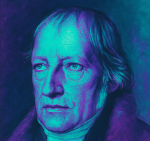
G. W. F. Hegel — The Philosopher of History, Freedom, and the Living Mind (1770–1831)
Hegel was the grand architect of a philosophy that tried to swallow the entire world — history, politics, art, logic, and human consciousness — into one vast, unfolding system. His thought is notoriously dense, but at its core lies a bold idea: reality is not static but a living, developing process driven by the mind's struggle toward freedom.
A Quiet Scholar with Gargantuan Ambition
Born in Stuttgart, Germany, Hegel grew up steeped in classical education and the intellectual energy of the Enlightenment. He spent years teaching and writing quietly, far from fame, while refining a philosophical vision that sought to make sense of the entire evolution of human thought. By the time he became a professor in Berlin, he had constructed one of the most influential systems in Western philosophy.
“We learn from history that we do not learn from history.”
Spirit, Dialectic, and the Movement of Thought
At the heart of Hegel’s philosophy is the concept of Geist — “Spirit.” It represents both individual consciousness and the collective mind of humanity as it develops through time. Spirit does not simply exist; it becomes. This becoming happens through what Hegel called the dialectic, a dynamic movement in which ideas unfold through conflict, contradiction, and eventual resolution.
The dialectic is not a mechanical formula but a description of how thought, culture, and history develop — always striving toward greater clarity and freedom. Hegel saw this movement everywhere: in logic, in art, in religion, and in the political life of nations.
“Truth is the whole.”
Freedom and the Drama of History
Hegel believed that history has a direction — not random chaos but a rational process through which human beings gradually recognize and realize their own freedom. Civilizations rise and fall, ideas clash, institutions transform, and through this dramatic sequence, Spirit becomes aware of itself.
For Hegel, freedom is not just personal liberty; it is the alignment of the individual with rational ethical life, embodied in families, communities, and just political institutions. History, then, is Spirit coming to know what it already is: free.
“Being is pure abstraction, and nothing else.”
System and Science — Philosophy as a Total Vision
Hegel’s system sprawls from the smallest concepts of logic to the broadest arcs of world history. His Science of Logic examines the deep structure of thought itself. His Phenomenology of Spirit maps the journey of consciousness from simple awareness to philosophical wisdom. His Philosophy of Right explores law, ethics, and the state as expressions of freedom.
Few philosophers have attempted so ambitious a project, and fewer still have shaped so many disciplines — from existentialism and Marxism to theology, political theory, and literary criticism.
“What is rational is actual; and what is actual is rational.”
Legacy — The Thinker Who Made Philosophy a World
Hegel’s legacy is immense. His ideas inspired revolutionaries, theologians, poets, and some of the most important philosophical movements of the 19th and 20th centuries. Even critics of Hegel often found themselves working within the questions he posed. His intense focus on history, freedom, and development reshaped how modern thinkers understand themselves and their world.
Whether revered or resisted, Hegel remains a towering figure — the philosopher who taught that reality itself is a grand, unfolding story of mind striving toward truth.
“To be independent of public opinion is the first formal condition of achieving anything great.”
CivilSimian.com created by AxiomaticPanic, CivilSimian, Kalokagathia