
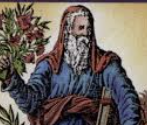
Iamblichus — Theurgy, the Divine Hierarchy, and the Soul's Ascent (c. 245–325 AD)
Iamblichus was a Syrian Neoplatonist philosopher whose radical reinterpretation of the Platonic tradition transformed late antique philosophy and religion and secured his reputation as the dominant figure in Neoplatonism after Plotinus.
Where Plotinus had emphasized the soul's capacity to ascend to the divine through philosophical contemplation alone, Iamblichus insisted that ritual, prayer, and sacred practice — what he called theurgy — were indispensable to genuine union with the gods.
His central concern: that the human soul is too deeply embedded in matter to reach the divine by intellect alone — and that the gods themselves must act, through divinely instituted rites, to lift the soul toward its source.
The Break with Plotinus
Plotinus, the founding genius of Neoplatonism, had taught that the highest part of the human soul remains eternally united with the divine intellect — that philosophy, practiced with sufficient rigor and dedication, could recover this union through a kind of interior ascent. The body and its rituals were obstacles, not aids.
Iamblichus rejected this with quiet but thoroughgoing force. The human soul, he argued, has fully descended into matter — there is no undescended part hovering perpetually in the divine realm. We are genuinely embedded in the physical world, genuinely in need of rescue, and philosophy alone is not sufficient to provide it.
This was not a retreat from Platonism but a radicalization of its implications — a recognition that the distance between the human and the divine is greater than Plotinus had allowed, and that the means of bridging it must be correspondingly more powerful.
The gods, Iamblichus insisted, must reach down to us as much as we reach up to them.
"The theurgist does not compel the gods — he prepares himself to receive their gift."
Theurgy — Divine Work
Theurgy — from the Greek for "divine work" — was the practice of ritual action designed not to manipulate the gods but to align the practitioner with the divine order and open a channel for divine power to descend.
Iamblichus developed the philosophical justification for theurgy in his treatise "On the Mysteries" — written as a response to his teacher Porphyry's skeptical questions about the validity of traditional religious practice. He argued that theurgic rites work not through human intention or understanding but through the inherent sympathy between divine symbols and the divine realities they represent.
Certain names, gestures, materials, and sequences of action were held to carry genuine divine power — not as magic in the vulgar sense but as the divinely established language through which the gods communicate with the material world. The theurgist learns this language and speaks it correctly.
The practice integrated hymns, invocations, sacred objects, and carefully structured ritual sequences into a comprehensive spiritual technology aimed at the soul's liberation from matter.
"It is not thought that links the theurgists to the gods — for what would hinder those who are theoretical philosophers from enjoying theurgic union? The case is not so. Theurgic union is attained only by the perfective operation of unspeakable acts."
The Divine Hierarchy
Iamblichus elaborated and systematized the Neoplatonic hierarchy of divine beings with a thoroughness no previous philosopher had attempted.
Between the ineffable One at the summit of reality and the material world at its base, he populated an intricate gradation of gods, archangels, angels, demons, heroes, and souls — each level mediating between those above and below it, each requiring appropriate forms of veneration and communication.
This hierarchy was not merely metaphysical speculation — it was a practical map for the theurgist, who needed to know which beings to approach, by what means, and for what purposes. The cosmos was alive with divine presences, each occupying its proper place in a chain of being that descended from the One to the stone.
His systematization became the template for virtually all subsequent late antique theology — pagan, Jewish, and Christian alike — including the Christian angelology of Pseudo-Dionysius the Areopagite, which shaped medieval theology for a millennium.
"The gods are present everywhere and to all things — but they are received by each according to its capacity."
Pythagoras and the Life of Philosophy
Iamblichus wrote an extensive biography of Pythagoras and a multi-volume collection on Pythagorean philosophy — works that preserved much of what we know about the Pythagorean tradition and established Pythagoras as the founding archetype of the philosopher as spiritual teacher and community builder.
The Pythagorean life, for Iamblichus, was the model of what philosophy properly understood demanded: not merely argument and contemplation but a structured communal way of life, with shared practices, dietary disciplines, ritual observances, and moral formation all working together to reshape the soul.
Philosophy was not a set of doctrines to be learned but a transformation to be undergone — and that transformation required a community, a teacher, and a way of life, not just a set of texts.
This vision of philosophy as spiritual formation deeply influenced Julian the Apostate, whose project of pagan renewal drew directly on Iamblichean ideas.
"Pythagoras showed that the purpose of all philosophy is the purification of the soul and its return to its divine origin."
Legacy — The Hidden Architect of Late Antiquity
Iamblichus died around 325 AD — the same year the Council of Nicaea was establishing the creed of the religion that would ultimately absorb or displace the tradition he had devoted his life to defending.
His direct influence on pagan philosophy was immense — every major Neoplatonist after him, including Proclus, Damascius, and the school of Athens, worked within the framework he established. Emperor Julian regarded him as second only to Plato and drew on his theology for the pagan revival.
His indirect influence on Christianity was equally substantial and far less acknowledged — the hierarchical cosmos, the divine names, the theology of mediation between the human and the absolute, all passed into Christian thought largely through channels that did not advertise their Iamblichean origins.
He stands as one of the great hidden architects of the Western spiritual imagination — a thinker whose framework shaped how subsequent centuries understood the relationship between the human and the divine, even as his name was largely forgotten.
"The soul has not wholly quitted the divine — it has descended, but the light that descends still carries within it the fire of its source."
CivilSimian.com created by AxiomaticPanic, CivilSimian, Kalokagathia