
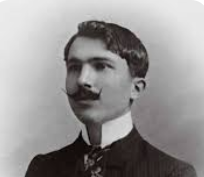
Nikos Kazantzakis — Struggle, Freedom, and the God Who Devours (1883–1957)
Nikos Kazantzakis was a Greek writer, poet, and philosopher whose novels, plays, and philosophical works made him one of the most spiritually intense and widely read European writers of the twentieth century.
Shaped by Nietzsche, Bergson, and the Orthodox mystical tradition, he forged a singular vision of human existence as an endless struggle toward freedom — a struggle that finds its meaning in the striving itself, not in any final arrival.
His central concern: that the human being is the place where matter becomes conscious of its own drive toward transcendence — and that to live fully is to burn completely, without reservation or comfort.
Zorba and the Life of Yes
"Zorba the Greek" remains Kazantzakis's most beloved work — the story of a cautious, bookish narrator transformed by his encounter with Alexis Zorba, a man of volcanic appetite and inexhaustible vitality.
Zorba is not a philosopher in any academic sense. He dances, drinks, loves, fails, and begins again — meeting catastrophe with laughter and treating life as something to be seized whole, not approached cautiously from a safe distance.
Through Zorba, Kazantzakis posed a question that runs through all his work: what does it cost a person to hold back from life? What is lost in the careful, hedged, half-committed existence that most people settle for?
Zorba's answer was to dance on the edge of the abyss and call it freedom.
"I felt once more how simple and frugal a thing is happiness: a glass of wine, a roast chestnut, a wretched little brazier, the sound of the sea. Nothing else."
The Last Temptation and the Struggle with God
Kazantzakis's most theologically explosive work imagined Christ tormented by doubt, desire, and the terror of his mission — a fully human figure wrestling with the weight of divinity.
The novel was placed on the Catholic Index of Forbidden Books and condemned by the Greek Orthodox Church. Kazantzakis responded with characteristic defiance, insisting that his intention was not blasphemy but the deepest possible reverence — to show the magnitude of what Christ overcame by making the temptations real.
For Kazantzakis, the struggle between flesh and spirit, between comfort and calling, was not a theological abstraction but the defining experience of every conscious human life.
Christ was not exempt — and that, he argued, was what made him worth taking seriously.
"Every man has his own little piece of the Great Struggle. My duty is not to let that piece die with me."
The Saviors of God — A Spiritual Exercises
Kazantzakis's most directly philosophical work was "The Saviors of God: Spiritual Exercises" — a prose poem of searing intensity that lays out his personal credo.
Drawing on Nietzsche's will to power and Bergson's élan vital, he proposed that God is not a fixed being but a force struggling to realize itself through matter — and that human beings are the most advanced front of this cosmic struggle.
To live consciously and fully, on this account, is to participate in the self-creation of God. To surrender to comfort, fear, or routine is to betray the entire enterprise of existence.
It is a vision of almost unbearable moral seriousness — and one that asks everything of the person who accepts it.
"You have your brush, you have your colors, you paint paradise, then in you go."
Crete, Greece, and the Roots of His Vision
Kazantzakis was born in Crete during the final years of Ottoman rule — a childhood marked by violence, occupation, and the fierce pride of a people who had resisted subjugation for centuries.
Crete saturates his imagination throughout his work: its harsh landscape, its warrior ethic, its blend of Byzantine Christianity and older pagan energies. The island gave him a template for the heroic life — existence as unceasing struggle, dignity purchased through resistance.
His modern retelling of the Odyssey — a sprawling epic poem of 33,333 lines — sent Odysseus beyond Ithaca into a restless journey toward the uttermost limits of human possibility, a figure for Kazantzakis's own refusal to settle.
He was, in the deepest sense, a Cretan — which is to say, someone who found peace suspicious.
"My entire soul is a cry, and all my work is a commentary on that cry."
Legacy — The Epitaph He Chose
Kazantzakis was nominated for the Nobel Prize in Literature multiple times, losing on at least one occasion by a single vote. The Church denied him burial in consecrated ground; he was interred on the walls of Heraklion, his grave looking out over the Cretan landscape he never left spiritually.
On his tombstone, by his own instruction, are three lines that stand as the most compressed expression of his entire philosophy:
"I hope for nothing. I fear nothing. I am free."
His work endures because the questions it raises do not resolve into comfort. He offers no reassurance — only the bracing proposition that a life fully lived, with nothing held back and nothing expected in return, is its own sufficient answer.
In an age that prizes safety, optimization, and managed risk, Kazantzakis stands as an uncompromising reminder that the examined life is not necessarily a comfortable one — and that this may be precisely the point.
CivilSimian.com created by AxiomaticPanic, CivilSimian, Kalokagathia