
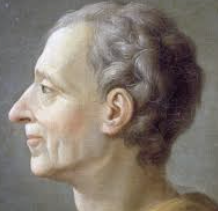
Montesquieu — The Philosopher of Law, Liberty, and the Architecture of Power (1689–1755)
Montesquieu was the anatomist of political power — a thinker who refused to moralize government in the abstract and instead studied how power actually behaves in the real world. Against absolutism and universal formulas, he argued that laws, institutions, and liberties grow out of concrete conditions: history, climate, economy, culture, and human psychology. Freedom, for Montesquieu, is not declared — it is carefully engineered.
An Aristocrat with an Empirical Eye
Born Charles-Louis de Secondat near Bordeaux, Montesquieu inherited wealth, title, and legal office. Unlike many Enlightenment philosophers, he was not an outsider attacking power from below, but an insider studying it from within.
Trained as a jurist and serving as a magistrate, he encountered law not as theory, but as a living institution — shaped by tradition, precedent, and compromise. This practical grounding would distinguish his philosophy from the more abstract rationalism of his contemporaries.
Montesquieu did not ask how states *ought* to function in theory. He asked how they *do* function in practice.
“To become truly great, one has to stand with people, not above them.”
The Persian Letters — Satire as Social Diagnosis
Montesquieu’s first major success, The Persian Letters, used fictional foreign observers to expose the absurdities of French society. Religion, monarchy, gender roles, and intellectual pretension are all quietly dismantled through irony.
The brilliance of the work lies in its distance. By making the familiar strange, Montesquieu revealed how customs masquerade as necessity. What people call “natural,” he showed, is often just habit reinforced by power.
This method — comparative, ironic, and empirical — would become central to his mature philosophy.
“Custom makes everything easy.”
The Spirit of the Laws — A New Science of Politics
Montesquieu’s masterpiece, The Spirit of the Laws, is one of the most ambitious works of political philosophy ever written. It is not a manifesto, but an inquiry — a vast comparative study of governments across history and geography.
Laws, Montesquieu argued, do not arise from pure reason. They reflect a society’s “spirit” — its climate, economy, religion, customs, and social structure. A law that preserves liberty in one context may destroy it in another.
Political wisdom therefore requires sensitivity to conditions, not blind application of ideals.
“Laws should be so appropriate to the people for whom they are made that it is very unlikely that those of one nation can suit another.”
Liberty and the Separation of Powers
Montesquieu’s most enduring contribution is his analysis of political liberty. Freedom, he argued, does not mean doing whatever one wishes. It means security — living without fear of arbitrary power.
Power, however, naturally seeks to expand. “Power,” he famously wrote, “ought to check power.” The solution is institutional: the separation of legislative, executive, and judicial authority.
When powers are divided and balanced, no single force can dominate. Liberty emerges not from virtue, but from structure.
“To prevent abuse of power, it is necessary that power should be a check to power.”
Moderate Government and Political Prudence
Montesquieu distrusted extremes. Absolute monarchy, radical democracy, and utopian rationalism all struck him as dangerous.
He favored moderate government — systems that evolve slowly, respect tradition, and restrain ambition through counterweights. His admiration for the English constitutional system lay not in its perfection, but in its capacity to limit domination.
Political liberty, he believed, survives only where institutions encourage restraint.
Climate, Culture, and Controversy
Montesquieu controversially argued that climate and geography influence temperament and institutions. Hot climates, he suggested, tend toward despotism; colder climates toward vigor and independence.
These claims are rightly criticized today, yet their intent was explanatory, not justificatory. Montesquieu sought causes, not hierarchies — patterns, not moral rankings.
His deeper insight remains: politics is inseparable from lived conditions.
Legacy — The Engineer of Constitutional Liberty
Montesquieu’s influence on modern constitutionalism is immense. His ideas shaped the American Founders, the structure of liberal democracies, and modern theories of checks and balances.
Unlike revolutionary thinkers, he offered no grand vision of human perfection. His contribution was more sober — a recognition that freedom survives only when power is fragmented, restrained, and made answerable to itself.
Montesquieu teaches that liberty is not born of passion, but of design.
“Liberty is the right of doing whatever the laws permit.”
CivilSimian.com created by AxiomaticPanic, CivilSimian, Kalokagathia