
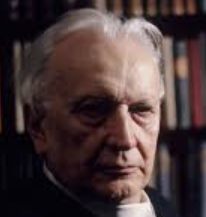
Karl Jaspers — Limit Situations, Existential Freedom, and Philosophical Communication (1883–1969)
Karl Jaspers was a philosopher of human boundaries — of the moments where rational control fails and existence reveals its deepest questions. Trained as a psychiatrist, he approached philosophy not as system-building but as existential clarification: an attempt to illuminate what it means to be a self who must choose, suffer, and take responsibility.
From Psychiatry to Philosophy
Jaspers began his career studying mental illness, developing methods for understanding subjective experience rather than reducing it to biological mechanisms. This early focus shaped his lifelong concern with the irreducible interior life of persons.
He concluded that scientific explanation, though powerful, cannot grasp the meaning of existence itself. Philosophy must take over where objective knowledge ends.
“Science gives knowledge, but philosophy gives orientation.”
Limit Situations — Where Existence Breaks Through
Jaspers introduced the idea of limit situations — experiences such as death, suffering, guilt, and struggle that cannot be eliminated or technically solved.
These moments shatter the illusion that life can be mastered by planning and calculation. Instead of offering solutions, they confront us with ourselves.
In facing these limits, individuals may awaken to authentic existence.
“Only in boundary situations do we truly become ourselves.”
Existenz — Not an Object, but a Task
Jaspers distinguished between objective being and what he called Existenz — the lived reality of becoming a self through decision.
Existenz cannot be observed or defined like an object. It is realized only in choosing, committing, and taking responsibility.
Philosophy therefore does not describe existence; it clarifies the path toward it.
“Existence is not given to us; it must be achieved.”
Communication as a Path to Truth
Unlike solitary existentialists, Jaspers believed authentic existence requires dialogue. Truth emerges not from isolated certainty but from open communication between free individuals.
Genuine communication is not persuasion or domination, but mutual recognition of freedom and fallibility.
Through dialogue, individuals transcend isolation without surrendering individuality.
“Truth begins between two people who speak honestly.”
The Axial Age — A Global Awakening
Jaspers proposed the idea of the Axial Age, a historical period when major civilizations independently produced profound spiritual and philosophical traditions.
Confucius, the Upanishads, the Hebrew prophets, Greek philosophy, and Zoroastrian thought all emerged within a few centuries of one another.
He saw this as humanity’s first great awakening to reflection, conscience, and transcendence.
Guilt, Responsibility, and Political Ethics
After World War II, Jaspers argued that nations must confront not only legal crimes but moral responsibility.
In The Question of German Guilt, he distinguished criminal, political, moral, and metaphysical forms of responsibility.
Freedom, he insisted, requires honest confrontation with history.
Legacy — Freedom Without Systems
Jaspers rejected closed philosophical systems, ideologies, and total explanations. Existence always exceeds theory.
His work stands between science and spirituality, existentialism and rational dialogue, individuality and shared humanity.
He remains a philosopher of open questions, of courage at the edge of certainty.
“Philosophy is the courage to face what cannot be solved.”
CivilSimian.com created by AxiomaticPanic, CivilSimian, Kalokagathia