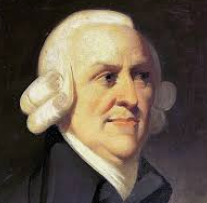
The key insight of Adam Smith's Wealth of Nations is misleadingly simple: if an exchange between two parties is voluntary, it will not take place unless both believe they will benefit from it. Most economic fallacies derive from the neglect of this simple insight, from the tendency to assume that there is a fixed pie, that one party can gain only at the expense of another.
0
⚖0
▼Source
source
Milton Friedman, Free to Choose: A Personal Statement (1981), p. 5.
I have found one just man in Gomorrah—Adam Smith, author of the Wealth of Nations. He was the Duke of Buccleuch's tutor, is a wise and deep philosopher, and although made commissioner of the customs here by the Duke and Lord Advocate, is what I call an honest fellow. He wrote a most kind as well as elegant letter to Burke on his resignation, as I believe I told you before; and on my mentioning it to him, he told me he was the only man here who spoke out for the Rockinghams.
0
⚖0
▼Source
source
Gilbert Elliot, letter (25 July 1782), quoted in Life and Letters of Sir Gilbert Elliott, First Earl of Minto from 1751 to 1806, Vol. I, ed. Countess of Minto (1874), p. 84
Adam Smith, had treated forestalling as an imaginary evil! Adam Smith, whom I knew well, was a man of investigation, knowledge, and sagacity; with a heart overflowing with benevolence and sociability; but he was strong tinctured with French Philosophy and systime! To mention two circumstances, in which I cannot be mistaken, because spoken to myself, and although contradictory to the sentiments that I had expressed, not spoken in publick, where men often sport opinions for argument, but in the familiarity of individual conversation, where the unreserved sentiments are spoke. These were "That the Christian Religion debased the human mind;" and that "Sodomy was a thing in itself indifferent." The considerate part of mankind will think that the opinions of such a man, or of any man, are not to be admitted as infallible dogmas; but to be fairly weighed, before they are adopted.
0
⚖0
▼Source
source
Alexander Dalrymple, Thoughts of an Old Man, of Independent Mind, Though Dependent Fortune, on the Present High Price of Corn (1800), p. 4
If I were five-and-twenty or thirty, instead of, unhappily, twice that number of years, I would take Adam Smith in hand—I would not go beyond him, I would have no politics in it—I would take Adam Smith in hand, and I would have a League for free trade in Land just as we had a League for free trade in Corn. You will find just the same authority in Adam Smith for the one as for the other; and if it were only taken up as it must be taken up to succeed, not as a political, revolutionary, Radical, Chartist notion, but taken up on politico-economic grounds, the agitation would be certain to succeed; and if you apply free trade in land and to labour too—that is, by getting rid of those abominable restrictions in your parish settlements, and the like—then, I say, the men who do that will have done for England probably more than we have been able to do by making free trade in corn.
0
⚖0
▼Source
source
Richard Cobden, speech in Rochdale (23 November 1864), quoted in John Bright and J. E. Thorold Rogers (eds.), Speeches on Questions of Public Policy by Richard Cobden, M.P. Volume II (1908), p. 493
About this time two others, men of great talents and learning, promoted the cause of the injured Africans, by the manner in which they introduced them to notice in their respective works. Dr. Adam Smith, in his Theory of Moral Sentiments, had, so early as the year 1759, held them up in an honourable, and their tyrants in a degrading light. "There is not a Negro from the coast of Africa, who does not, in this respect, possess a degree of magnanimity which the soul of his sordid master is too often scarce capable of conceiving. Fortune never exerted more cruelly her empire over mankind, than when she subjected those nations of heroes to the refuse of the gaols of Europe, to wretches who possess the virtue neither of the countries they came from, nor of those they go to, and whose levity, brutality, and baseness so justly expose them to the contempt of the vanquished." And now, in 1776, in his Wealth of Nations he showed in a forcible manner (for he appealed to the interest of those concerned,) the dearness of African labour; or the impolicy of employing slaves.
0
⚖0
▼Source
source
Thomas Clarkson The History of the Rise, Progress, and Accomplishment of the Abolition of the African Slave-Trade by the British Parliament, p. 75 (1808) [https://books.google.com/books?id=mfVeAAAAcAAJ&pg=PA75][http://www.gutenberg.org/ebooks/10633]
An excellent digest of all that is valuable in former Oeconomical writers with many valuable corrective Observations.
0
⚖0
▼Source
source
Edmund Burke, remark on The Wealth of Nations as recorded by Dugald Stewart (8 April 1784), quoted in Ian Simpson Ross, The Life of Adam Smith (1995; 2nd ed. 2010), p. 376
Adam Smith, who has strong claim to being both the Adam and the Smith of systematic economics, was a professor of moral philosophy and it was at that forge that economics was made.
0
⚖0
▼Source
source
Kenneth Boulding (1969) Economics As A Moral Science, p. 12
Mr. Burke talked in very high terms of Dr. Adam Smith; praised the clearness and depth of his understanding, his profound and extensive learning, and the vast accession that had accrued to British literature and philosophy from these exertions, and described his heart as being equally good with his head and his manners as peculiarly pleasing. Mr. Smith, he said, told him, after they had conversed on subjects of political economy, that he was the only man, who, without communication, thought on these topics exactly as he did.
0
⚖0
▼Source
source
Robert Bisset, The Life of Edmund Burke, Volume II (1800), pp. 428-429
We are forced, in equity, to share the government with the working class by considerations which were made supreme by the awakening of political economy. Adam Smith set up two propositions—that contracts ought to be free between capital and labour, and that labour is the source, he sometimes says the only source, of wealth. If the last sentence, in its exclusive form, was true, it was difficult to resist the conclusion that the class on which national prosperity depends ought to control the wealth it supplies, that is, ought to govern instead of the useless unproductive class, and that the class which earns the increment ought to enjoy it. That is the foreign effect of Adam Smith—French Revolution and Socialism.
0
⚖0
▼Source
source
Lord Acton to Mary Gladstone (24 April 1881), quoted in Lord Acton, Letters of Lord Acton to Mary, Daughter of The Right Hon. W. E. Gladstone, ed. Herbert Paul (1904), pp. 91-92