
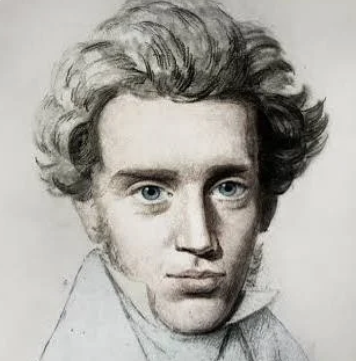
4 months 1 week ago
These two essays probably will essentially be able to interest only theologians. (Preface)
4 months 1 week ago
He lived year after year. He attended only to himself and to God and this picture-but he did not understand himself.
▼
Source
source
p. 57
4 months 1 week ago
He was extremely important to his contemporaries, who wanted nothing more than to see in him the Expected One; they wanted almost to press it upon him and and to force him into the role - but that he then refuses to be that!
▼
Source
source
p. 60
4 months 1 week ago
The greatest danger, that of losing one's own self, may pass off as quietly as if it were nothing; every other loss, that of an arm, a leg, five dollars, a wife etc., is sure to be noticed.
4 months 1 week ago
I see again what I thought I saw the first time, when I sent forth the little book that was compared to and in fact could best be compared to “a humble little flower under the cover of the great forest”
▼
Source
source
Preface Three Discourses at Friday Communion November 14, 1849 Hong translation 1997 P. 111 (From Without Authority)
4 months 1 week ago
In all the flat, lethargic, dull moments, when the sensate dominates a person, to him Christianity is a madness because it is incommensurate with any finite wherefore. But then what good is it? Answer: Be quiet, it is the absolute. And that is how it must be presented, consequently as, that is, it must appear as madness to the sensate person. And therefore it is true, so true, and also in another sense so true when the sensible person in the situation of contemporaneity (see II A) censoriously says of Christ, “He is literally nothing”-quite so, for he is the absolute. Christianity is an absolute. Christianity came into the world as the absolute, not, humanly speaking, for comfort; on the contrary, it continually speaks about how the Christian must suffer or about how a person in order to become and remain a Christian must endure sufferings that he consequently can avoid simply by refraining from becoming a Christian.
▼
Source
source
p. 61-62
4 months 1 week ago
When in sickness I go to a physician, he may find it necessary to prescribe a very painful treatment-there is no self-contradiction in my submitting to it. No, but if on the other hand I suddenly find myself in trouble, an object of persecution, because, because I have gone to that physician: well, then then there is a self-contradiction. The physician has perhaps announced that he can help me with regard to the illness from which I suffer, and perhaps he can really do that-but there is an "aber" [but] that I had not thought of at all. The fact that I get involved with this physician, attach myself to him-that is what makes me an object of persecution; here is the possibility of offense. So also with Christianity. Now the issue is: will you be offended or will you believe. If you will believe, then you push through the possibility of offense and accept Christianity on any terms. So it goes; then forget the understanding; then you say: Whether it is a help or a torment, I want only one thing, I want to belong to Christ, I want to be a Christian.
▼
Source
source
p. 115
4 months 1 week ago
Lord Jesus Christ, our foolish minds are weak; they are more than willing to be drawn—and there is so much that wants to draw us to itself. There is pleasure with its seductive power, the multiplicity with its bewildering distractions, the moment with its infatuating importance and the conceited laboriousness of busyness and the careless time-wasting of light-mindedness and the gloomy brooding of heavy-mindedness—all this will draw us away from ourselves to itself in order to deceive us. But you, who are truth, only you, our Savior and Redeemer, can truly draw a person to yourself, which you have promised to do—that you will draw all to yourself. Then may God grant that by repenting we may come to ourselves, so that you, according to your Word, can draw us to yourself—from on high, but through lowliness and abasement.
▼
Source
source
p. 157
4 months 1 week ago
"In hidden inwardness all are Christians; who would dare deny this? Anyone who would take it upon himself to deny it surely runs the risk of wanting to play the knower of hearts. So no one can deny it. That everyone is Christian in hidden inwardness is in this way a secretiveness that is almost locked up, so to speak, behind a jammed lock: it is impossible to find out whether all these thousands upon thousands actually are Christians, for they all are that, so it is said, in hidden inwardness. And not only for the Church but for everybody it holds true that one does not pass judgment on hidden and secret things, because one is unable to judge. Should it not, however, be possible to break this secretiveness and have a little disclosure without becoming guilty of being a knower of hearts? Yes, indeed! How so? In this way, that someone quite simply on his own responsibility takes it upon himself to confess Christ in the midst of Christendom. He does not judge a single person, far from it, but many will disclose themselves by the way they judge him. He does not claim to be a better Christian than others, no, far from it; on the contrary, to the others he makes the admission that they undoubtedly are better Christians than he, they who keep it hidden out of religious fear of winning honor and esteem, whereas he, poor simpleton that he is, on his own behalf is so afraid that it might prove to be shadowboxing with such an extreme Christianity, and therefore he holds to the old Christianity of confessing Christ. Therefore he does not inform against any of the others, that they are not Christians; far from it, he informs only against himself, that he is such a poor simpleton. Nevertheless the thoughts of many hearts would be disclosed by how they judge this poor simpleton, this imperfect Christian."
▼
Source
source
p. 220
4 months 1 week ago
That a woman is presented as a teacher, as a prototype of piety, cannot amaze anyone who knows that piety or godliness is fundamentally womanliness. ... from a woman you learn concern for the one thing needful, from Mary, sister of Lazarus, who sat silent at Christ's feet with her heart's choice: the one thing needful. P. 149
4 months 1 week ago
Happy is the one in whom there is true sorrow over his sin, so that the extreme unimportance to him of everything else is only the negative expression of the confirmation that one thing is unconditionally important to him, so that the unconditional unimportance to him of everything else is a deadly sickness that still is very far from being a sickness unto death but is precisely unto life, because the life is in this, that one thing is unconditionally important to him: to find forgiveness. ” P. 152
4 months 1 week ago
The next thing you can learn from the woman who was a sinner, something she herself understood, is that with regard to finding forgiveness she is able to do nothing at all. P. 155
4 months 1 week ago
To the contemporary, Christ can only say: I will offer myself as a sacrifice for the sins of the world and for yours also. Is this easier to believe now than when he has done it, has offered himself? Or is the comfort greater because of his saying that he will do it than it is because of his having done it? There is no greater love than this, that someone lays down his life for another, but when is it easier to believe, and when is the comfort greater: when the loving one says he will do it – or when he has done it? P. 159
4 months 1 week ago
To one unnamed, whose name will one day be named, is dedicated, with this little work, the entire authorship, as it was from the beginning. (Dedication) P. 163
4 months 1 week ago
When God chooses to let himself be born in lowliness, when he who holds all possibilities in his hand takes upon himself the form of a lowly servant, when he goes about defenseless and lets people do with him what they will, he surely must know well enough what he is doing and why he wills it; but for all that it is he who has people in his power and not they who have power over him-so history ought not play by this wanting to make manifest who he was.
▼
Source
source
p. 34
4 months 1 week ago
Accept the invitation so that the inviter may save you from what is so hard and dangerous to be saved from, so that, saved, you may be with him who is the Savior of all, of innocence also. For even if it were possible that utterly pure innocence was to be found somewhere, why should it not also need a Savior who could keep it safe from evil! –The invitation stands at the crossroad, there where the way of sin turns more deeply into sin. Come here, all you who are lost and gone astray, whatever your error and sin, be it to human eyes more excusable and yet perhaps more terrible, or be it to human eyes more terrible and yet perhaps more excusable, be it disclosed here on earth or be it hidden and yet known in heaven-and even if you found forgiveness on earth but no peace within, or found no forgiveness because you did not seek it, or because you sought it in vain: oh, turn around and come here, here is rest! The invitation stands at the crossroad, there where the way of sin turns off for the last time and disappears from view in-perdition. Oh, turn around, turn around, come here; do not shrink from the difficulty of retreat, no matter how hard it is; do not be afraid of the laborious pace of conversion, however toilsomely it leads to salvation, whereas sin leads onward with winged speed, with mounting haste-or leads downward so easily, so indescribably easily, indeed, as easily as when the horse, completely relieved of pulling, cannot, not even with all its strength, stop the wagon, which runs it into the abyss. Do not despair over every relapse, which the God of patience has the patience to forgive and under which a sinner certainly should have the patience to humble himself. No, fear nothing and do not despair; he who says “Come here” is with you on the way; from him there is help and forgiveness on the way of conversion that leads to him, and with him is rest.
▼
Source
source
p. 18-19
4 months 1 week ago
You complain that no one can put himself in your place. I can imagine that it may never have occurred to you, preoccupied day and night with that thought, that you should comfort others: and he, the Comforter, he is the only one of whom it truly holds that no one could put himself in his place-how true if he had complained in that way! He, the Comforter, in whose place no one could put himself, he can put himself completely in your place and in every sufferer's place. .... There is still one who is able to put himself completely in your place, the Lord Jesus Christ, who ”because he has suffered and himself been tempted is able to help those who are tempted” (Hebrews 2:18).
▼
Source
source
Three Discourses at Friday Communion November 14, 1849 Hong translation 1997 P. 119-120
4 months 1 week ago
Let us then in the brief prescribed moments simply consider the tax collector. Throughout all the ages he has been presented as the prototype of an honest and God-fearing churchgoer. Yet is seems to me that he is even more closely related to going to Communion, he who said, “God, be merciful to me, a sinner.” Is it not as if he were now going to Communion, he of whom it is said, “He went home to his house justified” – is it not as if he now went home from Communion!
▼
Source
source
Three Discourses at Friday Communion November 14, 1849 Hong translation 1997 P. 128
4 months 1 week ago
Self-accusation is the possibility of justification. The tax collector accused himself. There was no one else who accused him. It was not civic justice that seized him by the chest and said, “You are a criminal”: it was not the people whom he perhaps cheated who beat him on the breast and said, “You are a cheater” – but he beat his own breast and said, "God be merciful to me, a sinner. He accused himself, that he was a sinner before God.
▼
Source
source
Three Discourses at Friday Communion November 14, 1849 Hong translation 1997 P. 132
4 months 1 week ago
Confession should be only in secret before God, who knows everything anyway, and thus it could remain hidden in one's innermost being. But at a dinner – and a woman! A dinner-it is not some hidden, remote place, nor is the lighting dim, nor is the mood like that among graves, nor are the listeners silent or invisibly present.
▼
Source
source
Three Discourses at Friday Communion November 14, 1849 Hong translation 1997 P. 139
4 months 1 week ago
She has forgotten speech and language and the restlessness of thoughts, has forgotten what is even greater restlessness, this self, has forgotten herself-she, the lost woman, who is now lost in her Savior, who, lost in him, rests at his feet-like a picture. He speaks about her; he says: Her many sins are forgiven her, because she loved much. Although she is present, it is almost as if she were absent; it is almost as if he changed her into a picture, a parable.
▼
Source
source
Three Discourses at Friday Communion November 14, 1849 Hong translation 1997 P. 141
4 months 1 week ago
The truth is always in the minority, and the minority is always stronger than the majority, because as a rule the minority is made up of those who actually have an opinion, while the strength of the majority is illusory, formed of that crowd which has no opinion — and which therefore the next moment (when it becomes clear that the minority is the stronger) adopts the latter's opinion, which now is in the majority, i.e. becomes rubbish by having the whole retinue and numerousness on its side, while the truth is again in a new minority.
▼
Source
source
1850
4 months 1 week ago
The truth is a trap: you can not get it without it getting you; you cannot get the truth by capturing it, only by its capturing you.
▼
Source
source
1854
4 months 1 week ago
A white spot is on the horizon. There it is. A terrible storm is brewing. But no one sees the white spot or has any inkling of what it might mean. But no (this would not be the most terrible situation either), no, there is one person who sees it and knows what it means-but he is a passenger. He has no authority on the ship, can take no action. ... The fact that in Christendom there is visible on the horizon a white speck which means that a storm is threatening-this I knew; but, alas, I was an am only a passenger.
▼
Source
source
Søren Kierkegaard, Journals and Papers XI3 B 109 p 178ff (quoted in Kierkegaard’s Way to the Truth by Gergor Malantschuk 1963 Augsburg Publishing House
4 months 1 week ago
Editor’s Preface In this book, originating in the year 1848, the requirement for being a Christian is forced up by the pseudonymous author to the supreme ideality. Yet the requirement should indeed be stated, presented, and heard. From the Christian point of view, there ought to be no scaling down of the requirement, nor suppression of it-instead of a personal admission and confession. The requirement should be heard-and I understand what is said as spoken to me alone—so that I might learn not only to resort to grace but to resort to it in relation to the use of grace. S.K.
▼
Source
source
p. xii
4 months 1 week ago
An authorship that began with Either/Or and advanced step by step seeks here its decisive place of rest, at the foot of the altar, where the author, personally most aware of his own imperfections and guilt, certainly does not call himself a truth-witness but only a singular kind of poet and thinker who, without authority, has had nothing new to bring but “has wanted once again to read through, if possible in a more inward way, the original text handed down from the fathers” Preface P. 165
4 months 1 week ago
Deep within every human being there still lives the anxiety over the possibility of being alone in the world, forgotten by God, overlooked among the millions and millions in this enormous household. One keeps this anxiety at a distance by looking at the many round about who are related to him as kin and friends, but the anxiety is still there, nevertheless, and one hardly dares think of how he would feel if all this were taken away.
▼
Source
source
Journals VII 1A 363
4 months 1 week ago
My hearers, this discourse has not wandered out into the world to look for conflict, it has not tried to get the better of anybody, it has not even tried to uphold anybody, as though there was battle without. It has spoken to you; not by way of explaining anything to you, but trying to speak secretly with you about your relationship to that secret wisdom mentioned in our text. Oh that nothing may upset you in respect to this, “neither life nor death nor things present nor things to come nor any other creature” (Romans 8:38) –not this discourse, which, though it may have profited you nothing, yet has striven for what after all is the first and the last, to help you have what the Scripture calls “faith in yourself before God” (Romans 14:22).
▼
Source
source
P. 173
4 months 1 week ago
One could construe the life of man as a great discourse in which the various people represent different parts of speech (the same might apply to states). How many people are just adjectives, interjections, conjunctions, adverbs? How few are substantives, active verbs, how many are copulas? Human relations are like the irregular verbs in a number of languages where nearly all verbs are irregular.
▼
Source
source
Journals A 126 (March 1836)
4 months 1 week ago
I have just now come from a party where I was its life and soul; witticisms streamed from my lips, everyone laughed and admired me, but I went away — yes, the dash should be as long as the radius of the earth's orbit ——————————— and wanted to shoot myself.
▼
Source
source
March 1836
4 months 1 week ago
In vain do individual great men seek to mint new concepts and to set them in circulation — it is pointless. They are used for only a moment, and not by many, either, and they merely contribute to making the confusion even worse, for one idea seems to have become the fixed idea of the age: to get the better of one's superior. If the past may be charged with a certain indolent self-satisfaction in rejoicing over what it had, it would indeed be a shame to make the same charge against the present age (the minuet of the past and the gallop of the present). Under a curious delusion, the one cries out incessantly that he has surpassed the other, just as the Copenhageners, with philosophic visage, go out to Dyrehausen "in order to see and observe," without remembering that they themselves become objects for the others, who have also gone out simply to see and observe. Thus there is the continuous leap-frogging of one over the other — "on the basis of the immanent negativity of the concept", as I heard a Hegelian say recently, when he pressed my hand and made a run preliminary to jumping. — When I see someone energetically walking along the street, I am certain that his joyous shout, "I am coming over," is to me — but unfortunately I did not hear who was called (this actually happened); I will leave a blank for the name, so everyone can fill in an appropriate name.
▼
Source
source
Journals IA 328, 1835
4 months 1 week ago
How close men, despite all their knowledge, usually live to madness? What is truth but to live for an idea? When all is said and done, everything is based on a postulate; but not until it no longer stands on the outside, not until one lives in it, does it cease to be a postulate. (Dialectic - Dispute)
▼
Source
source
Journals of Søren Kierkegaard 1A75, 1835
4 months 1 week ago
It occurs to me that artists go forward by going backward, something which I have nothing against intrinsically when it is a reproduced retreat — as is the case with the better artists. But it does not seem right that they stop with the historical themes already given and, so to speak, think that only these are suitable for poetic treatment, because these particular themes, which intrinsically are no more poetic than others, are now again animated and inspirited by a great poetic nature. In this case the artists advance by marching on the spot. — Why are modern heroes and the like not just as poetic? Is it because there is so much emphasis on clothing the content in order that the formal aspect can be all the more finished?
▼
Source
source
Kierkegaard Journals and Papers 1A, 86 September 29, 1835
4 months 1 week ago
What I really need is to get clear about what I must do, not what I must know, except insofar as knowledge must precede every act. What matters is to find a purpose, to see what it really is that God wills that I shall do; the crucial thing is to find a truth which is truth for me, to find the idea for which I am willing to live and die.
▼
Source
source
Journal entry, Gilleleie (1 August 1835) Journals 1A; this is considered to be one of the earliest statements of existentialist thought. | Variant translation: My focus should be on what I do in life, not knowing everything, excluding knowledge on what yo
4 months 1 week ago
It is as useless for a person to want first of all to decide the externals and after that the fundamentals as it is for a cosmic body, thinking to form itself, first of all to decide the nature of its surface, to what bodies it should turn its light, which its dark side, without first letting the harmony of centrifugal and centripetal forces realize its existence and letting the rest come of itself. One must learn to know oneself before knowing anything else (gnothi seauton). Not until a person has inwardly understood himself and then sees the course he is to take does his life gain peace and meaning.
▼
Source
source
Journal entry, August 1, 1835
4 months 1 week ago
It will be easy for us once we receive the ball of yarn from Ariadne (love) and then go through all the mazes of the labyrinth (life) and kill the monster. But how many are there who plunge into life (the labyrinth) without taking that precaution?
▼
Source
source
Journal entry, August 1, 1835
4 months 1 week ago
In order to learn true humility (I use this expression to describe the state of mind under discussion), it is good for a person to withdraw from the turmoil of the world (we see that Christ withdrew when the people wanted to proclaim him king as well as when he had to walk the thorny path), for in life either the depressing or the elevating impression is too dominant for a true balance to come about. Here, of course, individuality is very decisive, for just as almost every philosopher believes he has found the truth, just as almost every poet believes he has reached Mount Parnassus, just so we find on the other hand many who link their lives entirely to another, like a parasite to a plant, live in him, die in him (for example, the Frenchman in relation to Napoleon). But in the heart of nature, where a person, free from life's often nauseating air, breathes more freely, here the soul opens willingly to every noble impression. Here one comes out as nature's master, but he also feels that something higher is manifested in nature, something he must bow down before; he feels a need to surrender to this power that rules it all. (I, of course, would rather not speak of those who see nothing higher in nature than substance — people who really regard heaven as a cheese-dish cover and men as maggots who live inside it.) Here he feels himself great and small at one and the same time, and feels it without going so far as the Fichtean remark (in his Die Bestimmung des Menschen) about a grain of sand constituting the world, a statement not far removed from madness.
▼
Source
source
Journals 1A 68 (29 July 1835)
4 months 1 week ago
After a considerable walk through the forest, where I became acquainted with several of the little lakes I am so fond of, I came to Hestehaven and Lake Carl. Here is one of the most beautiful regions I have ever seen. The countryside is somewhat isolated and slopes steeply down to the lake, but with the beech forests growing on either side, it is not barren. A growth of rushes forms the background and the lake itself the foreground; a fairly large part of the lake is clear, but a still larger part is overgrown with the large green leaves of the waterlily, under which the fish seemingly try to hide but now and then peek out and flounder about on the surface in order to bathe in sunshine. The land rises on the opposite side, a great beech forest, and in the morning light the lighted areas make a marvelous contrast to the shadowed areas. The church bells call to prayer, but not in a temple made by human hands. If the birds do not need to be reminded to praise God, then ought men not be moved to prayer outside of the church, in the true house of God, where heaven's arch forms the ceiling of the church, where the roar of the storm and the light breezes take the place of the organ's bass and treble, where the singing of the birds make up the congregational hymns of praise, where echo does not repeat the pastor's voice as in the arch of the stone church, but where everything resolves itself in an endless antiphony — Hillerød, July 25, 1835
4 months 1 week ago
The reason I cannot really say that I positively enjoy nature is that I do not quite realize what it is that I enjoy. A work of art, on the other hand, I can grasp. I can — if I may put it this way — find that Archimedian point, and as soon as I have found it, everything is readily clear for me. Then I am able to pursue this one main idea and see how all the details serve to illuminate it.
▼
Source
source
Journals of Søren Kierkegaard 1A 8, 1834
4 months 1 week ago
What if the equality between us human being, in which we completely resemble one another, were that none of us really thinks about his being loved? Preface P. 166
4 months 1 week ago
There is a contrast of primary significance between Augustine and Pelagius. The former crushes everything in order to rebuild it again. The other addresses himself to man as he is. The first system, therefore, in respect to Christianity, falls into three stages: creation – the fall and a consequent condition of death and impotence; a new creation – whereby man is placed in a position where he can choose; and then, if he chooses – Christianity. The other system addresses itself to man as he is (Christianity fits into the world). From this is seen the significance of the theory of inspiration for the first system; from this also is seen the relationship between the synergistic and the semipelagian conflict. It is the same question, only that the syngeristic struggle has its presupposition in the new creation of the Augustinian system.
▼
Source
source
Soren Kierkegaard's Journals and Papers, Volume 1 Hong translation 1967 p. 14-15 1 A 101 January 14, 1837
4 months 1 week ago
There are many people who reach their conclusions about life like schoolboys; they cheat their master by copying the answer out of a book without having worked out the sum for themselves.
▼
Source
source
[http://books.google.com/books?id=2iwmAQAAMAAJ&q=%22There+are+many+people+who+reach+their+conclusions+about+life+like+schoolboys+they+cheat+their+master+by+copying+the+answer+out+of+a+book+without+having+worked+out+the+sum+for+themselves%22&pg=PA53#v=onep
4 months 1 week ago
A man who for a long time has gone around hiding a secret becomes mentally deranged. At this point one would imagine that his secret would have to come out, but despite his derangement his soul still sticks to its hideout, and those around him become even more convinced that the false story he told to deceive them is the truth. He is healed of his insanity, knows everything that has gone on, and thereby perceives that nothing has been betrayed. Was this gratifying to him or not; he might wish to have disposed of his secret in his madness; it seems as if there were a fate which forced him to remain in his secret and would not let him go away from it. Or was it for the best, was there a guardian spirit who helped him keep his secret.
▼
Source
source
(JP IV A81) 1843
4 months 1 week ago
It seems to be my destiny to discourse on truth, insofar as I discover it, in such a way that all possible authority is simultaneously demolished. Since I am incompetent and extremely undependable in men's eyes, I speak the truth and thereby place them in the contradiction from which they can be extricated only by appropriating the truth themselves. A man's personality is matured only when he appropriates the truth, whether it is spoken by Balaam's ass or a sniggering wag or an apostle or an angel.
▼
Source
source
Journals IV A 87 (1843)
4 months 1 week ago
I may live for thirty years, or perhaps forty, or maybe just one day: therefore I have resolved to use this day, or whatever I have to say in these thirty years or whatever I have to say this one day I may have to live — I have resolved to use it in such a way that if not one day in my whole past life has been used well, this one by the help of God will be. JP VIII 1 A 533
4 months 1 week ago
To stand on one leg and prove God's existence is a very different thing from going on one's knees and thanking Him.
▼
Source
source
1841
4 months 1 week ago
It belongs to the imperfection of everything human that man can only attain his desire by passing through its opposite.
▼
Source
source
1841
4 months 1 week ago
I have never fought in such a way as to say: I am the true Christian, others are not Christians. No, my contention has been this: I know what Christianity is, my imperfection as a Christian I myself fully recognize — but I know what Christianity is. And to get this properly recognized must be, I should think, to every man's interest, whether he be a Christian or not, whether his intention is to accept Christianity or to reject it. But I have attacked no one as not being a Christian, I have condemned no one. Indeed, the pseudonym Johannes Climacus, who sets the problem ‘about becoming a Christian’, does exactly the opposite: he denies that he is a Christian and concedes this claim to the others — the remotest possible remove, surely, from condemning others! And I myself have from the first clearly asserted, again and again repeated, that I am ‘without authority’. My tactics were, by God's aid, to employ every means to make it clear what the requirement of Christianity truly is — even though not one single person should be induced to enter into it, and though I myself might have to give up being a Christian (in which case I should have felt obliged to make open admission of the fact). On the other hand, my tactics were these: instead of giving the impression, in however small a degree, that there are such difficulties about Christianity that an apology for it is needed if men are to be persuaded to enter into it, rather to represent it as a thing so infinitely lofty, as in truth it is, that the apology belongs in another place, is required, that is to say, of us for the fact that we venture to call ourselves Christians, or it transforms itself into a contrite confession that we have God to thank if we merely assume to regard ourselves as a Christian. But neither must this ever be forgotten: Christianity is just as lenient as it is austere, just as lenient, that is to say, infinitely lenient. When the infinite requirement is heard and upheld, heard and upheld in all its infinitude, then grace is offered, or rather grace offers itself, and to it the individual, each for himself, as I also do, can flee for refuge.
▼
Source
source
The Point of View of My Work as an Author (1848, 1851, 1859) p. 153-155
4 months 1 week ago
Seek first God's Kingdom, that is, become like the lilies and the birds, become perfectly silent — then shall the rest be added unto you.
▼
Source
source
The Lilies of the Field and the Birds of the Air (1849) | Alluding to words spoken by Jesus in the Sermon on the Mount
4 months 1 week ago
Above all do not forget your duty to love yourself; do not permit the fact that you have been set apart from life in a way, been prevented from participating actively in it, and that you are superflous in the obtruse eyes of a busy world, above all, do not permit this to deprive you of your idea of yourself, as if your life, if lived in inwardness, did not have just as much meaning and worth as that of any human being in the eyes of all-wise Governance, and considerably more than the busy, busiest haste of busy-ness - busy with wasting life and losing itself.
▼
Source
source
'[http://books.google.de/books?id=CUfkNXWLyboC&pg=PR21 Letter to Kierkegaard's cousin Hans Peter] (1848)
CivilSimian.com created by AxiomaticPanic, CivilSimian, Kalokagathia