[W]e must admit, with the same frankness, that we are ignorant whether matter has in itself the faculty of feeling, or only the power of acquiring it by those modifications or forms to which matter is susceptible; for it is true that this faculty of feeling appears only in organic bodies.This is then another new faculty which might exist only potentially in matter, like all the others which have been mentioned; and this was the hypothesis of the ancients, whose philosophy, full of insight and penetration, deserves to be raised above the ruins of the philosophy of the moderns.
A mere nothing, a tiny fibre, something that could never be found by the most delicate anatomy, would have made of Erasmus and Fontenelle two idiots, and Fontenelle himself speaks of this very fact in one of his best dialogues.
Among animals, some learn to speak and sing; they remember tunes, and strike the notes as exactly as a musician. Others, for instance the ape, show more intelligence... would it be absolutely impossible to teach the ape a language? I do not think so.
As a violin string or a harpsichord key vibrates and gives forth sound, so the cerebral fibres, struck by waves of sound, are stimulated to render or repeat the words that strike them.
[T]he sciences that are expressed by numbers or by other small signs, are easily learned; and... this facility rather than its demonstrability is what has made the fortune of algebra.
[W]hy should we divide the sensitive principle which thinks in man? ...For a thing that is divided can no longer without absurdity be regarded as indivisible.
The mind, like the body, has its contagious diseases and its scurvy. ...[W]e catch everything from those with whom we come in contact; their gestures, their accent, etc.
Ancient philosophy will always hold its own among those who are worthy to judge it, because it forms... a system that is solid and well articulated like the body, whereas all these scattered members of modern philosophy form no system.
Whatever the virtue may be, from whatever source it may come, it is worthy of esteem... Mind, beauty, wealth, nobility, although the children of chance, all have their own value, as skill, learning and virtue have theirs.
Whether the soul occupies only a particular point or a circuit we do not know, but as all nerves do not meet in one point in the brain, the former supposition is improbable. All knowledge is in the soul only at the moment in which it is affected by it; all preservation of it is to be resolved into organic conditions. Thus the 'Natural History of the Soul,' starting from ordinary notions, gradually leads us on into Materialism, and it is concluded that... which feels must also be material. How this comes about Lamettrie too does not know; but why should we (according to Locke) limit the omnipotence of the Creator because of our ignorance? Memory, imagination, passions, and so on, are then explained in a thoroughly materialistic way.
The very much shorter section on the rational soul discusses freedom, reflection, judgment, and so on, with the same strong leaning to Materialism there follows a chapter over which is written, "...religious faith alone can confirm our belief as to the existence of a rational soul." ...[T]he object... is to show how metaphysics and religion came to adopt the notion of a soul, and it concludes by saying that true philosophy freely confesses that the... soul is unknown to her. ...[M]ention is also made of Voltaire's phrase, 'I am body, and I think;' and Lamettrie refers with pleasure to the way in which Voltaire scoffs at the Scholastic proof for the proposition that no matter can think.
[T]he last chapter... bears the title, " Narratives which prove that all Ideas are derived from the Senses." ...Everywhere the consequence is drawn that only the education he receives through the senses makes man man, and gives him what we call the soul, while no development of the mind from within outwards ever takes place.
Lamettrie goes back to the father of the Church, Arnobius, from whose book, ' Adversus Gentes,' he borrows a hypothesis, which possibly became the original of the statue-man which plays its part in Diderot, Buffon, and particularly in Condillac.Let us suppose that in a feebly illuminated subterranean chamber, from which all sounds and sense-impressions are far removed, a new-born child is scantily nourished by a naked and ever-silent nurse... reared up without any knowledge... of the world or of human life until the age of... forty years. Then let this being leave his solitude. And now let him be asked what thoughts he has had in his solitude, and how he has been nourished and brought up. He will make no answer; he will not even know that the sound addressed to him has any meaning. Where now is that immortal particle of deity? Where is the soul that enters the body so well taught and enlightened?Like Condillac's statue, then, this creature, which has only the shape and the physical organisation of a man, must be supposed to have received feelings through the use of the senses that gradually arrange themselves, and education must do what else is necessary to give him the soul, the capacity for which is only dormant in his physical organisation. Although Cabanis, as pupil of Condillac, rightly rejected this unnatural hypothesis, we must nevertheless concede to it a certain justification as compared with the extremely weak foundation of the Cartesian doctrine of innate ideas.
In conclusion, Lamettrie lays down the principles, " No senses, no ideas." " The fewer senses, the fewer ideas." " Little education, few ideas." " No sense-impressions, no ideas."
[H]e... finally concludes: " The soul, then, depends essentially upon the organs of the body, with which it is formed, grows, decreases: 'Ergo participem leti quoque convenit esse.' "
In very different fashion does the book set to work that already in its very title declares that man is a machine. While the 'Natural History of the Soul' was cautious, cunningly arranged, and only gradually surprising us with its results, here, on the contrary,the final conclusion is expressed at the outset of the work. While the 'Natural History of the Soul' allied itself with the whole Aristotelian metaphysics only in order to prove by degrees that the soul is but an empty form, into which we may pour a materialistic content, here we no longer deal in all those fine distinctions.
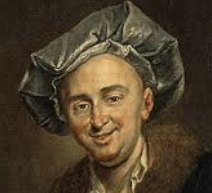
These features show truly the masterOf jollities, laughter and wit;Too bold he was in his natureTo take off the corners of it.He would have been but for one sageThe victim alas! of the fools of his age.
0
⚖0
▼Source
source
M. Desormes (actor and friend of La Mettrie) his lines accompanying the engraving of La Mettrie by .
La Mettrie was born with a fund of natural and inexhaustible gaiety; he had a quick mind, and such a fertile imagination that it made flowers grow in the arid field of medicine. Nature had made him an orator and a philosopher; but a yet more precious gift which he received from her was a pure soul and an obliging heart. All those who are not imposed upon by the pious insults of the theologians mourn in La Mettrie a good man and a wise physician.
0
⚖0
▼Source
source
Frederick the Great, Eulogy at the death of de La Mettrie (1751) as quoted by Paul Carus, "La Mettrie's View of Man as a Machine," The Mechanistic Principle and the Non-mechanical (1913)
Very ingeniously Lamettrie observes that at bottom I am immediately certain only of my own feeling. That other men also feel, I conclude with very much stronger conviction from the expression of their feelings in gestures and cries than from their articulate speech. That energetic language of the emotions is, however, the same in the animals as in men, and it carries with it much stronger proof than all the sophisms of Descartes. ...[T]he internal organisation of man and of the animals offers a perfect analogy. If it remains for the present incomprehensible how the capability of feeling can be an attribute of matter, it is with this, as with a thousand other puzzles, in which, according to an idea of Leibniz, instead of the thing itself we see only the veil that hides it. ...[S]ensation, like motion, must at all events potentially belong to all matter. So thought the ancients, whose philosophy is preferred by all capable minds to the inadequate attempts of the moderns. After this Lamettrie passes to the doctrine of substantial forms...

The 'Natural History of the Soul' begins by showing that as yet no philosopher, from Aristotle down to Malebranche, had been able to account for the nature of the soul.
As a friend, he may have been obliging and self-sacrificing; as an enemy, he was, as in particular had to experience, malicious and low in the choice of his means.
If one's organism is... the preeminent advantage, and the source of all others, education is the second. The best made brain would be a total loss without it...
Julien Offray de la Mettrie, or simply Lamettrie... is one of the most abused, but one of the least read, authors in the history of literature—an author known even superficially to but few of those who thought proper to abuse him when it suited them.
Lamettrie was not only the extremest of the French Materialists, but was the first also in point of time. ...for several decades men could with virtuous indignation condemn this sinner, while they were gradually absorbing his ideas.
Hettner forgets his own chronological data when he maintains that Lamettrie, instigated chiefly by Diderot's 'Pensées Philosophiques,' wrote in 1745 the 'Histoire Naturelle de l'Ame,' and in 1748 'L'Homme Machine;' and in Schlosser's ' History of the World' we may read that Lamettrie was a very ignorant man, who had the impudence to pass off the discoveries and observations of others as his own. Only that in nearly every case where we find a striking similarity of ideas between Lamettrie and any famous contemporary of his, the former had an indisputable priority!
Unity of principle in the multiplicity of organisms... we find it developed with great clearness and distinctness by Lamettrie as early as the 'L'Homme Plante' in 1748. Lamettrie was led to write this treatise by Linné's just published pioneering work on the classification of plants (1747), just as we find in all his writings constant traces of the zealous following up of the newest scientific investigations. Lamettrie cites Linné; none of the later writers think it necessary to cite Lamettrie... Whoever swims with the stream of tradition and neglects the chronology, will of course represent the 'ignorant' Lamettrie as decking himself with borrowed plumes!
[I]n [Lamettrie's] ' Natural History of the Soul,' the Materialism is covered only by a very transparent veil. In the same work we find an idea which in all probability afforded the suggestion for Condillac's sensitive statue [ Traité des sensations].
That the true connection could so long be misrepresented is, next to the influence of Hegel and his school, chiefly to be attributed to the resentment excited by Lamettrie's attack upon the Christian morality. People forgot, in consequence, his theoretical writings; and the calmest and most serious of them, including the 'Natural History of the Soul,' were most completely forgotten.