↑ Back to the start
6 months 1 week ago
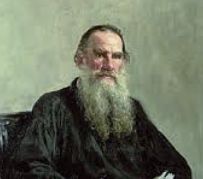
He was a revolutionary in his thinking and later in life he was an activist and reformer; he was best known as Russia's greatest moral authority, and his teachings on civil disobedience have inspired Gandhi, Martin Luther King, Jr. and countless others. He was, and still is, an author to be reckoned with.
0
⚖0
▼ Source
source
[http://www.oprah.com/article/oprahsbookclub/annkarenina/anna_author_bio Brief biography] at Oprah's Book Club
6 months 1 week ago
Even beyond their deaths, the two novelists stand in contrariety. Tolstoy, the foremost heir to the traditions of the epic; Dostoevsky, one of the major dramatic tempers after Shakespeare; Tolstoy, the mind intoxicated with reason and fact; Dostoevsky, the condemner of rationalism, the great lover of paradox; Tolstoy, the poet of the land, of the rural setting and pastoral mood; Dostoevsky, the arch-citizen, the master-builder of the modern metropolis in the province of language; Tolstoy, thirsting for the truth, destroying himself and those about him in excessive pursuit of it; Dostoevsky, rather against the truth than against Christ, suspicious of total understanding and on the side of mystery; Tolstoy, "keeping at all times," in Coleridge's phrase, "in the high road of life"; Dostoevsky, advancing into the labyrinth of the unnatural, into the cellarage and morass of the soul; Tolstoy, like a colossus bestriding the palpable earth, evoking the realness, the tangibility, the sensible entirety of concrete experience; Dostoevsky, always on the verge of the hallucinatory, of the spectral, always vulnerable to daemonic intrusions into what might prove, in the end, to have been merely a tissue of dreams; Tolstoy, the embodiment of health and Olympian vitality; Dostoevsky, the sum of energies charged with illness and possession.

0
⚖0
▼ Source
source
George Steiner in Tolstoy or Dostoevsky: An Essay in the Old Criticism (1959)
6 months 1 week ago
The universal is the unfolding of the potential of diverse and multiple locals, acting in self-organized ways but guided by the common principles of love and reverence for life. Tolstoy wrote from his deathbed: "Understanding that welfare for human beings lies only in their unity, and that unity cannot be attained by violence. Unity can only be reached when each person, not thinking about unity, thinks only about fulfilling the laws of life. Only this supreme law of love, alike for all humans, unifies humanity."
0
⚖0
▼ Source
source
Vandana Shiva Earth Democracy: Justice, Sustainability, and Peace (2005)
6 months 1 week ago
Tostoy's message has not grown out-of-date. In the present "end of an age" when fear and anxiety and collective crime have expanded beyond even Tolstoy's conception of the possibilities, these essays come to us with prophetic force and urgency. He strides like a giant over all the pettifogging economists and politicians and confronts us with his unanswerable accusations, his scorn and his love of life and humanity.
0
⚖0
▼ Source
source
Herbert Read, in a review of "Essays from Tula" by Tolstoy, in Freedom (13 November 1948)
6 months 1 week ago
It has been said that a careful reading of Anna Karenina, if it teaches you nothing else, will teach you how to make strawberry jam.
0
⚖0
▼ Source
source
Julian Mitchell, Radio Times (30 October 1976)
6 months 1 week ago
"Both of them are heresiarchs," Akhmatova used to say about Dostoyevski and Tolstoi. She compared the two greatest Russian writers to twin towers of the same building. Both of them sought salvation from imminent catastrophe, the nature of which was understood by Dostoyevski, though not by Tolstoi. In their actual proposals for salvation both of them exhibited license in the highest degree. In fact, however, not even the best of proposals would have been able to halt a process of decomposition already so far advanced.
0
⚖0
▼ Source
source
Nadezhda Mandelstam Hope Abandoned (1974) Translated from the Russian by Max Hayward
6 months 1 week ago
People of our generation were divided into supporters of Dostoyevski or Tolstoi, and M. tended to lean toward Tolstoi; but in a general sense he was immune to both, since he suspected that the one was just as much a heresiarch as the other.
0
⚖0
▼ Source
source
Nadezhda Mandelstam Hope Abandoned (1974) Translated from the Russian by Max Hayward
6 months 1 week ago
"Garrison was the first to proclaim this principle as a rule for the organization of man's life," Tolstoy acknowledged, and described the "spiritual joy" with which he discovered the existence of kindred thinkers in Garrison, Ballou and the earlier pacifist William Dymond. Later in his life Tolstoy added to the list of Americans who had influenced him, the names of Emerson, Thoreau and Walt Whitman, among others. He was also influenced in his economic views by Henry George's Progress and Poverty. In turn, Tolstoy exerted a considerable influence on American intellectuals, and his ideas inspired a revitalization of the American peace movement.
0
⚖0
▼ Source
source
Gerda Lerner, Why History Matters: Life and Thought (1997)
6 months 1 week ago
It was Jane Addams, the founder of Hull House in Chicago, who most consistently carried Tolstoyan ideas into practice. Addams had visited Tolstoy in Russia and was a lifelong admirer of his work. She well understood the practical implications of his ideas, which she expressed as follows: "Tolstoy would make non-resistance aggressive. He would carry over into the reservoirs of moral influence all the strength which is now spent in coercion and resistance." In his spirit, she advocated "a newer humanitarianism," aggressive in its pursuit of social welfare and international in its reach, as a moral equivalent for war. Addams steadfastly carried these convictions into practice in her peace activities during World War I and her leadership in the postwar Women's International League for Peace and Freedom. She suffered ostracism, vilification and isolation for her pacifism, but she was one of a handful of people who kept the idea and tradition alive in a time of conformity and reaction.
0
⚖0
▼ Source
source
Gerda Lerner, Why History Matters: Life and Thought (1997)
6 months 1 week ago
I was soaked in the Russian novels from the age of fourteen on. I read and reread Tolstoy and Dostoyevsky, and it's obvious to anyone who's familiar with their work that I've been tremendously influenced by them.
0
⚖0
▼ Source
source
1982 interview in Conversations with Ursula Le Guin edited by Carl Freedman (2008)

CivilSimian.com created by AxiomaticPanic, CivilSimian, Kalokagathia