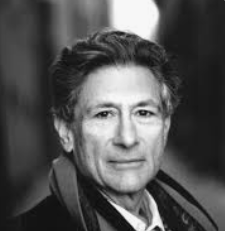
Ideas, cultures, and histories cannot seriously be understood or studied without their force, or more precisely their configurations of power, also being studied.
I retain my faith in the humanist tradition, that it's possible to deal with discrepant experiences truthfully without resolving into simple things like only women should write about women, only Chicanos should write about Chicanos, only Latinos should write about Latinos... I think that's the most damaging crime, and misapprehension of what I'm saying. That's why they debate all these things and they trace them back to me and people say 'you did that!' Absolutely not. I'm talking from a universalistic, if you like cosmopolitan point of view to which I adhere and which is the only way the world makes sense to me. I don't believe in the politics of identity, although in many ways paradoxically I seem to be the father of identity politics, but it's a thing I totally disbelieve in because I realise the damage that identities have done.
The central fact for me is, I think, that the [role of the] intellectual ... cannot be played without a sense of being someone whose place it is publicly to raise embarrassing questions, to confront orthodoxy and dogma (rather than to produce them), to be someone who cannot easily be co-opted by governments or corporations, and whose raison d'être is to represent all those people and issues that are routinely forgotten or swept under the rug. Representation of the Intellectual
An elaborated culture has a density, complexity, and historical-semantic value that is so strong as to make politics possible... Gramsci's insight is to have recognised that subordination, fracturing, diffusion, reproducing, as much as producing, creating, forcing, guiding, are necessary aspects of elaboration.
0
⚖0
▼Source
source
Quoted in Richard Middleton, Studying Popular Music (Philadelphia: Open University Press, 1990, ISBN 0-335-15275-9), p. 248