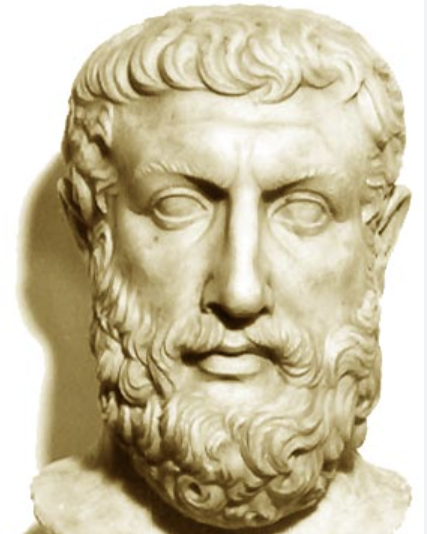
Parmenides believed that all Being is what he called the One, and denied absolutely the possibility of change. He believed that the cosmos is full (i.e., no void), uncreated, eternal, indestructible, unchangeable, immobile sphere of being, and all sensory evidence to the contrary is illusory. One Parmenidean fragment stated, "Either a thing is or it is not," meaning that creation and destruction is impossible.
0
⚖0
▼Source
source
John Freely, [http://books.google.com/books?id=MfhjAAAAQBAJ Before Galileo: The Birth of Modern Science in Medieval Europe] (2012)
The crisis at the heart of Parmenides' argument, "is or is not," rules out any candidate for an ultimate entity in an explanation of what there is that is subject to coming-to-be, passing-away, or alteration of any sort. Such an entity must be a whole, complete, unchanging unity: it must be a thing that is of a single kind … But it does not follow from this that there can be only one such entity. Parmenides' arguments allow for a plurality of fundamental, predicationally unified entities that can be used to explain the world reported by the senses.
0
⚖0
▼Source
source
Patricia Curd, in The Legacy of Parmenides (1997), p. 241
The Greek tradition was a complete contrast to that of the Far East. ...the Greeks placed logic at the pinnacle of human thinking. Their sceptical attitude towards the wielding of 'non-being' as some sort of 'something' that could be subject to logical development was exemplified by Parmenides' influential arguments against the concept of empty space. ...He maintained that you can only speak about what is: what is not cannot be thought of, and what cannot be thought of cannot be. ...more unexpected was the further conclusion that time, motion nor change could exist either.
0
⚖0
▼Source
source
John D. Barrow, The Book of Nothing (2009) chapter one "Zero—The Whole Story" p. 40
The purest example of the Greek desire to comprehend, a desire which in him would have nothing to do with what was not strictly knowable. If later philosophers appear softer by comparison, it is perhaps because of a revivifying compromise they made, one more acceptable and more tolerant of the discourse we perhaps need; but, by the same token, one can perhaps be forgiven for sometimes thinking them dwarfed by the inhuman shadow of the master.
0
⚖0
▼Source
source
Scott Austin, in Parmenides : Being, Bounds, and Logic (1986), p. 154
There is one story left, one road: that it is. And on this road there are very many signs that, being, is uncreated and imperishable, whole, unique, unwavering, and complete.
0
⚖0
▼Source
source
Frag. B 8.1-4, quoted by Simplicius, Commentary on the Physics, 144
Do not let habit, born from experience, force you along this road, directing aimless eye and echoing ear and tongue; but judge by reason the much contested proof which I have spoken.
0
⚖0
▼Source
source
Frag. B 7.3-8.1, quoted by Sextus Empiricus, Against the Mathematicians, vii. 3
The only roads of enquiry there are to think of: one, that it is and that it is not possible for it not to be, this is the path of persuasion (for truth is its companion); the other, that it is not and that it must not be — this I say to you is a path wholly unknowable.
0
⚖0
▼Source
source
Frag. B 2.2-6, quoted by Proclus, Commentary on the Timaeus I, 345