
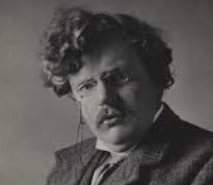
3 months 3 weeks ago
A change of opinions is almost unknown in an elderly military man.
▼
Source
A Utopia of Usurers (1917)
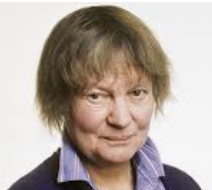
3 months 3 weeks ago
He felt neither guilt nor distress at the pleasure with which he was now filled by the proximity of this young creature, and when he discovered in himself even physical symptoms of his inclination he did not take fright, but continued cheerfully and serenely to see Nick whenever the ordinary run of his duties suggested it, congratulating himself upon the newly achieved solidity and rational calm of his spiritual life.
▼
Source
The Bell (1958) p. 91
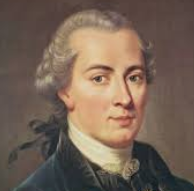
3 months 3 weeks ago
Let us suppose there was a teacher of whom an historical record (or, at least, a widespread belief which is not basically disputable) reports that he was the first to expound publicly a pure and searching religion, comprehensible to the whole world. … Suppose that all he did was done even in the face of a dominant ecclesiastical faith which was onerous and not conducive to moral ends (a faith whose perfunctory worship can serve as a type of all the other faiths, at bottom merely statutory, which were current in the world at the time). Suppose, further, we find that he had made this universal religion of reason the highest and indispensable condition of every religious faith whatsoever … and this without further adding to this faith burdensome new ordinances or wishing to transform acts which he had initiated into peculiar holy practices, required in themselves as being constituent elements of religion. After this description one will not fail to recognize the person who can be referenced, not indeed as the founder of the religion which, free from every dogma, is engraved in all men’s hearts (for it does not have its origin in an arbitrary will), but as the founder of the first true church.
▼
Source
Book IV, Part 1, Section 1, “The Christian religion as a natural religion”
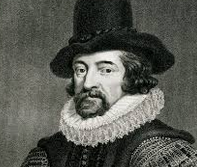
3 months 3 weeks ago
Those who have taken upon them to lay down the law of nature as a thing already searched out and understood, whether they have spoken in simple assurance or professional affectation, have therein done philosophy and the sciences great injury. For as they have been successful in inducing belief, so they have been effective in quenching and stopping inquiry; and have done more harm by spoiling and putting an end to other men's efforts than good by their own. Those on the other hand who have taken a contrary course, and asserted that absolutely nothing can be known — whether it were from hatred of the ancient sophists, or from uncertainty and fluctuation of mind, or even from a kind of fullness of learning, that they fell upon this opinion — have certainly advanced reasons for it that are not to be despised; but yet they have neither started from true principles nor rested in the just conclusion, zeal and affectation having carried them much too far.... Now my method, though hard to practice, is easy to explain; and it is this. I propose to establish progressive stages of certainty. The evidence of the sense, helped and guarded by a certain process of correction, I retain. But the mental operation which follows the act of sense I for the most part reject; and instead of it I open and lay out a new and certain path for the mind to proceed in, starting directly from the simple sensuous perception.
3 months 3 weeks ago
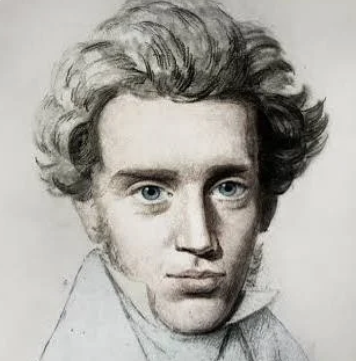
There is no one at the Communion table who retains against you even the least of your sins, no one, unless you yourself do it. So cast them away from yourself, and the recollection of them, lest in it your retain them; and cast the recollection of your having cast your sins away, lest in it you retain them. P. 170
3 months 3 weeks ago
We live in an age of artificial scarcity, maintained by ignorance and fear. The government has been paying farmers not to grow food for fifty years--while millions starve. Labor unions, business and government conspire to hold back the Microprocessor Revolution--because none of them know how to deal with the massive unemployment it will cause. (Fuller's books could tell them.) The utilities advertise continually that "solar power is at least forty years in the future" when my friend Karl Hess, and hundreds of others, already live in largely solar-powered houses. These propaganda advertisements are just a delaying action, because the utilities still haven't figured out how to put a meter between us and the sun.
▼
Source
Right Where You Are Sitting Now: Further Tales of the Illuminati. Berkeley, CA: Ronin Pub., 1993. p. 144.[http://books.google.com/books?id=ee8W8jQIQBQC&pg=PA144]

3 months 3 weeks ago
I met, not long ago, a young man who aspired to become a novelist. Knowing that I was in the profession, he asked me to tell him how he should set to work to realize his ambition. I did my best to explain. 'The first thing,' I said, 'is to buy quite a lot of paper, a bottle of ink, and a pen. After that you merely have to write.'
▼
Source
"Sermons in Cats"
3 months 3 weeks ago
Let me explain a little: Certain things are bad so far as they go, such as pain, and no one, not even a lunatic, calls a tooth-ache good in itself; but a knife which cuts clumsily and with difficulty is called a bad knife, which it certainly is not. It is only not so good as other knives to which men have grown accustomed. A knife is never bad except on such rare occasions as that in which it is neatly and scientifically planted in the middle of one's back. The coarsest and bluntest knife which ever broke a pencil into pieces instead of sharpening it is a good thing in so far as it is a knife. It would have appeared a miracle in the Stone Age. What we call a bad knife is a good knife not good enough for us; what we call a bad hat is a good hat not good enough for us; what we call bad cookery is good cookery not good enough for us; what we call a bad civilization is a good civilization not good enough for us. We choose to call the great mass of the history of mankind bad, not because it is bad, but because we are better. This is palpably an unfair principle. Ivory may not be so white as snow, but the whole Arctic continent does not make ivory black.
▼
Source
"Introduction"
3 months 3 weeks ago
We know that the real lesson to be taught is that the human person is precious and unique; but we seem unable to set it forth except in terms of ideology and abstraction.
▼
Source
Ch. 10, p. 148 (the concluding sentence of the book)
3 months 3 weeks ago
The child must be brought up free (that he allow others to be free). He must learn to endure the restraint to which freedom subjects itself for its own preservation (experience no subordination to his command). Thus he must be disciplined. This precedes instruction. Training must continue without interruption. He must learn to do without things and to be cheerful about it. He must not be obliged to dissimulate, he must acquire immediate horror of lies, must learn so to respect the rights of men that they become an insurmountable wall for him. His instruction must be more negative. He must not learn religion before he knows morality. He must be refined, but not spoiled (pampered). He must learn to speak frankly, and must assume no false shame. Before adolescence he must not learn fine manners ; thoroughness is the chief thing. Thus he is crude longer, but earlier useful and capable.
▼
Source
Part III : Selection on Education from Kant's other Writings, Ch. I Pedagogical Fragments, # 3
3 months 3 weeks ago
Let men learn (as we have said above) the difference that exists between the idols of the human mind, and the ideas of the Divine mind. The former are mere arbitrary abstractions; the latter the true marks of the Creator on his creatures, as they are imprinted on, and defined in matter, by true and exquisite touches. Truth, therefore, and utility are here perfectly identical.
▼
Source
Aphorism 124
3 months 3 weeks ago
In the New Testament sense, to be a Christian is, in an upward sense, as different from being a man as, in a downward sense, to be a man is different from being a beast. A Christian in the sense of the New Testament, although he stands suffering in the midst of life's reality, has yet become completely a stranger to this life; in the words of the Scripture and also of the Collects (which still are read-O bloody satire!-by the sort of priests we now have, and in the ears of the sort of Christians that now live) he is a stranger and a pilgrim-just think, for example of the late Bishop Mynster intoning, “We are strangers and pilgrims in this world”! A Christian in the New Testament sense is literally a stranger and a pilgrim, he feels himself a stranger, and everyone involuntarily feels that this man is a stranger to him.
▼
Source
Attack Upon Christianity, The Instant, No. 7, Søren Kierkegaard, 1854-1855, Walter Lowrie 1944, 1968
3 months 3 weeks ago
Animals outline their territories with their excretions, humans outline their territories by ink excretions on paper.
▼
Source
Ch. 4 : The Anal Emotional Territiorial Circuit, p. 68
3 months 3 weeks ago
In regard to man's final end, all the higher religions are in complete agreement. The purpose of human life is the discovery of Truth, the unitive knowledge of the Godhead. The degree to which this unitive knowledge is achieved here on earth determines the degree to which it will be enjoyed in the posthumous state. Contemplation of truth is the end, action the means.
3 months 3 weeks ago
We are then able to answer in some manner the question, "Why have we no great men?" We have no great men chiefly because we are always looking for them. We are connoisseurs of greatness, and connoisseurs can never be great; we are fastidious, that is, we are small. When Diogenes went about with a lantern looking for an honest man, I am afraid he had very little time to be honest himself. And when anybody goes about on his hands and knees looking for a great man to worship, he is making sure that one man at any rate shall not be great.
▼
Source
Ch 1: "The Dickens Period"
3 months 3 weeks ago
I should liken Kant to a man at a ball, who all evening has been carrying on a love affair with a masked beauty in the vain hope of making a conquest, when at last she throws off her mask and reveals herself to be his wife.
▼
Source
Arthur Schopenhauer, On the Basis of Morality (1840)
3 months 3 weeks ago
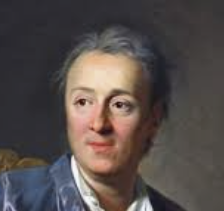
The more man ascends through the past, and the more he launches into the future, the greater he will be, and all these philosophers and ministers and truth-telling men who have fallen victims to the stupidity of nations, the atrocities of priests, the fury of tyrants, what consolation was left for them in death? This: That prejudice would pass, and that posterity would pour out the vial of ignominy upon their enemies. O Posterity! Holy and sacred stay of the unhappy and the oppressed; thou who art just, thou who art incorruptible, thou who findest the good man, who unmaskest the hypocrite, who breakest down the tyrant, may thy sure faith, thy consoling faith never, never abandon me!
▼
Source
As quoted in "Diderot" in The Great Infidels (1881) by Robert Green Ingersoll; The Works of Robert G. Ingersoll Vol. III (1900), p. 367

3 months 3 weeks ago
Logic is the last scientific ingredient of Philosophy; its extraction leaves behind only a confusion of non-scientific, pseudo problems.
▼
Source
p. 22
3 months 3 weeks ago
We can pool information about experiences, but never the experiences themselves. From family to nation, every human group is a society of island universes.
▼
Source
Page 159
3 months 3 weeks ago
We have passed the age of the demagogue, the man who has little to say and says it loud. We have come to the age of the mystagogue or don, the man who has nothing to say, but says it softly and impressively in an indistinct whisper.
▼
Source
"The Philosopher"
3 months 3 weeks ago
The following general definition of an animal: a system of different organic molecules that have combined with one another, under the impulsion of a sensation similar to an obtuse and muffled sense of touch given to them by the creator of matter as a whole, until each one of them has found the most suitable position for it shape and comfort.
▼
Source
No. 51

3 months 3 weeks ago
In its most general form, confinement was explained, or at least justified, by a will to avoid scandal. It thereby signalled an important change in the consciousness of evil. The Renaissance had let unreason in all its forms come out into the light of day, as public exposure gave evil the chance to redeem itself and to serve as an exemplum.
▼
Source
Part One: 5. The Insane
3 months 3 weeks ago
Kirk was an artist, a visionary, almost a prophet.
▼
Source
David Frum, “Russell Kirk” in The New Criterion (1994:16)
3 months 3 weeks ago
It is a political axiom that power follows property.
▼
Source
Chapter 12 (p. 113)
3 months 3 weeks ago
My friends, we will not go again or ape an ancient rage,Or stretch the folly of our youth to be the shame of age,
▼
Source
Ch. XXI: "The Road to Roundabout" ("The Rolling English Road", l. 19)
3 months 3 weeks ago
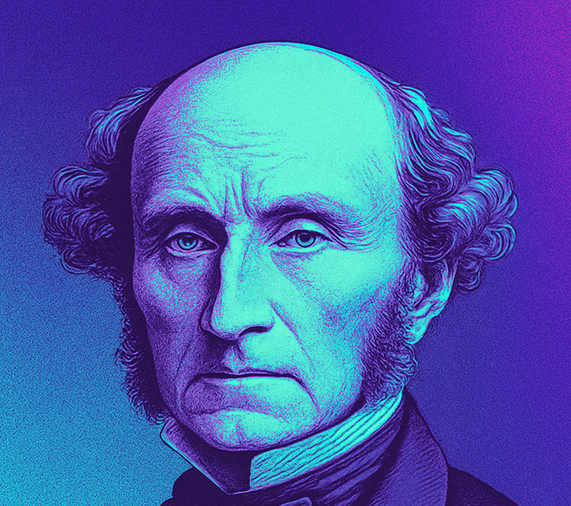
The principle itself of dogmatic religion, dogmatic morality, dogmatic philosophy, is what requires to be rooted out; not any particular manifestation of that principle. ¶ The very corner-stone of an education intended to form great minds, must be the recognition of the principle, that the object is to call forth the greatest possible quantity of intellectual power, and to inspire the intensest love of truth: and this without a particle of regard to the results to which the exercise of that power may lead, even though it should conduct the pupil to opinions diametrically opposite to those of his teachers. We say this, not because we think opinions unimportant, but because of the immense importance which we attach to them; for in proportion to the degree of intellectual power and love of truth which we succeed in creating, is the certainty that (whatever may happen in any one particular instance) in the aggregate of instances true opinions will be the result; and intellectual power and practical love of truth are alike impossible where the reasoner is shown his conclusions, and informed beforehand that he is expected to arrive at them.
▼
Source
"Civilization," London and Westminster Review (April 1836)
3 months 3 weeks ago
Good music is very close to primitive language.
▼
Source
"Correspondence of Ideas with the Motion of Organs"
3 months 3 weeks ago
The criticism of the reformers was directed not so much at the weakness or cruelty of those in authority, as at a bad economy of power.
▼
Source
Chapter Two, pp.. 79

3 months 3 weeks ago
She was beautiful, with a beauty so severe and so solitary that at first it was startling. "Ah! If only there were two of me," she thought, "one doing the talking and one listening, one living and one watching, how I would love myself. I'd envy no one."
▼
Source
p. 5
3 months 3 weeks ago
Even the tyrant never rules by force alone; but mostly by fairy tales. And so it is with the modern tyrant, the great employer. The sight of a millionaire is seldom, in the ordinary sense, an enchanting sight: nevertheless, he is in his way an enchanter. As they say in the gushing articles about him in the magazines, he is a fascinating personality. So is a snake. At least he is fascinating to rabbits; and so is the millionaire to the rabbit-witted sort of people that ladies and gentlemen have allowed themselves to become.
▼
Source
p. 19
3 months 3 weeks ago
Human nature is not a machine to be built after a model, and set to do exactly the work prescribed for it, but a tree, which requires to grow and develop itself on all sides, according to the tendency of the inward forces which make it a living thing.
▼
Source
Ch. III: Of Individuality, As One of the Elements of Well-Being
3 months 3 weeks ago
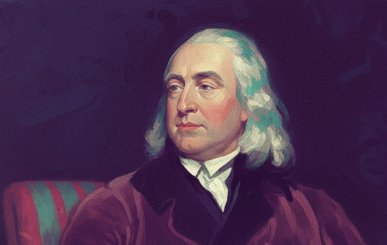
Lawyers are the only persons in whom ignorance of the law is not punished.
▼
Source
Attributed to Bentham in The Dictionary of Humorous Quotations (1949) by Evan Esar, p. 29; no earlier sources for this have been located.
3 months 3 weeks ago
The new governmental reason does not deal with what I would call the things in themselves of governmentality, such as individuals, things, wealth, and land. It no longer deals with these things in themselves. It deals with the phenomena of politics, that is to say, interests, which precisely constitute politics and its stakes; it deals with interests, or that respect in which a given individual, thing, wealth, and so on interests other individuals or the collective body of individuals. ... In the new regime, government is basically no longer to be exercised over subjects and other things subjected through these subjects. Government is now to be exercised over what we could call the phenomenal republic of interests. The fundamental question of liberalism is: What is the utility value of government and all actions of government in a society where exchange determines the value of things?
▼
Source
Lecture 2, January 17, 1979, pp. 45-46
3 months 3 weeks ago
Woman is an existent who is called upon to make herself object; as subject she has an aggressive element in her sensuality which is not satisfied on the male body: hence the conflicts that her eroticism must somehow overcome.
▼
Source
Bk. 2, Pt.. 3, Ch. 4: The Lesbian. P. 445 (1974 Vintage edition)
3 months 3 weeks ago
In the matter of reforming things, as distinct from deforming them, there is one plain and simple principle; a principle which will probably be called a paradox. There exists in such a case a certain institution or law; let us say, for the sake of simplicity, a fence or gate erected across a road. The more modern type of reformer goes gaily up to it and says, "I don't see the use of this; let us clear it away." To which the more intelligent type of reformer will do well to answer: "If you don't see the use of it, I certainly won't let you clear it away. Go away and think. Then, when you can come back and tell me that you do see the use of it, I may allow you to destroy it." This paradox rests on the most elementary common sense. The gate or fence did not grow there. It was not set up by somnambulists who built it in their sleep. It is highly improbable that it was put there by escaped lunatics who were for some reason loose in the street. Some person had some reason for thinking it would be a good thing for somebody. And until we know what the reason was, we really cannot judge whether the reason was reasonable. It is extremely probable that we have overlooked some whole aspect of the question, if something set up by human beings like ourselves seems to be entirely meaningless and mysterious. There are reformers who get over this difficulty by assuming that all their fathers were fools; but if that be so, we can only say that folly appears to be a hereditary disease. But the truth is that nobody has any business to destroy a social institution until he has really seen it as an historical institution. If he knows how it arose, and what purposes it was supposed to serve, he may really be able to say that they were bad purposes, or that they have since become bad purposes, or that they are purposes which are no longer served. But if he simply stares at the thing as a senseless monstrosity that has somehow sprung up in his path, it is he and not the traditionalist who is suffering from an illusion.
▼
Source
Ch. IV: The Drift From Domesticity
3 months 3 weeks ago
Stupidity is much the same all the world over. A stupid person's notions and feelings may confidently be inferred from those which prevail in the circle by which the person is surrounded. Not so with those whose opinions and feelings are an emanation from their own nature and faculties.
▼
Source
Ch. 1
3 months 3 weeks ago
In order for parrhesia to have positive political effects, it must... be linked to a good education, to intellectual and moral formation, to paideia or mathesis.
3 months 3 weeks ago
How singular is the thing called pleasure, and how curiously related to pain, which might be thought to be the opposite of it; for they never come to a man together, and yet he who pursues either of them is generally compelled to take the other. They are two, and yet they grow together out of one head or stem.
3 months 3 weeks ago
No philosopher would be willing to accept the idea of philosophy as a way of escape, but might there not be a question of the philosopher being in duty bound to refuse to accept a world, like our real world here, of disorder and crime where the values of the mind and spirit can no longer find a home?
▼
Source
p. 116
3 months 3 weeks ago
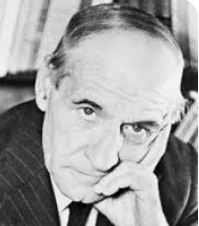
My father was as well aware as anyone that Christians do not, in general, undergo the demoralizing consequences which seem inherent in such a creed, in the manner or to the extent which might have been expected from it. The same slovenliness of thought, and subjection of the reason to fears, wishes, and affections, which enable them to accept a theory involving a contradiction in terms, prevents them from perceiving the logical consequences of the theory. Such is the facility with which mankind believe at one and the same time things inconsistent with one another, and so few are those who draw from what they receive as truths, any consequences but those recommended to them by their feelings, that multitudes have held the undoubting belief in an Omnipotent Author of Hell, and have nevertheless identified that being with the best conception they were able to form of perfect goodness.
▼
Source
([https://archive.org/details/autobiography01mill/page/41/mode/1up pp. 41–42])
3 months 3 weeks ago
I often asked myself the following question. There is no doubt that at all times for many men one of the greatest tortures of their lives has been the contact, the collision with the folly of their neighbours. And yet how is it that there has never been attempted — I think this is so — a study on this matter, an Essay on Folly? For the pages of Erasmus do not treat of this aspect of the matter.
▼
Source
Chap. VIII: The Masses Intervene In Everything, And Why Their Intervention Is Solely By Violence
3 months 3 weeks ago
As there are misanthropists, or haters of men, there are also misologists or haters of ideas, and both spring from the same cause, which is ignorance of the world. Misanthropy arises from too great confidence of inexperience; you trust a man and think him altogether true and good and faithful, and then in a little while he turns out to be false and knavish; and then another and another, and when this has happened several times to a man, especially within the circle of his most trusted friends, as he deems them, and he has often quarreled with them, he at last hates all men, and believes that no one has any good in him at all. ...The reason is that a man, having to deal with other men, has no knowledge of them; for if he had knowledge he would have known the true state of the case, that few are the good and few the evil, and that the great majority are in the interval between them.

3 months 3 weeks ago
What is dignity? The measure of liberty.
3 months 3 weeks ago
All those to whom I looked up, were of opinion that the pleasure of sympathy with human beings, and the feelings which made the good of others, and especially of mankind on a large scale, the object of existence, were the greatest and surest sources of happiness. Of the truth of this I was convinced, but to know that a feeling would make me happy if I had it, did not give me the feeling.
▼
Source
([https://archive.org/details/autobiography01mill/page/138/mode/1up p. 138])
3 months 3 weeks ago
That science is incapable of solving in its own way those fundamental questions is no sufficient reason for slighting them
▼
Source
p. 14

3 months 3 weeks ago
Whatever this is that I am, it is flesh and a little spirit and an intelligence.
▼
Source
This that I am, whatever it be, is mere flesh and a little breathe and the ruling Reason (Haines translation) | This Being of mine, whatever it really is, consists of a little flesh, a little breath, and the part which governs. | A little flesh, a little
3 months 3 weeks ago
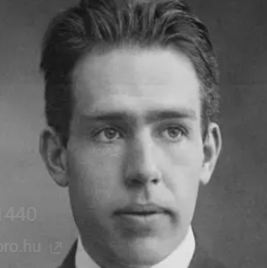
Two sorts of truth: profound truths recognized by the fact that the opposite is also a profound truth, in contrast to trivialities where opposites are obviously absurd.
▼
Source
As quoted by his son Hans Bohr in "My Father", published in Niels Bohr: His Life and Work (1967), p. 328 | Unsourced variant: The opposite of a correct statement is a false statement. But the opposite of a profound truth may well be another profound truth
3 months 3 weeks ago
What do you say about making a libation out of this cup to any god? ...I may and I must pray to the gods to prosper my journey from this to that other world—may this, then, which is my prayer, be granted to me. [Then holding the cup to his lips, quite readily and cheerfully he drank off the poison. And hitherto most of us had been able to control their sorrow; but now, when we saw him drinking, and saw too, that he had finished the draft, we could no longer forbear, and in spite of myself my own tears were flowing fast; so that I covered my face and wept over myself, for certainly I was not weeping over him, but at my own calamity at having lost such a companion. Nor was I the first, for Crito, when he found himself unable to restrain his tears, had got up, and moved away, and I followed; and at that moment, Apollodorus, who had been weeping all the time, broke out in a loud cry which made cowards of us all. Socrates alone retained his calmness:] What is this strange outcry? ...I sent away the women mainly in order that they might not offend in this way, for I have heard that a man should die in peace. Be quiet then, and have patience.
3 months 3 weeks ago
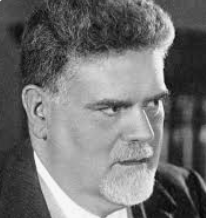
The Fascist, on the other hand, conceives philosophy as a philosophy of practice (”praxis”). That concept was the product of certain Marxist and Sorellian inspirations (many Fascists and the Duce, himself, received their first intellectual education in the school of Marx and Sorel)—as well as the influence of contemporary Italian idealistic doctrines from which Fascist mentality drew substance and achieved maturity.
▼
Source
“The Philosophy of Fascism,” first published in English in the Spectator, November 1928, pp. 36-37. Reprinted in Origins and Doctrine of Fascism, A. James Gregor, translator and editor, Transaction Publishers (2003) p. 33
3 months 3 weeks ago
I well knew that to propose something which would be called extreme, was the true way not to impede but to facilitate a more moderate experiment.
▼
Source
([https://archive.org/details/autobiography01mill/page/294/mode/1up p. 294])
CivilSimian.com created by AxiomaticPanic, CivilSimian, Kalokagathia