
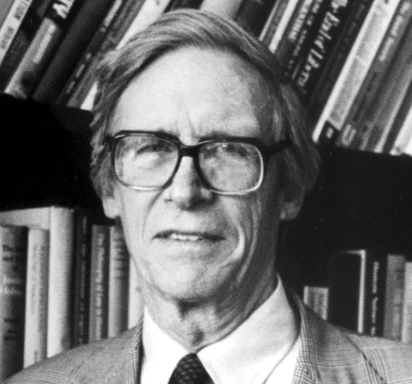
John Rawls — Justice as Fairness, the Veil of Ignorance, and the Difference Principle (1921–2002)
John Bordley Rawls was an American political philosopher — born on 21 February 1921 in Baltimore, Maryland, who grew up in a family struck by personal tragedy: two of his younger brothers died after contracting illnesses from him — diphtheria, then pneumonia — an experience of chance and undeserved suffering that shaped his lifelong preoccupation with moral luck and the arbitrary distribution of natural and social advantage. He grew up in racially segregated Baltimore, attended Kent School in Connecticut and Princeton University, and served as an infantryman in the Pacific during World War Two, seeing combat in New Guinea, the Philippines, and Japan, including time at the occupation of Japan after the atomic bombings. He left the army as a private — he had declined promotion — and returned to Princeton, earning his PhD in 1950, teaching at Cornell, MIT, and then Harvard from 1962, where he remained for the rest of his career. He suffered a series of strokes beginning in 1995 that substantially limited his ability to work. He died in Lexington, Massachusetts on 24 November 2002.
His major works were "A Theory of Justice" (1971) — almost certainly the most important work of political philosophy published in the twentieth century, which revived systematic normative political philosophy at a moment when many philosophers had concluded that normative political philosophy was impossible — "Political Liberalism" (1993), which substantially revised the foundations of his theory in response to communitarian critics, "The Law of Peoples" (1999), and "Justice as Fairness: A Restatement" (2001). In 1971 he taught a semester-long course with Robert Nozick titled "Capitalism and Socialism." Both books that came out of that course — Rawls's "Theory" and Nozick's "Anarchy, State, and Utopia" — defined the range of political philosophy for the next half century.
His central concern, consistent across three decades of continuous revision: to specify the principles of justice that free and equal citizens would agree to under fair conditions — principles that would govern the basic structure of society in a way that none could reasonably reject.
The Wartime Formation — Chance, Suffering, and Moral Luck
Two biographical facts shaped Rawls's philosophy more than any academic influence. The first was the deaths of his brothers from diseases contracted from him — chance events that killed others while leaving him unharmed, and that raised in acute personal form the question of what was owed to those who suffered through no fault of their own. The second was his wartime experience in the Pacific, which included seeing the results of the atomic bombings of Hiroshima and Nagasaki — an experience that moved him to write, late in life, a short essay arguing that the bombings were morally unjustified, violating the laws of war and the principle of discrimination between combatants and civilians. He declined promotion during his service, and his biographers have suggested that the combination of personal loss, combat experience, and encounters with arbitrary death and destruction produced in him the philosophical conviction that the distribution of advantage in human society was morally arbitrary in the same way — that those who were born talented, or healthy, or wealthy, or in a just society had not earned these advantages any more than he had earned his survival and his brothers had earned their deaths.
"Rawls's career is guided by a reasonable faith that a just society is realistically possible."
— Samuel Freeman, editor of Rawls's Collected Papers
Against Utilitarianism — The Separateness of Persons
The philosophical target of "A Theory of Justice" was utilitarianism — the dominant tradition in Anglo-American moral and political philosophy — which Rawls believed failed to respect what he called "the separateness of persons." Utilitarianism maximized aggregate welfare across society — it justified policies that produced the greatest happiness for the greatest number, even if this required sacrificing the interests of some individuals for the benefit of many others. The logic was that the aggregate gain outweighed the individual loss — but this logic, Rawls argued, treated persons as mere vessels for welfare to be added up and traded off, rather than as separate individuals each with their own life that could not be compensated by gains to others. "There is no one who suffers the sacrifice. Different persons sustain the different benefits and burdens." Each person's life was incommensurable with every other's: the suffering of one person was not cancelled by the welfare of another.
This critique aligned Rawls with the Kantian tradition that insisted on treating persons as ends in themselves — never merely as means to aggregate outcomes. But where Kant had derived the principles of justice from pure practical reason alone, Rawls sought a more politically grounded foundation: the principles that persons could agree to under fair conditions, which he developed through the device of the "original position."
"Utilitarianism does not take seriously the distinction between persons. Each member of society is thought to have an inviolability founded on justice that even the welfare of society as a whole cannot override."
— Rawls, A Theory of Justice
The Original Position and the Veil of Ignorance
The "original position" was Rawls's central device for identifying principles of justice — a hypothetical situation in which representatives of citizens chose the basic structure of their society without knowing their own position within it. Behind the "veil of ignorance," the parties did not know: their social class or economic status; their natural assets and abilities; their conception of the good — their values, life plans, and religious convictions; their generation; or even the particular facts about their society. They knew only the general facts of social science and human psychology — enough to reason about the consequences of different institutional choices.
The veil of ignorance was designed to model impartiality: by stripping away the particular facts that led people to favor principles that happened to benefit those in their situation, it forced the parties to choose principles that were fair from every position — that no one could reasonably reject. Since no party knew whether they would be the most or least advantaged, they would choose principles that protected the worst-off position — applying what Rawls called the "maximin" rule: maximize the minimum — make the worst-off position as good as possible.
"The veil of ignorance prevents anyone from knowing their social status, wealth, abilities, race, gender, or conception of the good. By depriving the parties of all facts that make them who they are and that might bias their choice in their own favor, the original position models the impartiality that justice requires."
The Two Principles — Liberty and Difference
Rawls argued that parties behind the veil of ignorance would choose two principles of justice, in strict lexical order — the first having absolute priority over the second. The first principle: each person has the same indefeasible claim to a fully adequate scheme of equal basic liberties compatible with the same scheme of liberties for all. No social or economic consideration could override basic liberties — freedom of thought and conscience, political liberties, freedom of the person. The first principle was lexically prior: no improvement in the second principle's terms could justify any violation of the first.
The second principle — the "difference principle" — governed social and economic inequalities: they were justified only if they were to the greatest benefit of the least advantaged members of society and attached to positions open to all under fair equality of opportunity. The difference principle was Rawls's most original and most debated contribution. It did not demand equality of outcome — it permitted inequalities whenever those inequalities improved the situation of the worst-off group compared to what strict equality would produce. If allowing a talented engineer higher pay gave her an incentive to work more productively, and if this productivity benefited even the least skilled workers through economic growth — then the inequality was just. But inequalities that did not benefit the least advantaged were unjust — not merely regrettable but a violation of what society owed its members.
"Social and economic inequalities are to be arranged so that they are to the greatest benefit of the least advantaged members of society. The difference principle holds that the better endowed are to benefit from their good fortune only on terms that improve the situation of those who have lost out."
— Rawls, A Theory of Justice
Political Liberalism — The Turn to Reasonable Pluralism
The communitarian critics of "A Theory of Justice" — Sandel, MacIntyre, Walzer, Taylor — had argued that Rawls's theory rested on a "comprehensive doctrine" — a full moral and metaphysical view about the nature of persons and the good — that citizens of a pluralistic democracy could reasonably reject. A liberal theory that appealed to a particular conception of the self and of practical reason was not as neutral as it claimed to be. "Political Liberalism" (1993) was Rawls's sustained response.
He acknowledged that a just society could not be built on any single comprehensive moral, philosophical, or religious doctrine — because free persons in a liberal democracy would reasonably disagree about such doctrines, and this disagreement was not a failure but an "inevitable long-term result of the powers of human reason at work under free institutions." His solution: justice as fairness was a "political conception" — a conception of justice that was "freestanding," not derived from any particular comprehensive doctrine, but capable of being endorsed by adherents of many different doctrines for their own internal reasons. This "overlapping consensus" — citizens agreeing on the principles of justice while disagreeing about the deeper reasons for them — was the most stable foundation a pluralistic liberal democracy could have. Political justification had to proceed through "public reason" — reasons that all citizens could in principle accept — not through appeal to contested metaphysical or religious premises.
"Reasonable pluralism is not a disaster but the natural outcome of the exercise of human reason under free institutions. The question is not how to achieve agreement on a comprehensive doctrine but how to identify the principles of justice on which citizens holding incompatible comprehensive doctrines can nonetheless agree for their own reasons — an overlapping consensus."
— Rawls, Political Liberalism
Legacy — The Revival of Political Philosophy
"A Theory of Justice" is almost universally regarded as the most important work of political philosophy published in the twentieth century — not because its conclusions were universally accepted but because it revived a tradition that many had declared dead. By 1971, the dominant view in Anglo-American philosophy was that normative political philosophy was impossible — that questions about what justice required were unanswerable or reducible to questions of preference and empirical fact. Rawls demonstrated that systematic, rigorous, philosophically serious normative political philosophy was possible, and in doing so reopened a conversation that Nozick, Dworkin, Cohen, Sandel, Walzer, Habermas, and Sen all entered, largely in response to him. Every major work of political philosophy in the last fifty years has been written in his shadow.
On CivSim he is the central figure of the contemporary tradition — the thinker whose framework most directly captures what Universal Humanism seeks to articulate. The veil of ignorance is the philosophical device that operationalizes the demand for impartiality — that translates the intuition that each person's life matters equally into a procedure for selecting principles of justice. The difference principle is the specific institutional implication of taking the least advantaged seriously. His challenge to his own system — and therefore to Universal Humanism — is the one he never fully resolved: can the principles of justice be justified to all reasonable citizens without appealing to a comprehensive doctrine? Or does the very concept of "reasonableness" smuggle in the values it was supposed to remain neutral between?
"Each person possesses an inviolability founded on justice that even the welfare of society as a whole cannot override. For this reason justice denies that the loss of freedom for some is made right by a greater good shared by others."
— Rawls, A Theory of Justice
CivilSimian.com created by AxiomaticPanic, CivilSimian, Kalokagathia