
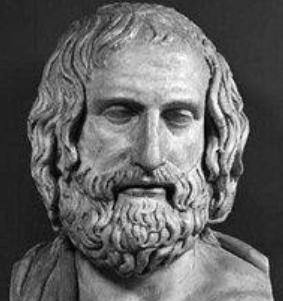
Anaxagoras — Mind in the Cosmos and the Birth of Scientific Explanation (c. 500–428 BCE)
Anaxagoras was the first philosopher to bring the heavens down to earth without stripping them of wonder. He explained cosmic phenomena without myth, introduced mind as a governing principle of nature, and helped pivot Greek thought from poetic cosmology toward rational science.
From the Periphery to Athens
Born in Clazomenae in Ionia, Anaxagoras came from the same intellectual coastline that produced Thales, Anaximander, and Heraclitus. Unlike them, however, he eventually moved to Athens, making him one of the first major philosophers to place inquiry at the heart of political and cultural life.
In Athens he became associated with Pericles and helped cultivate an atmosphere in which reason, debate, and explanation could rival tradition and myth. This intellectual boldness would ultimately place him in danger.
“All things were together; then mind came and set them in order.”
Nous — Mind as the Ordering Principle
Anaxagoras introduced one of the most influential ideas in ancient philosophy: Nous, or Mind. Unlike the gods of myth, Nous does not intervene arbitrarily. It initiates motion, imposes order, and allows the cosmos to unfold according to intelligible patterns.
Mind, for Anaxagoras, is pure, unmixed, and autonomous. It does not become entangled in matter, yet it knows and governs all things. This was neither personal deity nor mechanical force, but a rational principle bridging explanation and purpose.
“Mind has power over all things that have life.”
Everything in Everything
Anaxagoras rejected the idea that things come into being from nothing. Instead, he argued that all substances contain portions of all others — what later thinkers called “seeds.” Change is not creation or destruction, but rearrangement and predominance.
Bread nourishes flesh because flesh is already present within it, in minute proportions. This radical claim dissolved sharp boundaries between substances and anticipated later notions of composition and mixture.
“In everything there is a share of everything.”
The Sun Is Not a God
Anaxagoras famously declared that the sun was a red-hot stone larger than the Peloponnese, and that the moon reflected its light. Eclipses, he argued, had natural causes, not divine intention.
These claims marked a decisive break with religious cosmology. For explaining the heavens without reverence, Anaxagoras was charged with impiety. He narrowly escaped execution and spent his final years in exile.
“The sun is a mass of glowing stone.”
Influence on Socrates and Plato
Anaxagoras deeply influenced Athenian philosophy. Socrates admired his introduction of Mind but ultimately found it incomplete, disappointed that Nous explained motion without grounding ethics or meaning.
Plato inherited both the promise and the problem. The idea that intelligence structures reality would resurface in Plato’s Forms and later in Aristotle’s Unmoved Mover. Anaxagoras planted the seed; others tried to make it flourish.
“He seemed like a sober man among the drunk.”
Legacy — Reason Without Myth
Anaxagoras stands at a turning point in intellectual history. He showed that nature could be explained without divine storytelling, yet without reducing reality to blind mechanism. His cosmos is lawful, intelligible, and ordered by mind.
In exile and controversy, he helped invent the very idea that the universe is something we can understand — not by revelation, but by thought.
“Mind is infinite and self-ruling.”
CivilSimian.com created by AxiomaticPanic, CivilSimian, Kalokagathia