
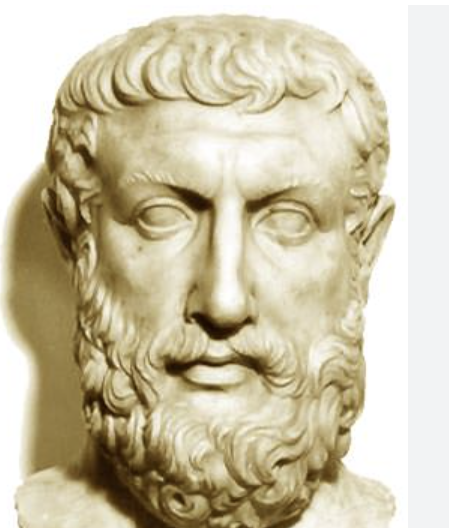
Melissus of Samos — The Infinite One and the Defense of Eleatic Philosophy (fl. c. 440 BC)
Melissus of Samos was a Greek philosopher and naval commander whose rigorous development of Eleatic monism made him the last and in some ways the most systematic representative of the school founded by Parmenides.
A man of practical as well as philosophical distinction — he defeated the Athenian fleet under Pericles in 441 BC — he brought a military commander's taste for clear argument and decisive conclusion to the most abstract questions of Greek metaphysics.
His central concern: that reality is one, unchanging, and infinite — and that the appearances of plurality, motion, and change that constitute ordinary experience are not reports of what is but illusions generated by the inadequacy of the senses.
The Eleatic Inheritance — Parmenides and the Way of Truth
To understand Melissus it is necessary to understand the extraordinary philosophical provocation that Parmenides had launched a generation earlier.
Parmenides had argued that genuine being must be one, ungenerated, indestructible, and unchanging — that the very concept of coming-into-being or passing-away is incoherent, since it would require something to come from nothing or return to nothing, and nothing cannot be. What is, is. What is not, is not and cannot be thought. Change, plurality, and motion are therefore impossible — appearances only, not reality.
This was a conclusion so counterintuitive that it divided Greek philosophy for a century — forcing every subsequent thinker to either refute it or find a way to accommodate it. Melissus chose to defend and extend it, producing the clearest surviving prose account of the Eleatic position.
Where Parmenides had written in obscure verse, Melissus wrote in plain argumentative prose — a philosophical innovation as significant in its way as the doctrines it conveyed.
"Nothing that is real can have a beginning or an end — for if it began, before it began it was nothing, and from nothing nothing can come."
The Infinite One — Melissus's Innovation
Melissus accepted Parmenides's core conclusions but introduced one significant modification that proved philosophically consequential: where Parmenides had described the One as finite — bounded like a well-rounded sphere — Melissus argued that it must be spatially infinite.
His reasoning was characteristic in its simplicity: if the One were finite, it would be bounded by something. But beyond the One there is nothing — and nothing cannot be a boundary. Therefore the One must be without limit, spatially infinite.
This move had large consequences. An infinite One cannot be a sphere — Parmenides's image was quietly abandoned. And an infinite, eternal, unchanging unity bears a closer resemblance to later conceptions of God, of the absolute, and of the physical universe than anything in Parmenides's more geometrically constrained version.
Aristotle criticized Melissus at length — a reliable sign that he was taken seriously.
"Since it did not come into being, it is and always was and always will be, and has no beginning and no end, but is infinite."
Against Motion, Plurality, and Pain
Melissus extended the Eleatic attack on the senses with a series of arguments against motion, change, plurality, and even against pain and grief — all of which, he argued, presuppose the reality of what is not, and therefore cannot belong to genuine being.
If the One is full — containing no void — then nothing can move, since motion requires empty space into which to move. If it is one, there can be no plurality of things. If it is eternal and unchanging, there can be no generation, destruction, growth, or alteration.
Pain, he argued, is incompatible with true being — a being in pain lacks something it needs, and a being that lacks something is not complete, and a being that is not complete is not truly one. This extension of the argument from metaphysics to experience is one of the stranger moves in ancient philosophy — and one of the most revealing about where the logic leads when followed without compromise.
The conclusion — that genuine reality is eternal, infinite, unchanging, painless, and undivided — is as far from ordinary experience as philosophy has ever ventured.
"If it were many, things would have to be of the same kind as I say the one is."
The Philosopher Admiral
Melissus is one of philosophy's more unexpected biographical figures — a man who commanded fleets as well as arguments. In 441 BC he led the Samian navy to a significant victory against an Athenian fleet that included Pericles himself, exploiting a moment of Athenian complacency to inflict a defeat that delayed the subjugation of Samos and won him lasting military honor.
The combination of philosophical rigour and military command was not as unusual in the ancient world as it would be today — Xenophon, Thucydides, and others moved between intellectual and military life without apparent contradiction. But Melissus remains distinctive in having excelled at the most abstract and the most practical of pursuits simultaneously.
Plutarch records that Aristotle mentioned him as both a philosopher and a statesman of Samos — a dual distinction that philosophy has rarely since combined with such apparent ease.
"The strongest argument is not the one that shouts loudest but the one that cannot be answered."
— attributed to Melissus in the ancient tradition
Legacy — The Argument That Forced a Response
Melissus survives only in fragments and in the extensive critical attention Aristotle paid him — which is itself a measure of his importance. Aristotle disagreed with him on virtually every point but found his arguments precise enough to require precise refutation.
The Eleatic challenge that Melissus crystallized forced Greek philosophy to develop the conceptual tools it needed to explain change, motion, and plurality — tools that Plato's theory of Forms, Aristotle's distinction between actuality and potentiality, and the atomism of Democritus were all, in different ways, designed to provide.
Without the Eleatic provocation, the most productive period in Greek metaphysics might never have generated its defining questions. Melissus, by pressing the monist argument to its most uncompromising conclusions, made the richness of subsequent philosophy necessary.
He is the rare thinker whose importance lies not in being right but in being so clearly and consequentially wrong that everyone else had to think harder.
"If things are many, they must each be such as I say the one is — and this is impossible."
CivilSimian.com created by AxiomaticPanic, CivilSimian, Kalokagathia