
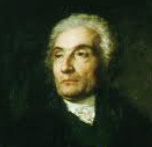
Joseph de Maistre — Sovereignty, Providence, and the Counter-Revolution (1753–1821)
Joseph de Maistre was a Savoyard diplomat, philosopher, and polemicist whose ferocious response to the French Revolution produced the most uncompromising and intellectually serious statement of counter-revolutionary thought in the Western tradition.
A Catholic royalist of fierce conviction, he rejected the entire edifice of Enlightenment rationalism — its faith in reason, its universalism, its confidence in human progress — and replaced it with a vision of human nature as irredeemably fallen, violent, and in permanent need of authority, tradition, and sacred power.
His central concern: that the attempt to remake society according to abstract rational principles does not liberate humanity but unleashes its darkest capacities — and that only the submission of reason to authority and faith can hold the chaos of human nature in check.
Against the Revolution and Its Principles
De Maistre watched the French Revolution unfold from across the Alps with a mixture of horror and grim vindication. The Terror, for him, was not an aberration of the revolutionary project but its logical conclusion — the inevitable result of attempting to construct a political order on the basis of abstract universal rights rather than inherited custom, religion, and authority.
His "Considerations on France," written in 1797, argued that the Revolution was a providential punishment — God's judgment on a civilization that had abandoned its spiritual foundations for the vanity of Enlightenment philosophy. The bloodshed was not accidental. It was the price of apostasy.
He attacked the very concept of a written constitution designed from first principles — arguing that no durable political order had ever been established by deliberate rational construction. Constitutions grow; they are not made. What men invent, men can destroy. What time and tradition have built carries an authority no document can replicate.
The Declaration of the Rights of Man, with its invocation of universal human nature, struck him as a particularly dangerous fiction — he had never, he said, met a man. He had met Frenchmen, Italians, Russians — never the abstract universal individual on whom the revolutionary project was founded.
"The constitution of 1795, like its predecessors, has been made for man. But there is no such thing as man in the world. During my life, I have seen Frenchmen, Italians, Russians — I know too, thanks to Montesquieu, that one can be a Persian; but I declare that I have never met man in my life."
The Executioner and the Sacred Violence
De Maistre's most disturbing and most original pages concern the figure of the executioner — the man who carries out the death sentence of the state.
In his "St. Petersburg Dialogues" he opens with an extended meditation on this figure: outcast from society, yet indispensable to it, the executioner is the hinge on which social order turns. Remove him and all human order collapses into chaos. He is both the most abject and the most necessary of men.
This was not mere provocation. De Maistre was making a serious argument: that legitimate social order rests not on rational consent but on the capacity for sanctioned violence — and that this capacity has a sacred dimension that liberal political theory systematically conceals from itself.
Isaiah Berlin, who wrote one of the most penetrating studies of de Maistre, identified him as a proto-fascist whose ideas about violence, authority, and the irrationality of social order anticipated much of what the twentieth century would produce. The claim is not without foundation.
"All greatness, all power, all social order depends upon the executioner. He is the terror of human society and the tie that holds it together."
Papal Authority and the Sovereignty of God
De Maistre's "Du Pape," published in 1819, argued for the absolute sovereignty of the Pope over all temporal and spiritual authority — a position so extreme it alarmed even many Catholics.
His argument moved from political philosophy to theology and back again with characteristic force: every political order requires a sovereign — a final authority from which there is no appeal. In the international order, only the Pope can occupy that position, providing a check on the absolute claims of nation states and a spiritual foundation for legitimate authority.
Without a transcendent source of authority above and beyond any merely human institution, sovereignty becomes a naked assertion of force — the will of the strongest dressed in the language of right. De Maistre preferred honest theocracy to dishonest liberalism.
The argument was widely rejected in his own time. But his identification of the problem — where does legitimate authority ultimately come from? — remains one of political philosophy's unsolved questions.
"Every nation has the government it deserves."
Human Nature and Original Sin
At the foundation of de Maistre's thought lies a doctrine of human nature more pessimistic than almost any other in the Western philosophical tradition.
Man is not, as the Enlightenment assumed, naturally good and corrupted by institutions. He is naturally violent, naturally irrational, naturally prone to destruction — and the institutions of religion, monarchy, and tradition are not the sources of his oppression but the fragile structures that contain his worst capacities.
War, he argued with chilling consistency, is not an aberration of the human condition but one of its permanent features — a divine ordinance as mysterious as it is terrible, through which Providence works its purposes in ways that human reason cannot comprehend.
This is a position that demands honest engagement rather than easy dismissal — the twentieth century provides substantial evidence for a darkened view of human nature, even if de Maistre's conclusions do not follow.
"War is divine in the mysterious glory that surrounds it and in no less mysterious attraction that draws men to it."
Legacy — The Dark Mirror of Liberalism
De Maistre is indispensable not because he was right but because he identified, with greater clarity than most liberals, what liberalism has difficulty accounting for — the role of violence in founding and maintaining order, the dependence of rational institutions on pre-rational loyalties, the limits of abstract universalism as a basis for political community.
Isaiah Berlin regarded him as one of the most dangerous thinkers in the Western tradition — precisely because his arguments were serious, his observations often accurate, and his conclusions monstrous. That combination, Berlin warned, is more threatening than simple error.
He sits in an uncomfortable triangle with Schmitt and Evola on CivSim — three thinkers who saw the violence and irrationality beneath the surface of liberal order and drew from that perception not a call for reform but for submission to something older and darker.
Reading him honestly means neither dismissing his diagnoses nor following his prescriptions — holding the legitimate questions he raises against the illegitimate answers he offers, and refusing the comfort of pretending the questions go away.
"False opinions are like false money — struck first of all by guilty men and thereafter circulated by honest people who perpetuate the crime without knowing what they do."
CivilSimian.com created by AxiomaticPanic, CivilSimian, Kalokagathia