
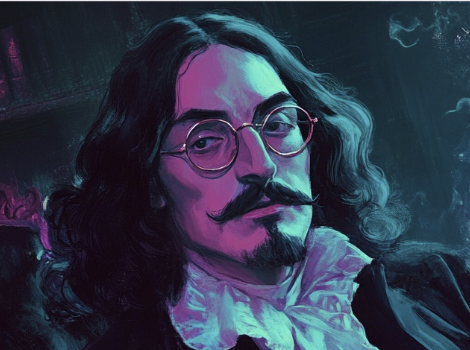
René Descartes — The Architect of Modern Philosophy (1596–1650)
Descartes was the thinker who cleared the intellectual slate of the medieval world and rebuilt it from the ground up. He sought certainty in an age of confusion, and in doing so, transformed philosophy, mathematics, and the scientific method.
A Soldier of Fortune with a Philosopher’s Mind
Born in La Haye en Touraine, France, Descartes spent his early years studying with Jesuits before drifting into the life of a gentleman soldier. He traveled across Europe, absorbing experiences and mulling over the question that would shape his life’s work: what, if anything, can be known with absolute certainty?
“It is not enough to have a good mind; the main thing is to use it well.”
Radical Doubt and the Birth of the Modern Self
Descartes’ method was bold: doubt everything. If a belief could survive absolute skepticism, it deserved to be the foundation of knowledge. This led him to his most famous insight — that even if all else could be doubted, the very act of doubting proved a thinker existed.
The result was the philosophical cornerstone of the modern age: Cogito, ergo sum — “I think, therefore I am.”
“Doubt is the origin of wisdom.”
Mathematics as the Blueprint of Reality
Descartes believed that the universe was written in the language of mathematics. He created analytic geometry — the bridge between algebra and geometry — and helped lay the groundwork for calculus. His approach to science emphasized clarity, rational order, and the search for simple principles beneath complex phenomena.
To him, nature wasn’t a mystery to be endured but a system to be understood.
“The reading of all good books is like a conversation with the finest minds of past centuries.”
Mind and Body — A Divided Reality
Descartes is also famous, and sometimes infamous, for dualism — the idea that the mind and the body are two fundamentally different substances. The mind, he argued, is immaterial; the body is mechanical. This split influenced centuries of debates about consciousness, identity, and the nature of the self.
Whether celebrated or challenged, his division of mind and matter remains a central axis of Western thought.
“Except our own thoughts, there is nothing absolutely in our power.”
Legacy — The First Modern Philosopher
Descartes’ attempt to rebuild knowledge from certainty shaped every major philosopher who followed. His emphasis on reason, clarity, and method laid intellectual foundations for the Enlightenment, modern science, and contemporary debates about consciousness and knowledge.
His influence lives in mathematics, in philosophy, and in the very idea of the rational individual as the center of inquiry.
“To live without philosophizing is in truth the same as keeping the eyes closed without trying to open them.”
CivilSimian.com created by AxiomaticPanic, CivilSimian, Kalokagathia